Book Summary: Social Engineering - The Art of Human Hacking (Chapter 9: Prevention & Mitigation)
A comprehensive summary of Chapter 9 of Christopher Hadnagy's 'Social Engineering: The Art of Human Hacking', detailing the 6 pillars of organizational defense, non-punitive awareness culture, employee verification scripts, and auditing guidelines.
Hello everyone,
Welcome to the ninth and concluding installment of our book summary series covering Christopher Hadnagy’s foundational work, “Social Engineering: The Art of Human Hacking” (Wiley Publishing).
Over the past eight chapters, we have analyzed the dark and fascinating mechanics of human deception:
- Chapter 1: The World of Social Engineering
- Chapter 2: Information Gathering & Communication Modeling
- Chapter 3: Elicitation & Subconscious Cues
- Chapter 4: Pretexting - How to Become Anyone
- Chapter 5: Mind Tricks & The Human Buffer Overflow
- Chapter 6: Influence & The Power of Persuasion
- Chapter 7: The Physical & Digital Toolsets
- Chapter 8: Real-World Case Studies Dissected
Today, in Chapter 9: Prevention and Mitigation, Hadnagy addresses the ultimate challenge facing security leadership, penetration testers, and defenders: How do we build an effective human firewall?
Hadnagy closes the book with Anton Chekhov’s poignant insight:
“Knowledge is of no value unless you put it into practice.”
— Anton Chekhov
Let’s examine the six strategic pillars of social engineering defense.
Series Navigation
| Previous Chapter | Current Chapter | Next Chapter |
|---|---|---|
| Chapter 8: Real-World Case Studies | Chapter 9: Prevention & Mitigation | Series Concluded (See Master Index Below) |
Key Takeaways
- The Fallacy of Annual Compliance Training: A 45-minute slide presentation once a year creates zero behavioral retention. Security awareness must be a continuous organizational culture.
- Making Security Personal: Employees ignore training when they feel “It’s not my data; what do I care?” Connect cybersecurity directly to their home banking, children, and personal identities.
- The “Lion’s Roar” Principle: Attackers thrive in manufactured chaos and emotional crises (disasters, executive panic, artificial deadlines). Teach staff to slow down and verify.
- Standardized Verification Scripts: Front-desk and call center personnel must be armed with step-by-step procedures to gracefully pause and verify authority claims without fear of retaliation.
- Non-Punitive Auditing: Firing employees who fail a simulated phishing attack weakens the organization. Tricked employees must be educated, not punished; they become your most alert defenders.
1. Why Traditional Defensive Security Fails Against People
In technical security, organizations spend millions of dollars deploying Next-Gen Firewalls, Endpoint Detection & Response (EDR), Intrusion Prevention Systems (IPS), and Multi-Factor Authentication. These controls inspect packets, verify digital certificates, and quarantine known malware hashes.
However, as Hadnagy points out:
“With social engineering, no software systems exist that you can attach to your employees or yourself to remain secure.”
Attackers bypass the technical perimeter by exploiting the software running between the human ears. A malicious caller does not exploit an unpatched buffer in a network stack; they exploit the human urge to be polite, helpful, or avoid confrontation with an authority figure.
When security leadership responds with fatalism—treating human vulnerability as “shikata ga nai” (the Japanese concept of “it cannot be helped”), organizations surrender. Hadnagy argues that while 100% security is impossible, a vigilant, educated culture raises the operational cost for attackers so high that they abandon the target for easier prey.
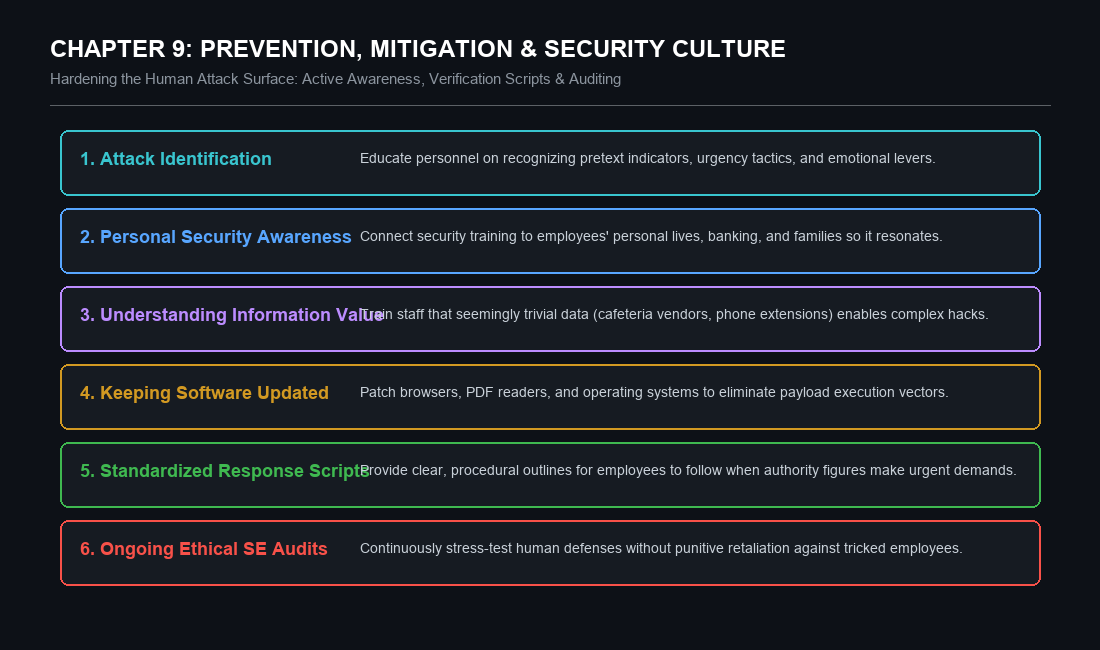
2. The 6 Pillars of Social Engineering Prevention
Hadnagy structures defensive mitigation into six operational pillars:
1
2
3
4
5
6
7
8
9
                          THE 6 PILLARS OF DEFENSE

    1. Attack Identification        Train staff on emotional levers & cues
    2. Personal Awareness Culture   Link security to personal life & home
    3. Information Valuation        Understand that small breadcrumbs kill
    4. Software Hygiene & Patches   Eliminate client-side execution bugs
    5. Procedural Response Scripts  Provide clear, non-punitive workflows
    6. Ethical Stress Audits        Test human defenses regularly & train
Pillar 1: Learning to Identify Social Engineering Attacks
In childhood, we are taught the fire safety rule: “Stop, Drop, and Roll.” We do not wait for our house to catch fire before learning how to crawl beneath smoke or feel door handles for heat.
Similarly, employees must be trained to recognize the psychological warning signs of an attack before the breach occurs:
1
2
3
4
5
6
7
8
9
10
11
12
                    RED FLAG EMOTIONAL TRIGGERS

   ARTIFICIAL URGENCY   UNUSUAL FLATTERY     INTIMIDATION
    "Must do this now     Excessive praise      Name-dropping CFOs
     or heads will roll   designed to loosen    or threatening job
     before the flight"   subconscious guard    termination

   GUILT & PITY         ABNORMAL SECRECY     SOCIAL CONSENSUS
    "Distressed parent"   "Don't tell anyone    "Jim in IT already
    or emergency lost      I asked you for       approved this for
    ticket pretexts        this favor..."        us yesterday"
Pillar 2: Creating a Personal Security Awareness Culture
At the Defcon 18 Social Engineering Capture the Flag (SECTF), every single targeted Fortune 500 company failed. Despite millions invested in compliance modules, employees divulged internal cafeteria vendors, operating system versions, browser types, and trash disposal companies over the telephone.
Why? Because traditional security awareness is impersonal, dull, and disconnected from the employee’s life.
How to Make Security Resonate:
- Connect Security to the Home: Teach employees how password reuse, public Wi-Fi risks at coffee shops, and social media oversharing compromise their own personal checking accounts, mortgages, and children’s privacy. When an employee takes personal security seriously at home, they naturally bring those habits to the office.
- Interactive Live Demonstrations:
- Instead of lecturing on password strength, invite a volunteer to type a “secure” password into a test laptop during an all-hands meeting. Run CUPP and John the Ripper to crack it in under 60 seconds on a projector.
- Demonstrate an active reverse shell: show employees the exact view an attacker sees when a weaponized PDF is opened. The visual reality of a live command prompt eliminates complacency immediately.
Pillar 3: Understanding the True Value of Information
One of the greatest vulnerabilities uncovered in the Defcon contest was that when information is perceived as having little or no value, zero effort is placed on protecting it.
Employees readily answer questions about:
- What cleaning service comes on Tuesday night.
- What brand of badge readers are mounted on the exterior doors.
- Whether the CFO is attending an offsite conference in Dallas.
To the employee, this is harmless office chit-chat. To a social engineer, these three breadcrumbs are all that is required to forge a vendor badge, pick the lock during a shift change, and impersonate the absent executive.
Mitigation Policy: Implement a standard “Verify Before Release” culture. Teach staff that no piece of internal operational data is trivial.
Pillar 4: Keeping Software Updated
Even the most brilliant social engineering pretext often relies on a technical payload to achieve final network persistence (e.g., weaponized PDFs, Java applets, or malicious Office macros).
In the Defcon 18 SECTF, over 60% of targeted enterprises were still running Internet Explorer 6 and Adobe Acrobat 8. Attackers did not need zero-days; they utilized public, automated Metasploit buffer overflow exploits that had been patched years prior.
- Maintain automated patch management across all endpoints.
- Replace vulnerable legacy software with modern, sandboxed alternatives (e.g., modern Chromium browsers, isolated PDF viewers).
- Enforce application allowlisting and disable legacy macro execution on untrusted files.
Pillar 5: Developing Standardized Verification Scripts
Employees frequently capitulate to social engineers because they are put on the spot and do not know what to say without appearing rude or uncooperative.
Hadnagy recommends arming customer-facing personnel, receptionists, and call center teams with procedural scripts:
1
2
3
4
5
6
7
8
9
10
11
12
13
14
                       INCOMING REQUEST VERIFICATION SCRIPT

    STEP 1: REQUEST IDENTIFICATION
    "May I have your full name, company, and employee ID number?"
    (Pause. Do not proceed until data is provided.)

    STEP 2: REQUEST AUTHORIZATION RECORD
    "What is the active Help Desk ticket or project authorization code?"

    STEP 3: IF UNVERIFIED OR EVASIVE
    "Company policy requires executive verification for this request.
     Please have your manager email formal authorization to my supervisor,
     and we will process this immediately. Thank you!"
A clear, management-backed script removes personal conflict. The employee is not saying “no”; they are simply following corporate procedure.
Pillar 6: Conducting Ethical Social Engineering Audits
Just as physical rehabilitation requires stress-testing a healed limb before clearing an athlete, an organization must stress-test its human defenses through realistic audits.
Rules of Engagement for Ethical SE Audits:
- Never Humiliate or Fire Employees: The single biggest mistake companies make is firing employees who fall for an authorized audit. An employee who was tricked and coached through a debrief is the most alert, resilient person in the company. Punishing staff creates a toxic culture of fear where employees hide incidents rather than reporting them.
- Strict Scope Limitations:
- Never target employees’ personal families or private homes.
- Never plant fabricated evidence of infidelity, illegal acts, or moral crimes to force compliance.
- Strictly observe legal boundaries: never impersonate law enforcement agents or commit federal communications wire fraud.
- Emergency Contact (“Get Out of Jail Free” Letter): Always designate an internal executive contact who can immediately verify the auditor’s identity if local police or building security intervene during a physical red team engagement.
3. The “Lion’s Roar” Analogy: Surviving Chaos
Hadnagy closes Chapter 9 with a metaphor from the wild:
“When a lion wants to confuse and disjoint a group of prey, it roars towards the ground, not toward the prey or sky, but the ground. The massive, fear-inspiring roar reverberates off the earth, surrounding the herd from all directions. Confused by where the danger lies, the animals panic and scatter in chaos, leaving their young and vulnerable members exposed.”
Malicious social engineers operate identically. They strike in the wake of natural disasters, corporate layoffs, tax seasons, or manufactured IT panics. They trigger emotional sensory overload so the target’s rational mind shuts down.
The defense is discipline: When the lion roars, do not scatter. Pause, breathe, adhere to your verification scripts, and refuse to let emotion override established policy.
4. Complete Book Series Master Index
Congratulations! You have completed the comprehensive chapter-by-chapter breakdown of Christopher Hadnagy’s classic work:
| Chapter | Title & Focus Area | Direct Link |
|---|---|---|
| Ch. 1 | A Look into the World of Social Engineering (Definitions, ROI, Anatomy) | Read Chapter 1 |
| Ch. 2 | Information Gathering (OSINT Sources, SMCR Communication Modeling) | Read Chapter 2 |
| Ch. 3 | Elicitation (NSA Rules, Questioning Funnel, Preloading) | Read Chapter 3 |
| Ch. 4 | Pretexting (Persona Creation, Cognitive Dissonance, Stanley Rifkin Heist) | Read Chapter 4 |
| Ch. 5 | Mind Tricks & Psychology (7 Microexpressions, NLP, Human Buffer Overflow) | Read Chapter 5 |
| Ch. 6 | Influence & Persuasion (Weapons of Influence, Reality Framing, Planograms) | Read Chapter 6 |
| Ch. 7 | Tools of the Social Engineer (Lockpicking, Shove Knives, Maltego, SET, CUPP) | Read Chapter 7 |
| Ch. 8 | Real-World Case Studies (Mitnick DMV/SSA, Overconfident CEO, Rogue Hacker) | Read Chapter 8 |
| Ch. 9 | Prevention & Mitigation (Human Firewall, Security Awareness Culture, Audits) | Current Chapter |
References & Authoritative Reading
- Hadnagy, Christopher. Social Engineering: The Art of Human Hacking. Chapter 9: Prevention and Mitigation. Wiley, 2011.
- National Institute of Standards and Technology (NIST). Special Publication 800-53, Rev. 5: Security and Privacy Controls for Information Systems and Organizations.
- SANS Institute. Security Awareness Roadmap: Building an Enterprise Culture of Security.
- Ponemon Institute. Cost of Data Breach Global Benchmark Report.
- Computer Security Institute (CSI) & Federal Bureau of Investigation (FBI). Computer Crime and Security Survey.
Let’s Connect
Thank you for reading this series! How does your organization train employees against advanced social engineering attacks? What chapter did you find most valuable?
- Abdulrahman Mohamed
This technical content and everything shared across this blog is dedicated with sincere intention to serve as enduring, beneficial knowledge (علم يُنتفع به) and an ongoing charity (صدقة جارية). If you find value in this research, please remember me and my family in your sincere prayers.