Book Summary: Social Engineering - The Art of Human Hacking (Chapter 7: The Tools of the Social Engineer)
A comprehensive summary of Chapter 7 of Christopher Hadnagy's 'Social Engineering: The Art of Human Hacking', analyzing physical bypass tools, covert surveillance, Maltego, the Social Engineer Toolkit (SET), and password profiling automation.
Hello everyone,
Welcome back to our book summary series covering Christopher Hadnagy’s “Social Engineering: The Art of Human Hacking” (Wiley Publishing).
In Chapter 6: Influence & Persuasion, we explored reality framing, psychological compliance weapons, and manipulation models.
Today, we transition from behavioral psychology into operational mechanics: Chapter 7: The Tools of the Social Engineer.
Hadnagy introduces this chapter with Thomas Carlyle’s classic insight:
“Man is a tool-using animal. Without tools he is nothing, with tools he is all.”
— Thomas Carlyle
However, Hadnagy immediately attaches a crucial caveat: tools do not make the social engineer. Wearing a Batman utility belt full of high-tech surveillance gear will not save an operator who lacks confidence, situational awareness, and conversational poise. Tools are like spices in cookingthey enhance the operation when applied with precision, but ruin it when overused.
In this chapter, we dissect the complete physical and digital arsenal: from lockpicks and shove knives to Maltego, SET, Asterisk caller ID spoofing, and password profilers.
Series Navigation
| Previous Chapter | Current Chapter | Next Chapter |
|---|---|---|
| Chapter 6: Influence & Persuasion | Chapter 7: The Tools of the Social Engineer | Chapter 8: Real-World Case Studies |
Key Takeaways
- The Physical Bypass Arsenal: Mechanics of pin-tumbler lock picking (tension wrenches, rakes), bump keys, padlock shims, and shove knives for rapid facility access.
- Johnny Long’s Hanger Bypass: How an enterprise-grade magnetic lock was bypassed in seconds using a coat hanger and a washcloth to trigger interior motion sensors.
- Covert Audio/Video Evidence: Why recording devices are non-negotiable for auditor protection and executive training (and the legal necessity of signed consent).
- Automated OSINT with Maltego: Graphing complex relational databases of targets, domains, metadata, and corporate hierarchy within minutes.
- Dave Kennedy’s SET (Social Engineer Toolkit): Generating spear-phishing payloads, cloning web portals, and producing infectious USB media.
- Targeted Password Profiling (CUPP & CeWL): Weaponizing personal biographical details to construct targeted wordlists for credential attacks.
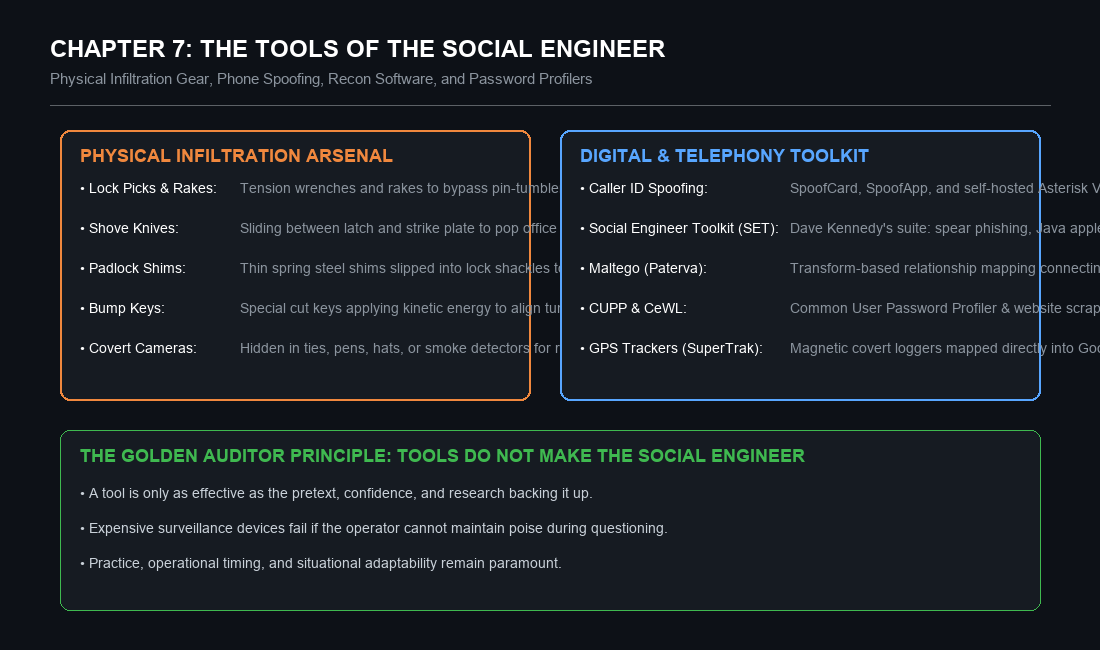
1. Physical Infiltration Tools
Physical security encompasses every non-computer obstacle designed to safeguard corporate assets. When an internal door or server cabinet blocks an auditor’s path, physical bypass skills become vital:
1
2
3
4
5
6
7
8
                          PHYSICAL BYPASS TAXONOMY

       LOCK PICKING          KINETIC / BYPASS      SURVEILLANCE

       Tension Wrenches     Shove Knives         Hidden Tie Cameras
       Rakes & Diamond P.   Bump Keys            Audio Recorder Pen
       Practice Locks       Padlock Shims        GPS Magnetic Track
A. Lock Picking & Raking Mechanics
A standard cylinder lock relies on upper driver pins, lower key pins, and springs:
- When the correct key is inserted, pins lift to align exactly along the shear line, allowing the internal plug to rotate.
- Raking Technique: The operator inserts a tension wrench, applies light rotational pressure, and gently slides a rake pick in and out across the pin stack. The rotational offset creates tiny ridges that catch pins as they lift.
- Hadnagy stresses that lock picking requires touch sensitivity and patience. Having a compact, credit card-sized lock pick set (like SouthOrd) can grant access to server racks and executive offices in under 30 seconds.
B. Shove Knives & Padlock Shims
- Shove Knives: Flexible metal blades engineered to slide between an outward-swinging door and the strike plate, depressing the latch without damaging the frame.
- Padlock Shims: Curved spring-steel tools slipped down the sides of a padlock shackle to disengage the spring-loaded internal locking pawls.
C. Magnetic & Electronic Lock Bypasses
Many modern enterprises rely on magnetic locks or electronic RFID doors, assuming they are impervious to mechanical picks. Hadnagy recounts famous hacker Johnny Long’s exploit:
- Long noticed that an enterprise glass door used a magnetic lock that disengaged automatically whenever an employee approached from the inside, triggered by an overhead motion sensor.
- Long slid a wire coat hanger with a damp washcloth through the narrow gap between the double glass doors and waved it.
- The motion sensor detected movement, disengaged the heavy magnetic lock, and popped the door wide open.
2. Covert Surveillance & Recording Tools
Hadnagy notes that covert recording devices are frequently misunderstood as voyeuristic gadgets. In professional security auditing, they serve two critical functions:
- Proof: Corporate leadership often refuses to believe their staff would divulge credentials or allow strangers into server rooms. High-definition video and audio recordings provide undeniable proof.
- Protection: If an auditor is accused of exceeding scope or stealing intellectual property, continuous logs prove exactly what occurred.
Hardware Form Factors
- The Spy Tie: A wearable business tie concealing a micro-camera running on a compact 12V battery, recording at a 70-degree angle.
- Audio Pen Recorders: Real, functional ink pens with high-sensitivity microphones capable of capturing crystal-clear conversations up to 20 feet away.
- GPS Loggers (SuperTrak): Magnetic tracking units attached to corporate vehicles, recording exact routes, speeds, and dwell times, which export directly into Google Earth.
Legal Precaution: Audio recording without two-party consent is a felony in many jurisdictions. Professional auditors must ensure explicit recording authorization is written into the formal penetration testing contract.
3. Automated Intelligence Gathering: Maltego
Collecting OSINT manually via search engines takes days. Maltego, developed by Paterva, revolutionized reconnaissance by treating the internet as a vast, relational entity graph:
1
2
3
4
5
6
7
8
9
[ Target Domain ]

         Whois Administrative Records --> Admin Email Addresses

         Transform: PGP Key Servers    Personal Secondary Emails

         Transform: Document Metadata --> Internal Usernames & Software Versions

         Transform: Social Graph       Family Members, Hobbies, & Venues
Case Study: Profiling the “Un-Hackable” CEO
Hadnagy was contracted to audit a regional printing firm whose CEO arrogantly claimed he was immune to hacking because he avoided social media:
- Hadnagy ran Maltego transforms against the company domain, extracting public file metadata.
- Metadata exposed an invoice spreadsheet created by user
"Chuck Jones". - Running transform queries on Jones’s personal email revealed online restaurant reviews he wrote in another state, mentioning his brother, his favorite local restaurant (Domingoes), his favorite dishes, and his children’s baseball team.
- In under two hours, Maltego assembled a complete psychological profile that formed the foundation for a devastating spear-phishing attack.
4. Dave Kennedy’s Social Engineer Toolkit (SET)
Developed by Dave Kennedy (ReL1K), SET automated social engineering vectors that previously required hours of manual scripting. Built natively into BackTrack (and later Kali Linux), it integrates directly with the Metasploit Framework:
1
2
3
4
5
6
7
8
9
10
11
12
13
14
15
16
17
18
19
                       SOCIAL ENGINEER TOOLKIT (SET)

    1. Spear Phishing Attack Vector
        Generates weaponized PDFs (e.g., Adobe util.printf() overflow)
        Configures Meterpreter Reverse_TCP listeners on Port 443 (HTTPS)
        Automates mass or targeted email delivery with spoofed headers

    2. Web Attack Vectors
        Site Cloner: Copies login portals (Gmail, Outlook Web Access)
        Java Applet Attack: Delivers self-signed binary execution lures
        Credential Harvester: Intercepts POST credentials silently
        Tabnabbing: Repurposes inactive browser tabs into fake logins

    3. Infectious Media Generator
        Creates autorun payloads for physical USB / CD / DVD drops

    4. Teensy HID Keyboard Hardware Injections
        Microcontroller boards that type automated shellcode on plug-in
5. Telephony Spoofing & Asterisk PBX
Telephone social engineering remains one of the fastest ways to extract credentials:
- Caller ID Spoofing: Changing the outbound telephone number displayed on the target’s handset. Using platforms like SpoofCard or self-hosted Asterisk PBX servers, an operator can place calls that appear to originate from the internal corporate help desk, local police departments, or partner banks.
- Audio Staging: Professional social engineers use ambient office sound generators (e.g., Thriving Office audio tracks) to simulate background office commotion, establishing immediate subliminal credibility.
6. Targeted Password Profiling: CUPP & CeWL
Industry metrics analyzed by BitDefender and security researchers revealed startling statistics:
- 75% of 250,000 surveyed users reused the identical password across corporate email and social networks.
- In a database of 734,000 intercepted passwords, over 17,000 used
123456, and 30,000 used their own first name.
Standard brute-force attacks against complex passwords can take centuries. However, humans construct passwords using personal biographical anchors:
Common User Password Profiler (CUPP)
Developed by Murgis Kurgan (j0rgan), CUPP is an interactive Python tool that generates customized dictionaries based on target intelligence:
1
2
3
4
5
6
7
8
9
10
11
12
13
root@bt4:~# ./cupp.py -i
[+] Insert information about the victim:
> Name: John
> Surname: Smith
> Nickname: Johnny
> Birthdate (DDMMYYYY): 03031965
> Spouse's Name: Sally
> Child's Name: Roger
> Child's Birthdate: 05042004
> Pet's Name: Max
> Company Name: ABC Paper
> Leet Mode? [Y/N]: Y
[+] Saving dictionary to John.txt, counting 13,672 words.
Instead of testing billions of random strings, CUPP generates permutations (Sally2004!, Max1965#, J0hnnyABC) that reflect real human psychology.
Custom Wordlist Generator (CeWL)
Developed by Robin Wood (digininja), CeWL spiders an organization’s website, extracts unique industry vocabulary, technical terminology, and client names, and outputs a custom dictionary tailored to that specific company’s culture.
Series Navigation
| Previous Chapter | Current Chapter | Next Chapter |
|---|---|---|
| Chapter 6: Influence & Persuasion | Chapter 7: The Tools of the Social Engineer | Chapter 8: Real-World Case Studies |
Next in the Series: Chapter 8 Preview
In Chapter 8: Real-World Case Studies, we see all the tools, pretexts, and psychological principles deployed in legendary real-world engagements:
- Kevin Mitnick’s DMV and Social Security Administration hacks.
- Christopher Hadnagy’s “Overconfident CEO” and “Theme Park Ticket” engagements.
- Two top-secret classified operations: an undercover corporate physical infiltration and social engineering a live rogue hacker over Windows Notepad.
- Ready to continue? Read Chapter 8: Real-World Case Studies
References & Authoritative Reading
- Hadnagy, Christopher. Social Engineering: The Art of Human Hacking. Chapter 7: The Tools of the Social Engineer. Wiley, 2011.
- Kennedy, Dave. The Social-Engineer Toolkit (SET) Documentation. TrustedSec.
- Long, Johnny. No-Tech Hacking: A Guide to Social Engineering, Dumpster Diving, and Shoulder Surfing. Syngress, 2008.
- Wood, Robin. CeWL: Custom Word List Generator. DigiNinja.
- The Open Organisation of Lockpickers (TOOOL) Guide & Reference
Let’s Connect
What is your preferred toolkit for OSINT and physical security assessments? Have you tested custom dictionary profiling with CUPP or CeWL?
- Abdulrahman Mohamed
This technical content and everything shared across this blog is dedicated with sincere intention to serve as enduring, beneficial knowledge (علم يُنتفع به) and an ongoing charity (صدقة جارية). If you find value in this research, please remember me and my family in your sincere prayers.