Book Summary: Social Engineering - The Art of Human Hacking (Chapter 3: Elicitation)
A comprehensive summary of Chapter 3 of Christopher Hadnagy's 'Social Engineering: The Art of Human Hacking', analyzing NSA elicitation guidelines, conversational preloading, questioning taxonomy, and psychological exploitation.
Hello everyone,
Welcome back to our book summary series covering Christopher Hadnagy’s “Social Engineering: The Art of Human Hacking” (Wiley Publishing).
In Chapter 2: Information Gathering, we examined the foundations of reconnaissance, OSINT data sources, and communication modeling.
Today, we explore Chapter 3: Elicitation, which covers one of the most sophisticated, low-risk, and devastatingly effective skills in offensive security: drawing confidential intelligence from an individual during an apparently innocent, everyday conversation.
Hadnagy opens Chapter 3 with Sun Tzu’s famous maxim:
“The supreme art of war is to subdue the enemy without fighting.”
— Sun Tzu
When done masterfully, elicitation leaves zero trace. The target never realizes an interrogation occurred, never suspects foul play, and often walks away feeling valued, respected, and happy with the interaction.
Series Navigation
| Previous Chapter | Current Chapter | Next Chapter |
|---|---|---|
| Chapter 2: Information Gathering | Chapter 3: Elicitation | Chapter 4: Pretexting |
Key Takeaways
- The NSA Definition: Elicitation is “the subtle extraction of information during an apparently normal and innocent conversation.”
- The 5 Universal Human Tendencies: Why targets naturally divulge data (politeness, desire to appear knowledgeable, ego, truth-bias, and responsiveness to empathy).
- The Deliberate Falsehood Tactic: People have an overwhelming psychological urge to correct wrong statements; throwing out incorrect facts compels the target to correct you with verified truths.
- Conversational Preloading: Planting emotional and conceptual seeds hours or days before making a request so the target accepts your premise as their own idea.
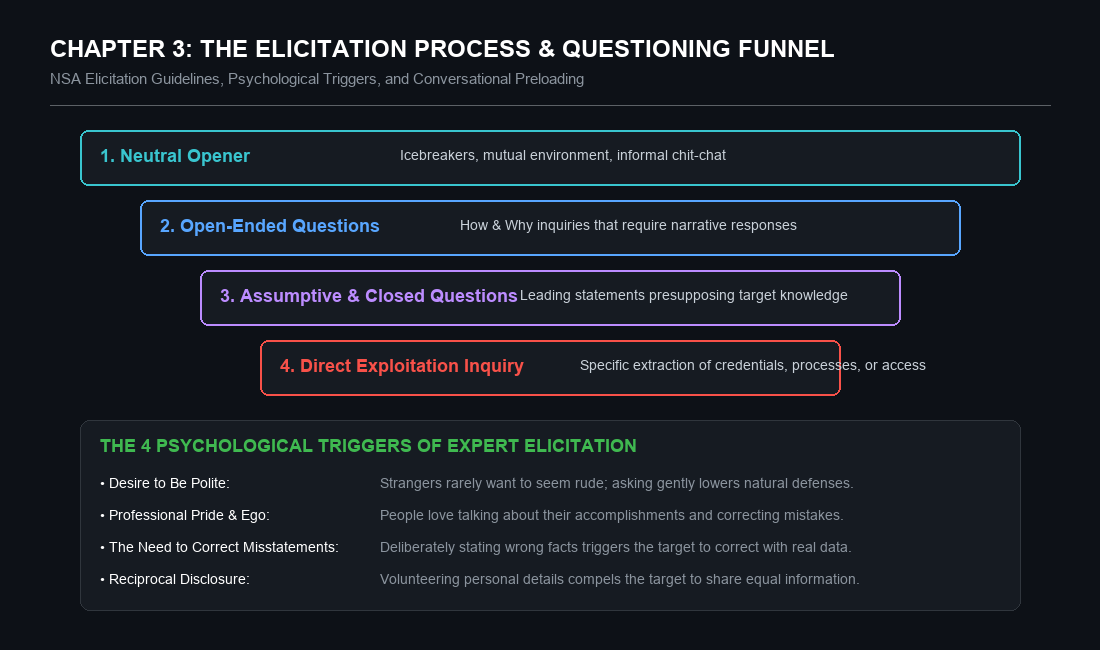
- The Questioning Funnel: Moving strategically from broad neutral icebreakers down to narrow, assumptive, and direct extraction inquiries.
1. What Is Elicitation? (The Intelligence Perspective)
In training manuals produced for federal agents, the United States National Security Agency (NSA) defines elicitation with surgical precision:
“The subtle extraction of information during an apparently normal and innocent conversation.”
Elicitation does not happen in an interrogation room with bright lights and bad cops. It occurs in hotel lobbies, airport lounges, coffee shops, conferences, and bars. It is favored by spies, intelligence operatives, and social engineers because it is virtually undetectable. If an elicitation attempt begins to arouse suspicion, the operator can gracefully retreat, pass it off as innocuous casual chatter, and exit without any operational compromise.
Why Humans Fall for Elicitation
Hadnagy isolates five core psychological traits inherent to human social interaction:
1
2
3
4
5
6
7
8
                  WHY ELICITATION SUCCEEDS

    1. Desire to be polite (especially to strangers)
    2. Professional pride (wanting to look competent)
    3. Susceptibility to praise (ego feeding)
    4. Truth-bias (humans rarely lie without purpose)
    5. Emotional reciprocity (connecting over shared woe
When an attacker subtly taps into these instincts, targets willingly bypass their own security training without ever realizing a breach occurred.
2. Case Study: The Chamber of Commerce Mixer
Hadnagy illustrates the practical power of elicitation through an engagement targeting a regional corporate supplier:
- The Setting: Hadnagy attended a local Chamber of Commerce business networking mixer. Spotting the company’s Chief Financial Officer (CFO) approaching the open bar, Hadnagy positioned himself alongside him.
- The Icebreaker: Rather than asking a business question, Hadnagy used self-deprecating humor:
“Escaping from the vultures?”
CFO (laughing): “Yeah, this is what makes these things worth the timeopen bar.” - The Hook & Ego Stroke: Hadnagy introduced himself with a clean, low-profile business card as a purchasing manager for an import firm. When the CFO named his company, Hadnagy feigned recognition:
“Oh right, you guys make that widget! I love that thing. I read in XYZ Magazine that it hit a new sales record for you guys.”
- The Elicitation: Flattered, the CFO puffed his chest out and began detailing proprietary metrics. In the course of 15 minutes of relaxed conversation, Hadnagy discovered:
- The company had recently migrated to a new accounting software suite.
- The Chief Security Officer (CSO) was away on vacation.
- The CFO himself was leaving that week for a cruise in the Bahamas.
- The Fatal Inquiry: Hadnagy delivered a soft, assumptive question:
“I know this is a weird question, but we’re a small company and my boss wants me to research door security systems. We just use metal keys right now, but he was thinking RFID. Do you know what you guys use?”
CFO: “I have no clue, I just sign the checks. What I do know is I have this fancy little card… I wave my wallet in front of the little box and the door opens.” (Pulls out his badge and shows it directly to Hadnagy). - The Exploitation: The next day, Hadnagy arrived at corporate headquarters. He approached the receptionist:
“Larry [the CFO] called me before he left for the Bahamas and said the time clock by manufacturing was malfunctioning. It’ll take me five minutes to test it.” Knowing that the visitor knew the CFO was in the Bahamas, that he was named Larry, and that the firm used RFID time clocks, the receptionist buzzed him into the internal facility within 30 seconds.
3. The Three Rules of Natural Conversation
Mastering elicitation requires shedding stiff, unnatural behaviors:
1. Be Natural
Nothing kills rapport faster than appearing rigid or hyper-focused. Hadnagy recommends practicing speaking about subjects you know deeply versus subjects you know nothing about. Observe how your vocal tone, posture, and eye contact change. To the target, any sign of discomfort signals deception.
2. Educate Yourself (Don’t Over-Claim)
Never pretend to be an expert in an area where your target is a veteran. If you are auditing a pharmaceutical firm and need data from a chemical engineer, do not pretend to be a senior chemist. The target will inevitably ask technical questions that expose your fraud. Instead, adopt a humble, believable pretext: a graduate research student struggling with a specific lab parameter who was told the target is the best authority in town.
3. Don’t Be Greedy
Amateur social engineers get excited when they receive their first piece of intel and immediately push for passwords or server IPs, triggering alarm bells. Elicitation is a give-and-take dance. If the target shares an insight, provide an observation in return. If the target wants to dominate the conversation, let them speak.
4. The Power of Conversational Preloading
Hadnagy defines preloading as the technique of planting emotional, sensory, or conceptual ideas into a target’s mind hours, days, or weeks before a request is made.
The Movie Trailer Analogy
Movie marketing teams rarely sell you a film directly; they preload your expectations:
- The screen turns dark, ominous low-frequency audio rumbles through the theater, and a deep voice intones dramatic phrases.
- By the time the title appears, your brain has already been preloaded into a state of suspense or anticipation.
Hadnagy’s 17-Year-Old Landlord Pretext
As a teenager working odd jobs while surfing, Hadnagy ran errands for an elderly apartment complex owner. For months, Hadnagy sat quietly, listening with genuine empathy to the landlord’s personal complaints, family divorces, and health struggles:
- Hadnagy never offered unsolicited advice; he simply listened and showed respect.
- When the landlord announced he wanted to retire out West to be near his daughter, Hadnagy suggested: “Why don’t you go back and let me run your 30-unit apartment complex for you?”
- For an adult to entrust an entire commercial complex to a 17-year-old was objectively absurd. Yet, because the landlord’s mind had been preloaded for months with the belief that Hadnagy was responsible, mature, and caring, the proposal was accepted immediately.
5. Deconstructing the DHS Elicitation Guidelines
Chapter 3 reviews an internal elicitation awareness pamphlet issued by the U.S. Department of Homeland Security (DHS), reversing each defensive countermeasure into an offensive methodology:
| DHS Defensive Warning | Offensive SE Technique | Operational Example |
|---|---|---|
| Appealing to Ego | Flatter professional status or perceived influence. | “You must hold a critical role here; senior leadership seems to rely heavily on your team.” |
| Expressing Mutual Interest | Fabricate a common professional hobby, certification, or tool. | “You work with ISO 27001 compliance databases? Our team just built an automated reporting engine for that.” |
| Deliberate False Statement | Intentionally state a minor inaccuracy to provoke a correction. | “Didn’t Vendor X beat your firm’s market share last quarter?” “Actually, our private sales were 23% higher!” |
| Volunteering Information | Share a vulnerability or secret first to trigger reciprocity. | “Our department budget got slashed again…” Target responds by disclosing internal resource constraints. |
| Assuming Knowledge | Speak with an air of complete familiarity with internal jargon. | Referencing internal code names (“Did you finish the MCS audit for District 3?”) so the target assumes you belong. |
| The Effects of Alcohol | Social settings with alcohol lower cognitive inhibitions by 10x. | A 1980 Los Alamos nuclear fusion scientist divulged classified neutron bomb threshold physics at a Chinese banquet. |
6. Questioning Taxonomy: The Social Engineer’s Toolkit
Elicitation requires knowing which type of question to deploy at each stage of an interaction:
1
2
3
4
5
6
7
8
9
10
11
12
13
14
15
16
17
18
                               THE QUESTIONING FUNNEL

            1. OPEN-ENDED QUESTIONS
                "What do you think of...?"
                "How did your team handle...?"

            2. LEADING QUESTIONS
                Bartlett & Loftus Reconstructive Memory
                "You were in the office late, right?"

            3. ASSUMPTIVE QUESTIONS
                Presupposing facts already exist
                "Where does your backup server replicate?"

            4. CLOSED-ENDED QUESTIONS
                Forcing binary compliance
                "Can you print this from my USB?"
A. Open-Ended Questions
Inquiries that cannot be answered with a simple “yes” or “no”. Asking “Pretty cold out today, huh?” elicits a grunt. Asking “What do you think of this sudden storm?” forces cognitive engagement.
- The Pyramid Approach: Start with narrow inquiries (“What class are you taking?” “Algebra II”) and gradually branch into expansive discussions (“How do you feel about that teacher’s grading style?”).
B. Leading Questions (Reconstructive Memory)
In 1932, British psychologist Frederic Bartlett proved that human memory is not a video recording; it reconstructs facts based on cultural schemas and suggestive prompts.
- Dr. Elizabeth Loftus proved that asking “Did you see a teddy bear?” yields neutral accuracy, while asking “Did you see the teddy bear?” increases false positives because the definite article presupposes its existence.
- In social engineering, leading questions implant premises that the target inadvertently verifies.
C. Assumptive Questions
Questions structured on the assumption that the target already possesses the data:
- Instead of asking: “Do you have a database administrator onsite?”
- An assumptive operator asks: “When does your database administrator step out for lunch so I don’t disrupt his cluster maintenance?”
Series Navigation
| Previous Chapter | Current Chapter | Next Chapter |
|---|---|---|
| Chapter 2: Information Gathering | Chapter 3: Elicitation | Chapter 4: Pretexting |
Next in the Series: Chapter 4 Preview
In Chapter 4: Pretexting - How to Become Anyone, we will break down:
- What pretexting really is: building the complete backstory, wardrobe, grooming, and mindset.
- The 7 core principles of successful pretexts.
- Stanley Mark Rifkin’s historic $10.2 million wire transfer heist without holding a weapon.
- The 2006 Hewlett-Packard board spying scandal and the legal boundaries of the Federal Trade Commission (FTC) Act.
- Ready to continue? Read Chapter 4: Pretexting
References & Authoritative Reading
- Hadnagy, Christopher. Social Engineering: The Art of Human Hacking. Chapter 3: Elicitation. Wiley, 2011.
- United States Department of Homeland Security (DHS). Office of the Chief Security Officer (OCSO): Elicitation Awareness Guidelines.
- Loftus, Elizabeth F. Eyewitness Testimony. Harvard University Press, 1996.
- Bartlett, Frederic C. Remembering: An Experimental and Social Study. Cambridge University Press, 1932.
- Glasser, William. Choice Theory: A New Psychology of Personal Freedom. Harper Perennial, 1999.
Let’s Connect
Have you ever caught someone using elicitation techniques in your daily life? How do you train security staff to recognize subtle conversational probing?
- Abdulrahman Mohamed
This technical content and everything shared across this blog is dedicated with sincere intention to serve as enduring, beneficial knowledge (علم يُنتفع به) and an ongoing charity (صدقة جارية). If you find value in this research, please remember me and my family in your sincere prayers.