Book Summary: Social Engineering - The Art of Human Hacking (Chapter 5: Mind Tricks & Psychology)
A comprehensive summary of Chapter 5 of Christopher Hadnagy's 'Social Engineering: The Art of Human Hacking', analyzing Paul Ekman's 7 microexpressions, DoD interrogation tactics, NLP embedded commands, and the Human Buffer Overflow equation.
Hello everyone,
Welcome back to our book summary series covering Christopher Hadnagy’s masterpiece, “Social Engineering: The Art of Human Hacking” (Wiley Publishing).
In Chapter 4: Pretexting, we explored the principles of constructing believable characters and navigating operational legal boundaries.
Today, we arrive at the intellectual centerpiece of the entire book: Chapter 5: Mind Tricks - Psychological Principles Used in Social Engineering.
In this chapter, Hadnagy bridges the gap between offensive security and decades of peer-reviewed behavioral psychology. We examine Dr. Paul Ekman’s universal microexpressions, Neurolinguistic Programming (NLP), Department of Defense (DoD) interrogation tactics, and Hadnagy’s groundbreaking formulation: The Human Buffer Overflow (HBO).
As psychologist Carl Gustav Jung famously observed:
“It all depends on how we look at things, and not on how they are themselves.”
— Carl Gustav Jung
Let’s dissect the science of hacking the human cognitive operating system.
Series Navigation
| Previous Chapter | Current Chapter | Next Chapter |
|---|---|---|
| Chapter 4: Pretexting | Chapter 5: Mind Tricks & Psychology | Chapter 6: Influence & Persuasion |
Key Takeaways
- The 7 Universal Microexpressions: Dr. Paul Ekman’s FACS research proves that emotional facial contractions last 1/25th of a second and are biologically universal across all humans.
- The Duchenne Smile: Separating authentic happiness from calculated deception by tracking contractions of the orbicularis oculi (eye crinkles) versus the mouth.
- The Human Buffer Overflow (HBO): Exploiting cognitive latency by pairing the Law of Expectations, mental padding, and embedded commands to hijack decision-making.
- 12 DoD Interrogation Tactics: Adapting professional military and polygraph interrogation methods to lead targets to voluntary disclosure.
- Albert Mehrabian’s 7-38-55 Rule: In high-stakes communication, 7% of meaning comes from words, 38% from vocal tone, and 55% from body language.
1. Cognitive Sensory Modes: Discerning the Target’s Mind
In August 2001, the FBI Law Enforcement Bulletin published a pivotal finding:
“Simply confirming your nonverbal behavior to the client, using language from the client’s preferred representational system and matching speech volume, tone, and area of speech often overcomes client reluctance to communicate.”
Human beings process sensory reality across three dominant modalities:
1
2
3
4
5
6
7
8
9
10

   1. VISUAL THINKERS       Thinks in pictures, spatial layouts, colors.
                            Uses: "I see", "Looks clear", "Picture this"

   2. AUDITORY THINKERS     Driven by sound, rhythm, tone, cadence.
                            Uses: "Loud & clear", "Sounds right", "Hear"

   3. KINESTHETIC THINKERS — Driven by touch, physical presence, feelings.
                            Uses: "I can grasp that", "How does it feel?"
Hadnagy recalls a veteran salesman named Tony who could determine a customer’s dominant mode in under 60 seconds:
- He held a polished silver-and-gold pen, making broad gestures. If the target’s eyes tracked the pen, they were Visual.
- If eyes did not track, he clicked the pen open and closed at key talking points. If the target blinked or adjusted posture to the sound, they were Auditory.
- If neither worked, he lightly touched the table edge or forearm. If the target leaned in comfortably, they were Kinesthetic.
Once identified, Tony shifted his entire vocabulary and pace to match that mode, making targets feel instantly understood and at ease.
2. Paul Ekman’s 7 Universal Microexpressions
In 1872, Charles Darwin postulated that human facial expressions were biological rather than cultural. A century later, Dr. Paul Ekman proved this across thousands of subjects worldwide, creating the Facial Action Coding System (FACS).
Unlike macroexpressions (which last several seconds and can be easily faked), microexpressions are involuntary muscular twitches lasting between 1/25th and 1/15th of a second.
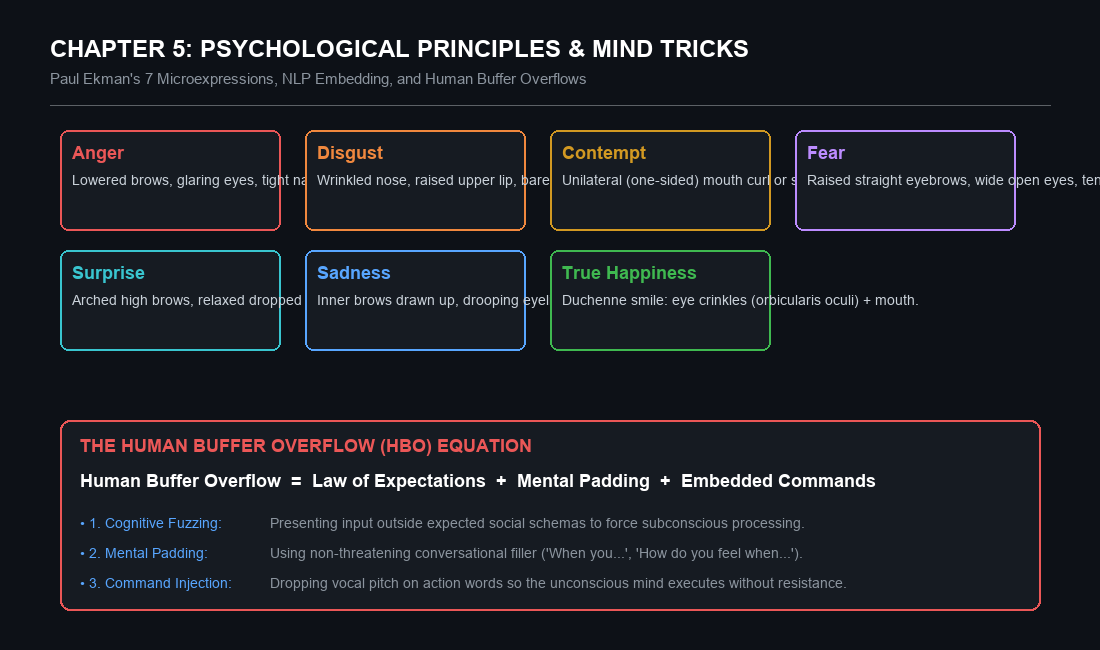
| Microexpression | Muscular Cues | Tactical Social Engineering Context |
|---|---|---|
| Anger | Eyebrows pulled down and together; lips tightly pressed and narrow; glaring eyes. | Signals resistance. Back down immediately; pushing further causes cognitive shutdown. |
| Disgust | Upper lip raised exposing teeth; bridge of the nose wrinkled; cheeks raised. | Extreme rejection of appearance, scent, or premise. Rework your pretext or exit. |
| Contempt | Unilateral mouth curl (smirk) on one side of the face only. | The target feels intellectually or morally superior. Feed their ego to lower their guard. |
| Fear | Eyebrows raised and pulled together; upper eyelids pulled up; lips tense toward ears. | Target senses danger or consequences. Provide a face-saving, low-stress alternative. |
| Surprise | Eyebrows arched high; jaw unhinged and dropped; wide eyes. Lasts < 1 second. | Opens a temporary mental gap. Follow up with a warm smile and conversational hook. |
| Sadness | Inner corners of eyebrows raised; upper eyelids drooping; corners of mouth pulled down. | Generates powerful mirror neurons. Subtle sadness elicits immediate target empathy. |
| Happiness | Authentic Duchenne smile: cheeks raised, outer eye crinkles (orbicularis oculi). | Confirms total rapport. Target is relaxed and receptive to requests. |
1
2
3
4
5
6
        DUCHENNE (AUTHENTIC) SMILE            VS           FAKE (COURTESY) SMILE

        Eye Crinkles ("Crow's Feet")                 Eyes Dead & Unchanged
        Cheeks Pulled Upward                       Mouth Smiles Mechanically
        Involuntary Muscle Action                  Forced Voluntary Muscle
3. The Human Buffer Overflow (HBO)
In binary exploitation, a buffer overflow occurs when a program receives input larger than its allocated memory buffer. The stack overflows, the execution flow is corrupted, and the CPU jumps to an attacker-controlled instruction pointer (EIP).
Hadnagy discovered that the human brain operates on an identical cognitive architecture:
- Humans speak at 150 words per minute, but process thoughts at 500 to 600 words per minute.
- Brains run automated “scripts” for daily routines (driving to work, taking coffee, greeting coworkers) without conscious thought.
- When presented with input that disrupts expected social algorithms, the conscious “firewall” hesitates for a split second, opening a window where commands can be injected directly into the subconscious.
Hadnagy formalizes this into an equation:
\[\text{Human Buffer Overflow} = \text{Law of Expectations} + \text{Mental Padding} + \text{Embedded Codes}\]1
2
3
4
5
6
7
8
9
10
[ Step 1: Establish Law of Expectations ]
Act with absolute assumption that compliance is normal and already agreed upon.
[ Step 2: Apply Mental Padding ]
Insert cognitive filler phrases: "When you...", "As you consider...", "How do you feel when..."
[ Step 3: Inject Embedded Commands ]
Drop vocal pitch on imperative verbs: "You can [PRINT THIS] from my USB."
Cognitive Fuzzing Demonstration: The Stroop Effect
Hadnagy references the classic Stroop experiment: reading words where the text spells one color (e.g., GREEN), but is printed in red ink. The conscious brain stumbles because visual processing of words conflicts with chromatic perception. In social engineering, introducing subtle cognitive contradictions temporarily disables analytical defenses.
4. Neurolinguistic Programming (NLP) in Social Engineering
Developed in the 1970s by Richard Bandler and John Grinder, NLP models how language patterns affect thought structures. While Hadnagy cautions against pop-culture “mind control” myths, he emphasizes three highly practical NLP techniques:
1. Vocal Modulation & Pitch Direction
In the English language, the ending pitch of a sentence dictates its cognitive category:
- Pitch rises at the end The brain registers a Question (“Are you ready?”).
- Pitch stays level The brain registers a Statement (“It is five o’clock.”).
- Pitch drops (deepens) The brain registers an Imperative Command (“Shut the door.”).
A social engineer embeds commands into questions by intentionally lowering vocal pitch on the operative words:
“When you log into the portal, do you see the update?”
(Pitch deepens on “log into the portal”, subtly registering as an instruction).
2. Conversational Negation (Reverse Psychology)
The human subconscious cannot process a negative without first conceptualizing the positive:
- If you hear “Do not think of a red cow,” your mind must construct the red cow to reject it.
- A social engineer uses negation to bypass resistance: “I wouldn’t want you to give me access before verifying my identity.” The target’s unconscious mind fixates on giving access.
3. The Ultimate Voice Technique
Trained speakers project their voice from the “mask” (the resonating facial area around the sinus and mouth). Hum exercises (humming “umm” and transitioning to “ready”, “one”, “two”) create a crisp, resonant tone that commands natural respect and disarms tension.
5. Professional Interrogation Tactics (DoD Framework)
Hadnagy contrasts an Interview (where the subject leads, non-accusatory, relaxed environment) with an Interrogation (where the operator leads, high psychological focus, aimed at specific disclosure).
Drawing from Department of Defense polygraph training, Hadnagy outlines 12 proven approaches:
1
2
3
4
5
6
7
                          12 INTERROGATION STRATEGIES

  1. Direct Approach     5. Logical Approach     9. Face-Saving
  2. Indirect Approach   6. Aggressive Approach 10. Egotistical
  3. Sympathetic Approach 7. Combination Mode    11. Exaggeration
  4. Emotional Approach | 8. Indifferent Stance | 12. Wedging the Alibi
The Face-Saving Technique (The Pentester’s Best Friend)
When a target realizes a request violates protocol, they experience acute panic. A master social engineer provides an immediate, external rationalization that allows the target to comply without feeling responsible:
“I understand you’re not supposed to let unbadged personnel in. But I’d hate for Mr. Smith [the VP] to blame you on Monday when his presentation fails because I couldn’t drop off this flash drive.”
The target latches onto the excuse: they are not breaking the rule; they are saving the VP from a disaster.
Wedging the Alibi
Never demand the ultimate objective upfront. Elicit minor, seemingly trivial admissions first:
- Confirm the target was in the building.
- Confirm they use a specific software version.
- Confirm who has administrative access.
- Each small admission wedges the door wider until full compliance is achieved.
6. Building Instant Rapport: The Foundation of Influence
Without rapport, social engineering fails. Hadnagy identifies three essential steps:
- Be Genuine About Wanting to Know People: Targets instantly detect phony enthusiasm. Approach human beings with genuine curiosity about their perspective.
- Mehrabian’s Rule of Nonverbal Dominance:
- 7% Words (Verbal content)
- 38% Vocal Tone (Pitch, cadence, resonance)
- 55% Physiology (Posture, eye contact, microexpressions)
- Reflective Responding: Never parrot statements. Reframe the target’s emotional state using non-committal empathy:
- Target: “Management is driving me crazy with these shift changes.”
- Auditor: “It sounds like you’re completely overwhelmed by how unpredictable things have been lately.”
- This signals active listening, validates the target’s emotions, and cements subconscious trust.
Series Navigation
| Previous Chapter | Current Chapter | Next Chapter |
|---|---|---|
| Chapter 4: Pretexting | Chapter 5: Mind Tricks & Psychology | Chapter 6: Influence & Persuasion |
Next in the Series: Chapter 6 Preview
In Chapter 6: Influence - The Power of Persuasion, we will explore:
- Robert Cialdini’s Weapons of Influence: Reciprocity, Scarcity, Authority, and Social Proof.
- Cognitive reality framing: Frame Bridging, Frame Amplification, and Frame Transformation.
- The subtle psychology of manipulation: Planograms, color theory, and conditioning the human operating system.
- Ready to continue? Read Chapter 6: Influence & Persuasion
References & Authoritative Reading
- Hadnagy, Christopher. Social Engineering: The Art of Human Hacking. Chapter 5: Mind Tricks. Wiley, 2011.
- Ekman, Paul. Telling Lies: Clues to Deceit in the Marketplace, Politics, and Marriage. W. W. Norton & Company, 2009.
- Bandler, Richard, & Grinder, John. The Structure of Magic: A Book About Language and Therapy. Science and Behavior Books, 1975.
- Mehrabian, Albert. Silent Messages: Implicit Communication of Emotions and Attitudes. Wadsworth Publishing, 1971.
- Li, Wen, et al. “Neural and Behavioral Evidence for Affective Priming from Unconsciously Perceived Emotional Facial Expressions.” Journal of Cognitive Neuroscience, 2008.
Let’s Connect
Have you ever spotted a microexpression of contempt or fear during an audit or interview? How do you apply active listening in your daily security interactions?
- Abdulrahman Mohamed
This technical content and everything shared across this blog is dedicated with sincere intention to serve as enduring, beneficial knowledge (علم يُنتفع به) and an ongoing charity (صدقة جارية). If you find value in this research, please remember me and my family in your sincere prayers.