Book Summary: Social Engineering - The Art of Human Hacking (Chapter 2: Information Gathering)
A comprehensive summary of Chapter 2 of Christopher Hadnagy's 'Social Engineering: The Art of Human Hacking', exploring OSINT sources, Shannon-Weaver and SMCR communication models, and the art of target profiling.
Hello everyone,
Welcome back to the second installment of our book summary series covering Christopher Hadnagy’s classic text, “Social Engineering: The Art of Human Hacking” (Wiley Publishing).
In Chapter 1: A Look into the World of Social Engineering, we explored the foundational definition of social engineering, the attacker’s Return on Investment (ROI), and the overarching framework that governs human-centric engagements.
Today, we delve into Chapter 2: Information Gathering, where Hadnagy states the undisputed mantra of every professional penetration tester:
“I am only as good as the information I gather.”
Without thorough, disciplined reconnaissance, even the most charismatic pretext or technical payload will collapse under the slightest scrutiny. In this chapter, Hadnagy outlines where data hides, how to harvest it, and how to construct rigorous Communication Models to ensure your delivery achieves compliance.
Series Navigation
| Previous Chapter | Current Chapter | Next Chapter |
|---|---|---|
| Chapter 1: The World of Social Engineering | Chapter 2: Information Gathering | Chapter 3: Elicitation |
Key Takeaways
- Napoleon’s Principle: “War is ninety percent information.” No detail uncovered during reconnaissance is ever truly irrelevant.
- The Stamp Collection Vector: How a single forum post about 1950s postal stamps enabled Mati Aharoni to breach an air-gapped financial institution.
- Organized Intelligence: Collecting raw data without cataloging tools (like Dradis or BasKet) results in cognitive overload and missed vectors.
- Thinking Like an Attacker: Turning discarded coffee cups, rental car trash, and corporate metadata into active exploitation pathways.
- Communication Modeling (SMCR): Reversing the communication process, starting from the target’s desired response and tailoring the Source, Message, and Channel to match their sensory reality.
1. The Crux of Every Engagement
Hadnagy opens Chapter 2 with a quote from Napoleon Bonaparte:
“War is ninety percent information.”
— Napoleon Bonaparte
Many aspiring security auditors make the mistake of rushing toward exploitation. They want to pick up the phone immediately, draft an aggressive phishing template, or walk into a lobby with a fake badge. Hadnagy emphasizes that if a security assessment is scheduled for three weeks, at least 50% of that time should be spent exclusively on information gathering.
Case Study: Mati Aharoni and the 1950s Stamp Collection
To demonstrate that no piece of information is trivial, Hadnagy recounts an engagement conducted by his mentor, Mati Aharoni (creator of BackTrack and Kali Linux):
- The Target: A high-security financial institution with virtually zero public web footprint, hardened firewalls, and no external remote access services.
- The Discovery: While scouring public internet forums, Mati located a corporate email address belonging to a high-ranking executive who had posted on an obscure forum expressing an interest in collecting rare stamps from the 1950s.
- The Pretext: Mati registered a domain (
stampcollection.com), populated it with antique stamp images from Google, and embedded a hidden exploit frame targeting an unpatched Internet Explorer vulnerability. - The Approach: Mati called the executive’s direct office line:
“Good morning, sir, this is Bob. I saw your posting on the forum. My grandfather recently passed away and left me a collection of 1950s stamps that I would like to sell. I took pictures and created a website so you can take a look.”
- The Outcome: The executive opened the link immediately. The browser exploited silently, delivered a reverse shell, and compromised the internal perimeter of a bank that had spent millions on firewalls.
2. Tools for Storing & Structuring Intelligence
Gathering hundreds of megabytes of documents, employee names, phone numbers, and network diagrams is useless if you cannot recall and connect them under pressure.
Hadnagy highlights two essential open-source tools:
BasKet Note Pads
A multi-tabbed organization system specifically designed for penetration testers:
- Allows grouping data by category: Whois records, social media dossiers, executive hobbies, Google Maps facility layouts.
- Embeds screenshots, network charts, and audio transcriptions in a single workspace.
- Enables one-click export into structured HTML reports.
Dradis Framework
A collaborative, web-based repository for red team operations:
- Centralizes intelligence across multiple team members conducting simultaneous audits.
- Hierarchical branch structure: hosts, services, employee targets, planned pretexts, and evidence.
- Includes dedicated staging sections for drafting phone scripts and tracking credential disclosures.
3. Thinking Like a Social Engineer: Real-World Recon Vectors
An effective social engineer approaches the physical and digital world with perpetual curiosity:
A. The Rental Car Ripped-Up Check
Hadnagy shares an incident while traveling for a security conference:
- Inspecting a discarded fast-food bag in the back of a rented vehicle revealed torn pieces of paper.
- Taping the four pieces together reconstructed a handwritten check for thousands of dollars along with a bank deposit receipt.
- The paper exposed the previous driver’s full name, employer, home address, bank routing number, account number, and total account balance—sufficient data to execute account takeover via phone banking within minutes.
B. The 7:30 AM Coffee Shop Surveillance
During a physical security assessment, Hadnagy shadowed a target company’s VP of Finance:
- Observation: Learned that the executive stopped at a local coffee shop every morning at 7:30 AM, ordered a medium cafe latte, and read the local newspaper for 35 minutes.
- The Engagement: Hadnagy sat adjacent to him, noticed an article about a local event on page 3, and made a casual remark: “Even in small towns things are scary nowadays. Do you live around here?”
- The Harvest: Within a 5-minute conversation, the executive revealed:
- His direct extension and department.
- That he was leaving on Wednesday for an anniversary cruise in the Bahamas.
- His company business card.
- The Exploit: On Thursday (knowing the VP was at sea), Hadnagy entered corporate headquarters wearing a suit, carried professional business cards, and told the receptionist:
“I have an appointment with Mr. Smith at 10:00 AM.”
Receptionist: “He’s on vacation, are you sure it was today?”
Hadnagy (acting surprised): “Wait, his cruise was this week? I thought he left next week!” - By demonstrating intimate knowledge of the VP’s itinerary, Hadnagy established instant proxy trust. Feigning embarrassment, he asked to use the restroom and planted USB drives loaded with Meterpreter payloads in the stalls and breakrooms.
4. Primary OSINT Reconnaissance Sources
Chapter 2 categorizes data gathering into systematic operational avenues:
1
2
3
4
5
6
7
8
9
10
                          OSINT HARVESTING SOURCES


   CORPORATE WEB               SEARCH & NETWORK              HUMAN & PHYSICAL

   Executive Bios           Google Dorking           Dumpster Diving
   Job Postings             Shodan Queries           Badge & Uniform
   Email Patterns           Whois & DNS              Local Hangouts
   Tech Stack Logs          Public Servers           Background Check
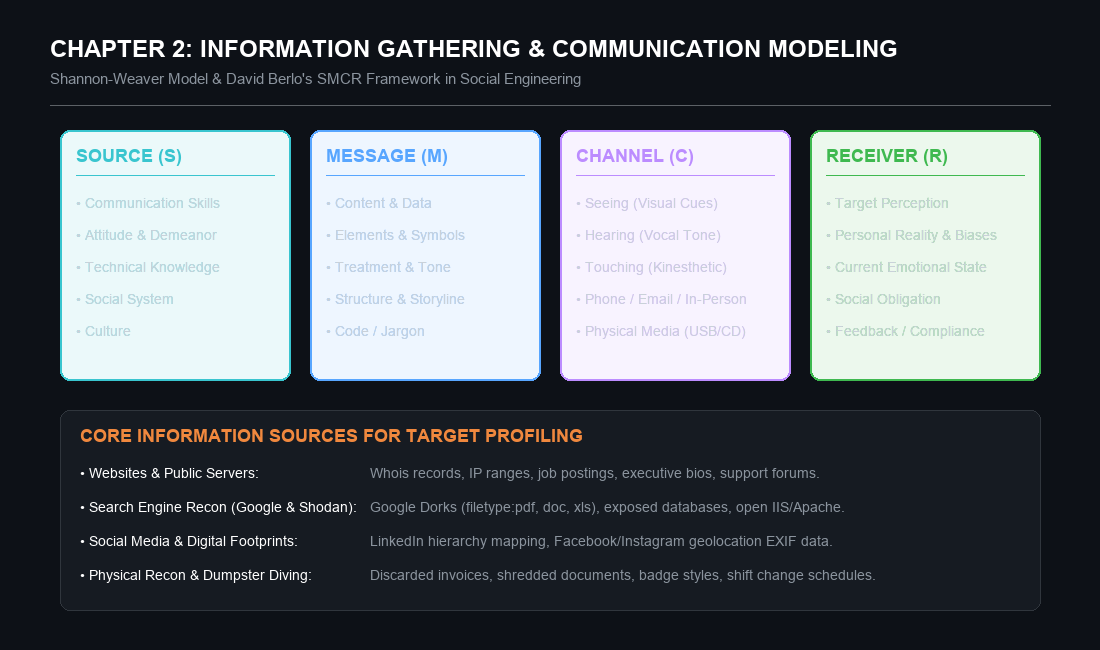
- Corporate & Personal Websites:
- Job Postings: Detail exact software versions, database platforms, firewall vendors, and programming languages in use.
- Email Naming Schemes: Discovering whether the company uses
first.last@company.comorflast@company.com.
- Google Dorking:
- Utilizing advanced operators to locate exposed sensitive files:
1
2
3
4
site:targetcompany.com filetype:pdf "confidential"
site:targetcompany.com filetype:xls "salary" OR "budget"
site:targetcompany.com filetype:doc "internal use only"
site:targetcompany.com inurl:admin OR inurl:login
- Utilizing advanced operators to locate exposed sensitive files:
- Shodan (
shodanhq.com):- John Matherly’s search engine indexing internet-connected infrastructure: servers, webcams, SCADA systems, and unauthenticated network devices.
- Whois & Public Server Recon:
- Identifying DNS servers, administrative contacts, netblocks, and third-party cloud hosting providers.
- Physical Recon & Dumpster Diving:
- Extracting intact paper documents, employee rosters, and disposed media. (Remember Hadnagy’s golden rules: wear thick boots, dark clothing, bring a flashlight, and practice grab-and-run tactics).
5. Communication Modeling: The Science of Transmission
Once information is gathered, how do you deliver a message so that the target complies without friction?
Hadnagy explores classical communication theory:
The Shannon-Weaver Model (1947)
Known as the “Mother of all Models,” it breaks communication into:
- Information Source: Formulates the core message.
- Transmitter: Encodes message into signals.
- Channel: The medium of transmission (subject to noise/interference).
- Receiver: Decodes the signal back into meaning.
- Destination: Where the message arrives.
Shannon and Weaver identified three levels of communication breakdowns:
- The Technical Problem: How accurately is the signal transmitted?
- The Semantic Problem: How precisely does the received message convey the intended meaning?
- The Effectiveness Problem: How successfully does the message alter the receiver’s behavior? (The central focus of social engineering).
David Berlo’s SMCR Framework (1960)
Berlo expanded communication into four distinct variables:
1
2
3
4
5
6
  [ SOURCE (S) ]            [ MESSAGE (M) ]            [ CHANNEL (C) ]           [ RECEIVER (R) ]
   Comm. Skills             Content                   Seeing                   Comm. Skills
   Attitudes                Elements                  Hearing                  Attitudes
   Knowledge                Treatment                 Touching                 Knowledge
   Social System            Structure                 Smelling                 Social System
   Culture                  Code                      Tasting                  Culture
The Three Sensory Modes of Thinking
To communicate effectively, you must identify your target’s dominant processing mode:
| Mode | Characteristics | Key Language Indicators | Tactical Strategy |
|---|---|---|---|
| Visual | Thinks in pictures, colors, spatial layouts. Makes decisions based on appearance. | “I see what you mean”, “That looks good”, “I get the picture” | Present visual evidence, documents, clean uniforms, polished credentials. |
| Auditory | Processes sound, rhythm, and tone. Highly sensitive to vocal delivery. | “Loud and clear”, “That sounds okay”, “Something tells me” | Control cadence, tone modulation, avoid harsh words or unnatural accents. |
| Kinesthetic | Driven by physical touch, visceral feelings, and emotional comfort. | “I can grasp that”, “How does that feel?”, “Let’s touch base” | Focus on physical comfort, handshakes, posture, and emotional resonance. |
6. Developing an Operational Communication Strategy
Hadnagy recommends reversing the communication model during audit planning:
1
2
3
4
5
6
7
8
9
10
11
12
13
14
15
16
17
18
[ Step 1: Define Desired Feedback ]
    What exact action must the target take? (e.g., click link, open door)


[ Step 2: Analyze the Receivers ]
    Who are they? Demographics, interests, stressors, daily habits


[ Step 3: Craft the Message ]
    Vocabulary, grammar, tone, urgency hooks, preloaded emotional triggers


[ Step 4: Select the Channel ]
    In-person visit, direct telephone call, targeted email, physical dropped media


[ Step 5: Establish the Source ]
    Authoritative vendor, distressed peer, delivery technician, job applicant
Scenario: The Fantasy Basketball Phishing Lure
- Receivers: 45 male corporate employees; 24 participate in an office fantasy basketball league.
- Goal (Feedback): Compel targets to click a verification link during work hours.
- Pretext & Channel: Email from the league platform announcing exclusive premium draft tracking features for the first 100 members who log in.
- Execution: Targets click the link immediately to claim the benefit, triggering an automated client-side browser exploit.
Series Navigation
| Previous Chapter | Current Chapter | Next Chapter |
|---|---|---|
| Chapter 1: The World of Social Engineering | Chapter 2: Information Gathering | Chapter 3: Elicitation |
Next in the Series: Chapter 3 Preview
In Chapter 3: Elicitation, we will dissect:
- The National Security Agency (NSA) definition and rules of elicitation.
- The 5 psychological reasons why elicitation bypasses natural defenses.
- Mastering conversational preloading, open-ended inquiries, and deliberate false statements.
- Real-world operational scenarios in hotels, business conferences, and corporate bars.
- Ready to continue? Read Chapter 3: Elicitation
References & Authoritative Reading
- Hadnagy, Christopher. Social Engineering: The Art of Human Hacking. Chapter 2: Information Gathering. Wiley, 2011.
- Long, Johnny. Google Hacking for Penetration Testers. Syngress, 2007.
- Berlo, David K. The Process of Communication: An Introduction to Theory and Practice. Holt, Rinehart & Winston, 1960.
- Shannon, Claude E., & Weaver, Warren. The Mathematical Theory of Communication. University of Illinois Press, 1949.
- Maltego Official Community Documentation
- Shodan Search Engine Knowledge Base
Let’s Connect
How do you approach OSINT and target profiling during penetration testing? Have you ever noticed how communication modeling changes an interaction?
- Abdulrahman Mohamed
This technical content and everything shared across this blog is dedicated with sincere intention to serve as enduring, beneficial knowledge (علم يُنتفع به) and an ongoing charity (صدقة جارية). If you find value in this research, please remember me and my family in your sincere prayers.