Book Summary: Social Engineering - The Art of Human Hacking (Chapter 1)
An in-depth summary and technical breakdown of Chapter 1 of Christopher Hadnagy's classic 'Social Engineering: The Art of Human Hacking', analyzing the anatomy of human deception, attacker ROI, real-world case studies, and the core Social Engineering Framework.
Hello everyone,
I hope you’re doing well and having a productive week.
Today marks the beginning of an in-depth, chapter-by-chapter book summary series on one of the most foundational texts ever written on offensive security and human vulnerability: “Social Engineering: The Art of Human Hacking” by Christopher Hadnagy (Wiley Publishing).
As cybersecurity professionals, we spend thousands of hours configuring firewalls, deploying intrusion detection systems, auditing code repositories, and conducting penetration tests against web applications and networks. Yet time and time again, the most devastating enterprise breaches do not originate from a zero-day exploit against an Apache server or a memory corruption bug in an operating system kernel. They originate from an email clicked, a phone call answered, or a badge swiped for a charismatic stranger.
In this series, we will dissect Hadnagy’s framework systematically. We will analyze the psychological principles, the covert reconnaissance techniques, the communication models, the physical tools, and the defensive countermeasures required to protect modern organizations.
Let’s dive into Chapter 1: A Look into the World of Social Engineering.
Series Navigation
| Previous Chapter | Current Chapter | Next Chapter |
|---|---|---|
| First Chapter in Series | Chapter 1: The World of Social Engineering | Chapter 2: Information Gathering |
Key Takeaways
- Social Engineering Defined: It is not merely “lying” or “acting.” It is the science and art of skillfully maneuvering human beings into taking actions that may or may not be in their best interest.
- The Master Chef Analogy: A successful attack is rarely a single trick; it is a recipe blending elicitation, pretexting, psychological framing, observation, and timing.
- The Attacker’s ROI: Threat actors exploit humans because of Return on Investment (ROI). Why spend 100 hours reverse-engineering an encrypted binary when a 10-minute pretexted phone call can yield the administrative credentials?
- The Insider Threat Reality: Multiple industry surveys reveal that internal personnel and uneducated employees represent over 60% of data exposure risks.
- The “Security Through Education” Mantra: Traditional security relies on software patches; human security relies on building an active, non-punitive awareness culture.
1. Demystifying Social Engineering
Hadnagy opens Chapter 1 with a timeless quote from Sun Tzu’s The Art of War:
“If you know the enemy and know yourself, you need not fear the results of a hundred battles.”
— Sun Tzu
For years, social engineering (SE) was trivialized within both popular culture and technical communities. Some viewed it as petty deception, tricks used by teenagers to get free pizza or con artists peddling bogus lottery tickets. Others viewed it as a dark, mystical form of mind control that only mentalists or Hollywood illusionists could wield.
Hadnagy dismisses both extremes. Social engineering is an everyday human phenomenon. A child negotiating with a parent in a supermarket aisle is using social engineering. A salesperson establishing rapport to close a contract is using social engineering. A doctor framing difficult medical advice to ensure patient compliance is using social engineering.
Like any tool, social engineering is neutral:
1
2
3
4
5
6
7
8
9
10
11
12
13
14
15
16
                  +------------------------------------+
                  |         SOCIAL ENGINEERING         |
                  | "Skillfully maneuvering human action"|
                  +-----------------+------------------+
                                    |
                  +-----------------+------------------+
                  |                                    |
                  v                                    v
  +-------------------------------+    +-------------------------------+
  |    CONSTRUCTIVE / ETHICAL     |    |    MALICIOUS / ADVERSARIAL    |
  +-------------------------------+    +-------------------------------+
  | * Penetration Testing Audits  |    | * Ransomware Infiltration     |
  | * Security Awareness Labs     |    | * Corporate Espionage         |
  | * Doctor-Patient Compliance   |    | * Financial Fraud & Scams     |
  | * Law Enforcement Interrog.   |    | * Credential Harvesting       |
  +-------------------------------+    +-------------------------------+
The difference between ethical penetration testers and malicious actors lies in intent, authorization, and ethics, not in the mechanics of the human psyche.
The “Master Chef” Analogy
One of Hadnagy’s most compelling analogies compares a master social engineer to a master chef:
“A wonderful meal is not just one ingredient, but is made up by the careful combining, mixing, and adding of many ingredients… Put in a little dab of elicitation, add a shake of manipulation, and a few heaping handfuls of pretexting, and bam! out comes a great meal of the perfect social engineer.”
Just knowing that a recipe needs salt does not make someone a chef. Similarly, memorizing a phishing template does not make someone an offensive security practitioner. The craft requires understanding the proportion, timing, and environmental temperature of each interaction.
As veteran social engineer Chris Nickerson famously stated:
“True social engineering is not just believing you are playing a part, but for that moment you are that person, you are that role, it is what your life is.”
2. The Economics of Attacking Humans (Attacker ROI)
Why do attackers continue to target people despite billions of dollars invested in cybersecurity solutions? The answer comes down to pure economics: Return on Investment (ROI).
Software vendors continuously harden operating systems, implement memory mitigations (ASLR, DEP, Control Flow Guard), and mandate hardware-level protections (TPM 2.0, Secure Boot). Writing a functional zero-day exploit for modern enterprise software can take months of intensive reverse engineering, with high failure rates and huge capital expense.
In contrast, attacking the human infrastructure requires minimal financial investment and produces immediate results:
| Attack Vector | Skill Requirement | Time to Prepare | Defense Effectiveness | Probability of Success |
|---|---|---|---|---|
| 0-Day Kernel Exploit | Elite Software Engineering | Months / Years | High (EDR, Sandboxing, Patches) | Variable (10% - 30%) |
| Brute-Force Passwords | Low - Moderate | Days - Weeks | High (Account Lockout, Rate Limiting) | Low (< 5%) |
| Social Engineering Call | Psychology & Communication | Hours - Days | Low (Bypasses Technical Perimeter) | High (60% - 85%) |
Hadnagy makes a blunt observation that every CISO and penetration tester must confront:
“The sad result in the end is that no way exists to be 100% secure, unless you unplug all electronic devices and move to the mountains.”
Because air-gapping entire enterprises and abandoning modern infrastructure is impossible, our strategy must shift from pretending we can prevent every interaction to educating personnel so they can identify and disrupt attacks in real time.
3. Dissecting the Shocking Industry Data
Chapter 1 highlights sobering industry metrics that remain remarkably relevant today:
- Kaspersky Lab Research: Attacks executed via social platforms and human channels achieved a success rate 10 times higher than purely technical perimeter attacks.
- Ponemon Institute & FBI/CSI Surveys: Over 77% of surveyed organizations identified employees or contractors as the source of major security incidents.
- Financial Impact: The average cost of organizational data breaches was calculated between $1 million and $53 million, with malicious code, web-based attacks, and malicious insiders accounting for more than 90% of total cybercrime costs.
- Data Loss Prevention (Vontu / Symantec): Approximately 1 out of every 500 emails sent from corporate environments contains sensitive or confidential data.
- The Perception Paradox:
- 66% of employees reported that coworkers and internal personnel posed the greatest risk to corporate security.
- Only 10% viewed external hackers as the primary danger.
- 46% claimed it would be “easy” to “extremely easy” to exfiltrate sensitive databases from their employer.
- 32% (nearly one in three) had zero knowledge of internal data security policies.
4. Real-World Case Studies from Chapter 1
Hadnagy illustrates the real-world impact of social engineering with practical accounts:
Case Study: The Canadian Forces Base (CFB) Trenton Incident
One of the most astonishing security breaches cited in Chapter 1 occurred at the Canadian Forces Base in Trenton, home to the Canadian Joint Incident Response Unit (handling nuclear, chemical, and biological threats):
- The Asset: Highly classified defense blueprints, detailed perimeter security fence locations, building floor plans, and internal access camera layouts.
- The Attack Vector: No zero-days, no high-altitude antennas, no malware.
- The Reality: The documents were simply discarded into a regular trashcan and collected in an unsecured dumpster. A simple dumpster dive provided complete physical architecture blueprints to unauthorized hands.
Takeaway: Information gathering starts at the lowest, most mundane levels. When companies fail to enforce physical sanitation policies (cross-cut shredding, locked bins, waste auditing), technical defenses become completely irrelevant.
Case Study: Password Profiling and The Golf Course Placemat
Hadnagy shares a personal experience speaking with an acquaintance about account security:
- The Conversation: The acquaintance insisted that her accounts were impossible to guess. Hadnagy pointed out that human beings inherently construct passwords using significant emotional anchors: spouse names, birthdays, anniversaries, children, and pets.
- The Exploit Demonstration: While dining at a local restaurant, Hadnagy spotted a promotional coupon printed on a table placemat offering “$50 off local golf club membership.” To qualify, patrons had to write down their full name, date of birth, home address, email, and choose a password for an online account.
- The Vulnerability: Diners were writing down their primary personal passwords in plain ink on paper left on the table.
1
2
3
4
5
[ Public Restaurant Placemat ]

         Name + Birthday + Address  > Identity Profiling (CUPP)
         Personal Email Address     > Target Account Identification
         Chosen Account Password    > Credential Stuffing on Corporate Portal
5. The Taxonomy of Social Engineers
Chapter 1 categorizes the broad spectrum of individuals and groups who utilize human exploitation techniques:
1
2
3
4
5
6
7
8
9
10
11
12
13
14
                    +------------------------------------+
                    |          SOCIAL ENGINEERS          |
                    +-----------------+------------------+
                                      |
         +----------------------------+----------------------------+
         |                            |                            |
         v                            v                            v
+------------------+         +------------------+         +------------------+
| OFFENSIVE/AUDIT  |         |  INTERNAL RISK   |         |COERCIVE/MALICIOUS|
+------------------+         +------------------+         +------------------+
|* Ethical Pentesters        |* Disgruntled Staff         |* Black Hat Hackers|
|* Red Teams       |         |* Careless Insiders         |* Identity Thieves|
|* Security Audits |         |* Executive Recruit         |* Con Artists/Scams|
+------------------+         +------------------+         +------------------+
- Hackers (Black Hats): Combine technical acumen (scripts, scanners, malware payloads) with psychological lures to breach hardened environments.
- Penetration Testers (White Hats): Contracted professionals simulating real adversary tactics to evaluate physical, technical, and human defenses, strictly bound by scope, laws, and ethical contracts.
- Foreign Intelligence & Spies: Operate with social engineering as a permanent lifestyle. They leverage cultural integration, deep-cover pretexts, and extensive elicitation over months or years.
- Identity Thieves: Harvest personal identifiable information (PII) including Social Security Numbers, dates of birth, and banking details to conduct credential fraud and impersonation.
- Disgruntled Employees: Insiders who feel mistreated, underpaid, or passed over for promotions. Employee theft and intentional corporate sabotage account for an estimated $15 billion annually in the United States alone.
- Scam Artists & Con Men: Specialists in leveraging greed, urgency, and vulnerability to execute advanced fee fraud (such as the infamous Nigerian 419 scam) or fraudulent check schemes.
- Marketers & Governments: Use framing, authority, and social consensus to steer public behavior, sway political agendas, and stimulate purchasing decisions.
- Lawyers, Therapists, & Law Enforcement: Employ structured interview, elicitation, and interrogation methodologies to extract hidden truths and guide client decisions.
6. The Social Engineering Framework Architecture
Hadnagy developed the world’s first comprehensive Social Engineering Framework (originally hosted at social-engineer.org). Chapter 1 introduces this framework not as an academic theory, but as an operational progression:
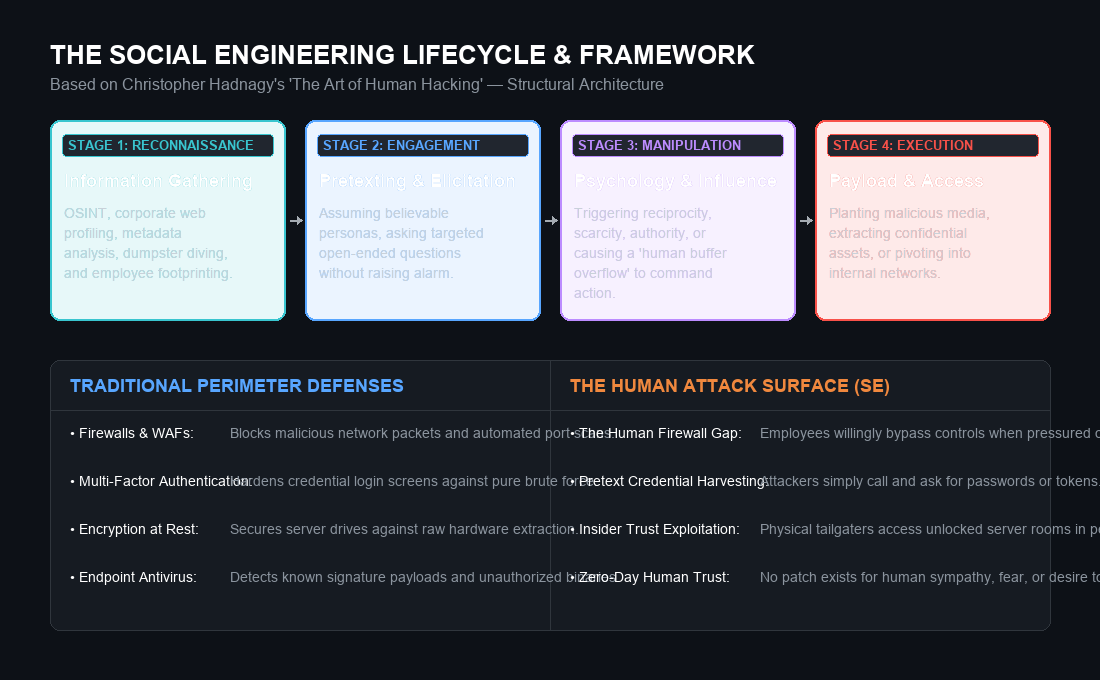
The framework models the lifecycle of a human-centric penetration test:
1
2
3
4
5
6
7
8
9
10
11
12
13
14
15
16
17
18
19
20
21
22
23
[ Phase 1: Information Gathering ]
          Passive OSINT, footprinting, corporate website analysis
          Phone recon, dumpster diving, social media correlation

[ Phase 2: Communication Modeling ]
          Shannon-Weaver & SMCR models (Source, Message, Channel, Receiver)
          Understanding sub-modalities (Visual, Auditory, Kinesthetic)

[ Phase 3: Elicitation & Pretexting ]
          Creating believable personas and seamless conversational hooks
          Extracting information through open-ended & assumptive questions

[ Phase 4: Psychological Exploitation & Influence ]
          Microexpressions (Paul Ekman FACS model)
          Neurolinguistic Programming (NLP) & Embedded Commands
          Cialdini's Weapons of Influence (Reciprocity, Scarcity, Authority)

[ Phase 5: Technical & Physical Tool Execution ]
          Physical: Lockpicks, bump keys, shove knives, hidden cameras
          Digital: SET (Social Engineer Toolkit), Maltego, CUPP, CeWL

[ Phase 6: Mitigation & Defensive Hardening ]
           Policies, verification protocols, educational security culture
7. Strategic Implications for Penetration Testers & Defenders
For Penetration Testers & Red Teams
- Never Jump In Unprepared: 80% of social engineering success happens during Phase 1 (Information Gathering). If your background research is shallow, your pretext will crumble under the first routine inquiry.
- Keep Pretexts Simple: Elaborate, movie-style covers introduce too many moving parts. A clipboard, a believable vendor polo shirt, and a calm, polite demeanor will grant access to 90% of corporate facilities.
- Practice Active Listening: True social engineering is not talking fast; it is listening intently to identify the target’s emotional state, dominant communication mode, and underlying concerns.
For Blue Teams & Security Leaders
- Move Beyond Annual “Check-the-Box” Training: A 45-minute slide deck once a year is completely ineffective. Security awareness must be continuous, practical, and interactive.
- Demonstrate, Don’t Lecture: When educating employees, show them how password cracking tools (like CUPP and John the Ripper) operate in real time against common personal details. Show them how a malicious PDF payload executes a reverse shell on a workstation.
- Establish Clear Verification Protocols: Employees must never be penalized for verifying requests from authority figures. Provide employees with standard scripts and non-punitive verification paths:
1
2
3
4
5
6
7
8
9
10
11
12
13
14
[ Suspicious Request Received ]


   [ Ask for Employee ID & Project Code ]


   [ Provided ]   [ Refused / Evasive ]


[ Cross-Verify ]  [ Terminate Interaction ]
                 [ Report to Security SOC ]

[ Process Request ]
Series Navigation
| Previous Chapter | Current Chapter | Next Chapter |
|---|---|---|
| First Chapter in Series | Chapter 1: The World of Social Engineering | Chapter 2: Information Gathering |
Next in the Series: Chapter 2 Preview
In the next installment of this series, we will examine Chapter 2: Information Gathering. We will explore:
- The social engineer’s core mantra: “I am only as good as the information I gather.”
- Passive vs. active reconnaissance tools (Maltego, Whois, Shodan, Google Dorking).
- Communication Modeling (the Shannon-Weaver model and David Berlo’s SMCR framework).
- Practical case studies including how a forum post about a 1950s stamp collection led to the complete compromise of a financial institution.
- Ready to continue? Read Chapter 2: Information Gathering
References & Authoritative Reading
- Hadnagy, Christopher. Social Engineering: The Art of Human Hacking. Wiley Publishing, 2011.
- Mitnick, Kevin D., & Simon, William L. The Art of Deception: Controlling the Human Element of Security. Wiley, 2002.
- Cialdini, Robert B. Influence: The Psychology of Persuasion. Harper Business, 2006.
- Ekman, Paul. Emotions Revealed: Recognizing Faces and Feelings to Improve Communication and Emotional Life. Times Books, 2003.
- Social-Engineer.org Official Framework & Knowledge Repository
- NIST SP 800-53 Rev. 5: Security and Privacy Controls (AT: Awareness and Training)
Let’s Connect
Have you encountered social engineering attempts in your assessments or organization? What are your favorite takeaways from Christopher Hadnagy’s work?
- Abdulrahman Mohamed
This technical content and everything shared across this blog is dedicated with sincere intention to serve as enduring, beneficial knowledge (علم يُنتفع به) and an ongoing charity (صدقة جارية). If you find value in this research, please remember me and my family in your sincere prayers.