Book Summary: Social Engineering - The Art of Human Hacking (Chapter 4: Pretexting)
A comprehensive summary of Chapter 4 of Christopher Hadnagy's 'Social Engineering: The Art of Human Hacking', covering the 7 principles of pretexting, cognitive dissonance alignment, Stanley Rifkin's $10.2M heist, and the HP legal scandal.
Hello everyone,
Welcome back to our continuing book summary series on Christopher Hadnagy’s “Social Engineering: The Art of Human Hacking” (Wiley Publishing).
In Chapter 3: Elicitation, we unpacked the NSA guidelines for subtle intelligence gathering and conversational preloading.
Today, we dive into Chapter 4: Pretexting - How to Become Anyone.
If information gathering provides the intelligence, and elicitation provides the conversational mechanism, pretexting is the vehicle that carries the attack. It encompasses the character, backstory, physical wardrobe, grooming, vocabulary, and psychological mindset that an auditor adopts to achieve compliance.
Hadnagy frames this chapter with comic Richard Jeni’s biting quote:
“Honesty is the key to a relationship. If you can fake that, you’re in.”
— Richard Jeni
Let’s dissect how professional social engineers construct believable realities—and where the legal boundaries lie.
Series Navigation
| Previous Chapter | Current Chapter | Next Chapter |
|---|---|---|
| Chapter 3: Elicitation | Chapter 4: Pretexting | Chapter 5: Mind Tricks & Psychology |
Key Takeaways
- Pretexting Defined: It is far more than a lie or a script; it is the comprehensive synthesis of backstory, dress, grooming, demeanor, and psychological conviction required to become the persona.
- The Simplicity Rule: Dr. Paul Ekman’s research (“Lies That Fail”) demonstrates that complex pretexts fail because human memory falters under cognitive stress. The simpler the story, the higher the survival rate.
- Cognitive Dissonance: Resolving psychological inconsistencies between what a target observes and what they expect (Leon Festinger’s 1957 theory).
- The $10.2M Stanley Rifkin Heist: How a computer consultant walked away with millions from Security Pacific Bank without holding a weapon or hacking a computer.
- The Legal Red Line: The 2006 Hewlett-Packard pretexting scandal, the Federal Trade Commission (FTC) Act, and the criminal liabilities of unauthorized impersonation.
1. What Is Pretexting? (Beyond Acting)
A common misconception among beginners is that pretexting is simply putting on a disguise—like wearing a fake mustache or throwing on a high-vis vest.
Hadnagy dismisses this superficial view. Pretexting requires adopting a persona so thoroughly that for the duration of the engagement, you are that person. If you view yourself as a security auditor playing a delivery driver, your eyes, microexpressions, and body language will leak hesitation. But if your mindset is that you are a tired UPS delivery driver who has 40 boxes left in the truck and is running 15 minutes behind schedule, every nonverbal cue aligns automatically.
Hadnagy recalls an interview with radio broadcaster Tom Mischke:
- Radio hosts must connect intimately with hundreds of thousands of listeners who feel they “know” the host personally.
- Mischke explained that the secret is the illusion of spontaneity wrapped in meticulous preparation. He rehearsed his tone, seated posture, and conversational pacing so extensively that when he went live, the delivery sounded effortlessly natural.
2. The 7 Principles of Successful Pretexting
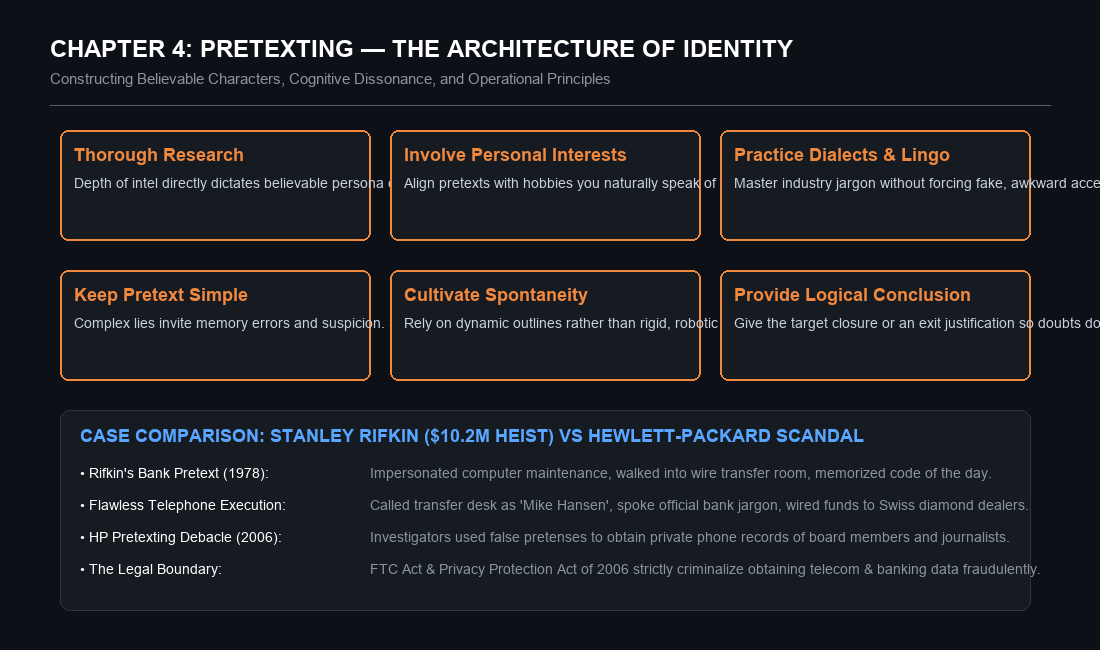
Hadnagy synthesizes decades of operational experience into seven fundamental principles:
1
2
3
4
5
6
7
8
9
10
                          THE 7 PRETEXTING PRINCIPLES

    1. Thorough Research        Pretext quality matches OSINT depth
    2. Involve Personal Hobbies Natural passion projects confidence
    3. Practice Dialects/Lingo — Learn jargon; never force fake accents
    4. Never Neglect the Phone — Telephone pretexts require equal rigor
    5. Keep the Pretext Simple — Complex backstories collapse under stress
    6. Cultivate Spontaneity    Use flexible outlines, not robotic scripts
    7. Provide Logical Closure — Always give the target an expected exit
Principle 1: The More Research You Do, the Better the Chance of Success
Your pretext must be anchored in the specific reality of the target organization. Mimicking a third-party IT contractor fails instantly if the company uses an internal two-person support desk where everyone knows each other by face.
Principle 2: Involve Personal Interests
Confidence is directly tied to comfort. If you have never built a server in your life, do not pretext as a senior database administrator. If you love woodworking, cars, or sports, find an angle that connects your target’s interests with topics you can discuss with genuine, fluent enthusiasm.
Principle 3: Practice Dialects and Expressions
Never attempt an accent unless you can deliver it flawlessly. Hadnagy recounts listening to trainees attempt fake British or Southern accents that sounded like caricatures, immediately triggering alarm bells. When in doubt, drop the accent and focus on regional terminology and industry slang.
Principle 4: The Phone Demands Equal Effort
Because phone interactions lack visual cues, operators often get lazy. In reality, phone social engineering is harder because vocal tone, pitch, pauses, and background noise carry 100% of the message. Hadnagy recommends:
- Using audio background tracks (e.g., Thriving Office CD tracks simulating ambient keyboard typing and muted office banter).
- Outlining conversational checkpoints rather than reading word-for-word scripts.
- Utilizing legitimate caller ID spoofing tools (Asterisk, SpoofCard) to match target expectations.
Principle 5: The Simpler the Pretext, the Better
Hadnagy cites renowned deception psychologist Dr. Paul Ekman’s 1993 research paper, “Lies That Fail”:
“There is not always time to prepare the line to be taken, to rehearse and memorize it… Even when there has been ample advance notice, some liars have trouble recalling the line they have previously committed themselves to, so that new questions cannot be consistently answered quickly.”
Keep details minimal. Allow the target’s imagination to fill in the blanks.
Principle 6: The Pretext Should Appear Spontaneous
“Get out of your head and into the world.” If an unexpected obstacle arises, do not freeze or panic. A skilled social engineer laughs at minor hitches, rolls with unexpected turns, and treats errors as ordinary occurrences.
Principle 7: Provide a Logical Conclusion (Follow-Through)
Human psychology demands closure. If a “tech support specialist” walks into a server room, installs a rogue device, and walks out without saying a word, employees will discuss the weird encounter and call IT security. But if the specialist stops by the front desk and says:
“I finished updating the file system indexes on server prod-02; you should see faster query times by tomorrow morning. Have a great day!”
The target feels satisfied, the interaction is normalized, and no security incident is reported.
3. Cognitive Dissonance in Pretexting
In 1957, psychologist Leon Festinger formulated the theory of Cognitive Dissonance: human beings have an intense, unconscious drive to maintain consistency among their beliefs, perceptions, and reality. When an inconsistency arises, psychological tension forces them to resolve it:
- Reduce the importance of the dissonant belief.
- Add consonant beliefs that outweigh the dissonance.
- Change the dissonant belief entirely.
Operational Application: The Defcon 18 SE CTF
During the inaugural Social Engineering Capture the Flag (SECTF) at Defcon 18, contestants impersonated corporate vendors:
- When a target receptionist asked: “What is your employee badge number?”
- Unskilled contestants panicked, stammered, or hung up, intensifying cognitive dissonance.
- Skilled contestants aligned the dissonance immediately: “Oh, I’m calling from the outside logistics contract team; we’re tracked under ticket number 4092 rather than internal badges.” By introducing a consonant, believable explanation, the target’s mind relaxed and compliance followed.
4. Case Study: Stanley Mark Rifkin ($10.2 Million Wire Transfer)
In October 1978, computer consultant Stanley Mark Rifkin executed one of the most audacious bank heists in American history against Security Pacific National Bank in Los Angeles:
- The Target: A 55-floor granite-and-glass corporate fortress with armed guards, surveillance cameras, and high-security wire transfer controls.
- The Reconnaissance: Rifkin learned that wire transfers required a daily authorization code that changed every morning. The bank’s transfer room was located in the basement (D-level).
- The Physical Pretext: Wearing a casual button-down and carrying tech manuals, Rifkin took the elevator down to D-level. Because employees recognized him as an IT contractor, he walked into the wire room, feigned maintenance, and simply read the daily code written on an internal chalkboard.
- The Telephony Pretext: Rifkin walked to a nearby public telephone booth, called the wire transfer room, and adopted his second pretext: “This is Mike Hansen from the International Department.”
- The Transfer: Speaking with polished banking jargon, Rifkin authorized a transfer of $10,200,000 to the Irving Trust Company in New York, credited to a Swiss bank account.
- The Exfiltration: Rifkin flew to Switzerland, purchased Russian diamonds with the cash, and returned to the US. He was caught weeks later only because he bragged about the heist to a business associate.
Rifkin never touched a firearm, never wrote a line of malware, and never forced a door. He executed four seamless pretexts in sequence.
5. The Hewlett-Packard Boardroom Scandal & The Legal Line
In 2006, one of the most infamous corporate pretexting scandals erupted at Hewlett-Packard (HP):
- The Context: HP Chairwoman Patricia Dunn initiated an internal investigation to uncover a boardroom member who was leaking sensitive strategy to journalists at CNET.
- The Tactics: Outside private investigators hired by HP impersonated board members, their spouses, and journalists to deceive telecommunication providers (AT&T, Verizon) into releasing private, itemized phone call records.
- The Fallout:
- Pretexting phone records was exposed as a violation of the Federal Trade Commission (FTC) Act regarding fraud, deceptive practices, and identity theft.
- Criminal felony indictments were issued against HP executives and private investigators.
- The U.S. Congress enacted the Telephone Records and Privacy Protection Act of 2006, formally criminalizing pretexting used to obtain confidential telecommunication records.
Ethical Red Line for Pentesters: An authorized penetration testing contract protects you when testing the client’s internal personnel and assets. It does not authorize you to impersonate law enforcement, commit perjury, or social engineer third-party telecommunications and banking infrastructure.
Series Navigation
| Previous Chapter | Current Chapter | Next Chapter |
|---|---|---|
| Chapter 3: Elicitation | Chapter 4: Pretexting | Chapter 5: Mind Tricks & Psychology |
Next in the Series: Chapter 5 Preview
In Chapter 5: Mind Tricks - Psychological Principles Used in Social Engineering, we will break down:
- Paul Ekman’s Facial Action Coding System (FACS) and the 7 universal microexpressions.
- Neurolinguistic Programming (NLP): voice cadence, sensory predicates, and embedded commands.
- Professional interrogation strategies adapted from Department of Defense polygraph manuals.
- Hadnagy’s breakthrough theory: The Human Buffer Overflow (HBO).
- Ready to continue? Read Chapter 5: Mind Tricks & Psychology
References & Authoritative Reading
- Hadnagy, Christopher. Social Engineering: The Art of Human Hacking. Chapter 4: Pretexting. Wiley, 2011.
- Festinger, Leon. A Theory of Cognitive Dissonance. Stanford University Press, 1957.
- Ekman, Paul, & Frank, Mark G. “Lies That Fail.” In Lying and Deception in Everyday Life, Guilford Press, 1993.
- United States Federal Trade Commission (FTC). Pretexting: Your Personal Information Revealed.
- United States Congress. Telephone Records and Privacy Protection Act of 2006 (P.L. 109-476).
Let’s Connect
What is your golden rule when developing realistic pretexts for physical or telephone assessments?
- Abdulrahman Mohamed
This technical content and everything shared across this blog is dedicated with sincere intention to serve as enduring, beneficial knowledge (علم يُنتفع به) and an ongoing charity (صدقة جارية). If you find value in this research, please remember me and my family in your sincere prayers.