Book Summary: Social Engineering - The Art of Human Hacking (Chapter 6: Influence & Persuasion)
A comprehensive summary of Chapter 6 of Christopher Hadnagy's 'Social Engineering: The Art of Human Hacking', analyzing Cialdini's weapons of influence, reality framing theory, retail planograms, and ethical manipulation tactics.
Hello everyone,
Welcome back to our book summary series covering Christopher Hadnagy’s “Social Engineering: The Art of Human Hacking” (Wiley Publishing).
In Chapter 5: Mind Tricks & Psychology, we analyzed microexpressions, NLP vocal modulation, and the Human Buffer Overflow.
Today, we dive into Chapter 6: Influence - The Power of Persuasion.
Hadnagy begins this chapter with a profound definition:
“Influence and the art of persuasion is the process of getting someone else to want to do, react, think, or believe in the way you want them tobecause they want to.”
In true social engineering, an attacker does not hold a victim at gunpoint or threaten them with violence. The target complies voluntarily, believes the action was their own idea, and frequently thanks the operator afterward.
Hadnagy frames this chapter with Benjamin Franklin’s immortal advice:
“If you would persuade, you must appeal to interest rather than intellect.”
— Benjamin Franklin
Let’s dissect the psychological mechanisms of influence, cognitive reality framing, and manipulation tactics.
Series Navigation
| Previous Chapter | Current Chapter | Next Chapter |
|---|---|---|
| Chapter 5: Mind Tricks & Psychology | Chapter 6: Influence & Persuasion | Chapter 7: The Tools of the Social Engineer |
Key Takeaways
- The Five Fundamentals: Setting definite outcomes, meeting the target in their emotional reality, maintaining sensory acuity, adapting flexibly like a willow branch, and mastering personal biases.
- Cialdini’s Weapons of Influence: Exploiting reciprocity, scarcity, authority, commitment, liking, and social proof in offensive engagements.
- Reality Framing (Snow & Benford): How language subtly alters perception (e.g., “75% lean” vs “25% fat”; “economic stimulus” vs “bailout”).
- The 4 Rules of Framing: Every word evokes a mental frame; negating a frame reinforces it; causing a target to ponder a frame cements it into memory.
- The Mechanics of Manipulation: Analyzing retail planograms, color theory, and cognitive conditioning (from Pavlov’s dog to modern marketing).
1. The Five Fundamentals of Influence
Before deploying persuasion techniques, an operator must ground themselves in five fundamental mindsets:
1
2
3
4
5
6
7
8
                      THE 5 INFLUENCE FUNDAMENTALS

    1. Clear Goal Setting     Know what you want and how you'll gauge it
    2. Deep Empathic Rapport — Start in the target's mental state, not yours
    3. Sensory Acuity         Notice subtle eye blinks, vocal shifts, cues
    4. Cognitive Flexibility — Be a willow branch that bends, not a steel rod
    5. Emotional Self-Control Never let personal moral filters blow cover
1. Have a Clear Goal in Mind
Hadnagy quotes NLP pioneer Jamie Smart: “The map is not the territory.” Before any call or onsite visit, define two precise checkpoints:
- What exact outcome do I want?
- What specific indicator will prove I have achieved it?
2. Meet the Target Where They Are Mentally
You cannot influence a target from your own frame of mind. If a friend is hooked on cigarettes, preaching cancer statistics fails because logic cannot overturn emotional addictions. You must enter their reality, understand what the habit provides them, and frame your message to align with their self-interest.
3. Sensory Acuity (Watch & Listen)
Neuropsychologist Chris Westbury estimates the human brain processes 20 million billion calculations per second. These calculations manifest through vocal pitch changes, respiration rates, hand gestures, and microexpressions. An operator who is caught up in their own internal monologue will miss these critical indicators.
4. Be Flexible (Don’t Act Insane)
The classic definition of insanity is doing the same thing repeatedly and expecting different results. If a gatekeeper blocks your first approach, pushing harder guarantees failure. Bend like a willow branch: shift pretexts, alter your tone, or execute a planned exit strategy.
5. Get in Touch with Yourself
Hadnagy shares an honest lesson from his own early career: raised in a strict, traditional Italian household where respecting women was paramount, he once blew an operational vector because a target made an offensive remark about a female coworker. Hadnagy’s visible anger broke rapport instantly. You must master your personal triggers.
2. Cialdini’s Weapons of Influence in Offensive Operations
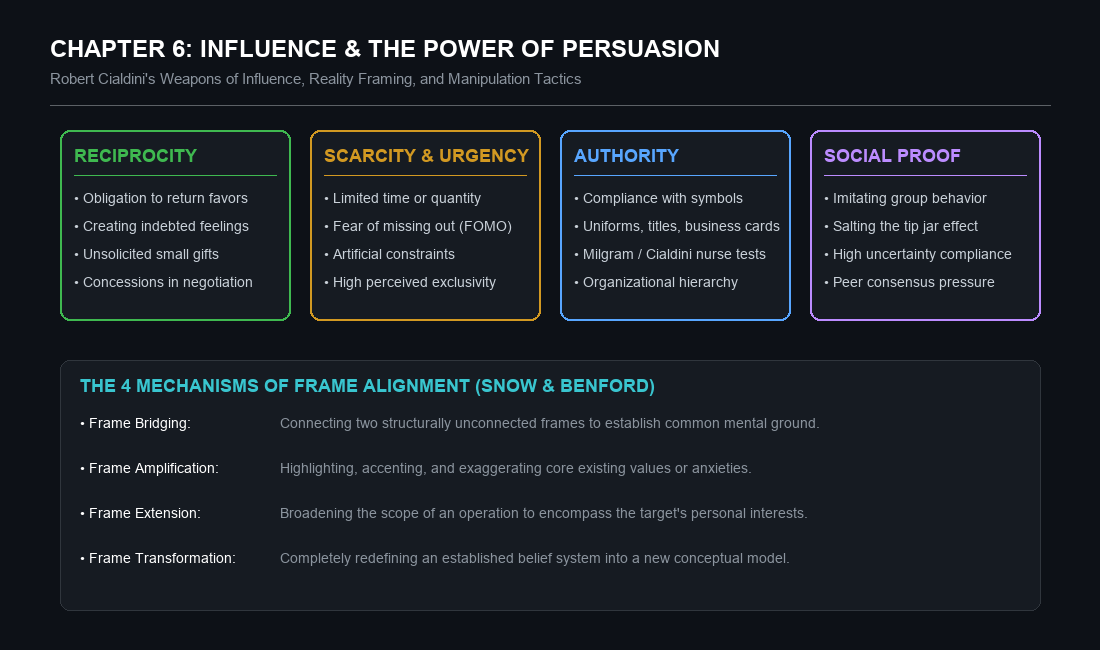
Drawing from Dr. Robert Cialdini’s seminal research, Hadnagy breaks down how social engineers weaponize compliance principles:
1
2
3
4
5
6
7
8
9
                            WEAPONS OF INFLUENCE


   RECIPROCITY                  AUTHORITY                    SOCIAL PROOF

   Indebted favors          Uniforms & gear          Group consensus
   Concessions              Executive titles         Uncertainty bias
   Door-in-the-Face         Autopilot trust          Salting tip jar
1. Reciprocation & Indebtedness
Sociologist Alvin Gouldner proved that the norm of reciprocity is universal across all human societies:
- People feel an overwhelming psychological obligation to help those who have helped them.
- The Minesweeper Receptionist Incident: Entering a corporate lobby, Hadnagy saw the receptionist frantically playing Minesweeper on her desktop just as the angry CFO pulled into the parking lot. Hadnagy gave her a heads-up: “Look, I’m here for a meeting, but your boss just pulled up in a terrible mood…” The receptionist quickly closed the game. Relieved that Hadnagy saved her from being reprimanded, she immediately escorted him into the HR executive suite as “her personal friend.”
2. Concessions & The “Door-in-the-Face” Technique
Humans treat concessions as reciprocal transactions:
- If you ask for a huge commitment (“Can you donate $200?”) and receive a refusal, immediately countering with a small request (“I understand, could you do just $20?”) triggers compliance.
- The target feels that because you made a concession, they are socially obligated to compromise as well.
3. Scarcity & Artificial Urgency
Opportunities appear substantially more valuable when availability is limited:
- Marketers use “Supplies limited!” or “Only 3 days left!” (e.g., Nintendo’s intentional supply constraints on Wii consoles).
- In social engineering, scarcity is paired with authority: “Mr. Smith is boarding a flight to London in 20 minutes; he urgently needs this file uploaded before departure.” Time becomes the scarce asset, forcing the target to skip security verification.
4. Authority & Symbols of Compliance
Humans are conditioned from childhood to obey authority figures (teachers, police, doctors, managers):
- In Robert Cialdini’s famous hospital experiment, 95% of nurses in 22 hospital stations agreed to administer a lethal drug overdose to a patient simply because an unknown voice on the telephone claimed to be a physician.
- Harvard psychologist Dr. Ellen Langer demonstrated that people spend much of their day on cognitive autopilot. Presenting the symbols of authority (uniforms, badges, clipboards, technical jargon) allows an attacker to walk straight through security gates without question.
5. Commitment and Consistency
Once a person takes a public stand, psychological pressure forces them to behave consistently with that choice:
- Thomas Moriarty’s 1972 Beach Radio Experiment: An actor staged a portable radio on a crowded beach and walked away. An accomplice ran by and snatched it. Only 20% (4 out of 20) of bystanders intervened.
- In the second test, the actor turned to a stranger before leaving and asked: “Could you please watch my things for a minute?” When the thief struck, 95% (19 out of 20) actively intervened, physically chasing down the thief.
- In social engineering, eliciting a small, trivial “yes” early in a call locks the target into a consistency loop that can be escalated to full credential disclosure.
6. Social Proof (Consensus)
When uncertain, people mirror the behavior of others:
- Bartenders “salt” their tip jars with dollar bills so arriving patrons assume tipping is standard.
- Television producers use canned laughter because audiences laugh longer and rate jokes as funnier when they hear peers laughing.
- Social engineers exploit this: “Jim in Accounting verified my credentials yesterday and let me into the server room; isn’t it on file?”
3. Altering Reality: The Science of Framing
Framing is the conceptual structure that dictates how human beings interpret facts and make decisions. Presenting the exact same objective reality through different linguistic frames completely alters the outcome:
1
2
3
4
5
6
7
  OBJECTIVE REALITY               FRAME A                      FRAME B

  Meat composition:        "75% LEAN"                "25% FAT"
  75% protein / 25% fat        (Sounds healthy & premium)    (Sounds greasy & cheap)

  Government economic      "ECONOMIC STIMULUS"       "CORPORATE BAILOUT"
  intervention                 (Sounds proactive & helpful)  (Sounds like sinking ship)
The 4 Frame Alignment Processes (Snow & Benford)
- Frame Bridging: Connecting two structurally separate belief systems (e.g., connecting an employee’s personal interest in environmentalism to a corporate waste audit).
- Frame Amplification: Accenting and exaggerating an existing fear or value (e.g., highlighting airport security threats to justify full-body scanners).
- Frame Extension: Broadening your operational scope to include the target’s hobbies, favorite sports teams, or local charity causes.
- Frame Transformation: Completely converting a target’s worldview (the most complex and long-term form of alignment).
The 4 Rules of Framing
- Everything You Say Will Evoke a Frame: Describing a meal with sensory words (vine-ripened tomatoes, fresh oregano, homemade garlic bread) forces the brain to picture restaurant-grade dining.
- Words Defined Within a Frame Evoke the Entire Concept: Describing a sticky web, struggling prey, and a cocoon makes the target picture a spider without ever uttering the word.
- Negating the Frame Reinforces It: Telling a security guard “Don’t worry about rogue USB drives dropped in the lobby” forces their subconscious to fixate on the USB drives.
- Pondering the Frame Cements It: The more a target visualizes a scenario, the more real and acceptable it becomes.
4. The Psychology of Manipulation
Hadnagy explains that while influence aims for mutual benefit, manipulation seeks to control the target’s environment to force compliance:
Retail Planograms & Sensory Conditioning
- Planograms: Grocery chains structure horizontal and vertical shelving (placing high-margin goods in 1530 cm eye-level zones) to dictate purchasing behavior.
- Ambient Odors: Canadian mall studies proved that pumping custom citrus and floral scents into ventilation increased consumer spending by an average of $50 per shopper.
- Color Psychology:
- Blue: Elicits trust, calmness, and lowers metabolic rates (ideal for corporate and legal pretexts).
- Red: Triggers excitement, passion, and urgency (ideal for emergency alerts, but risks hostility).
- Green: Connotes safety and balance, but can provoke subconscious associations with greed or wealth.
Series Navigation
| Previous Chapter | Current Chapter | Next Chapter |
|---|---|---|
| Chapter 5: Mind Tricks & Psychology | Chapter 6: Influence & Persuasion | Chapter 7: The Tools of the Social Engineer |
Next in the Series: Chapter 7 Preview
In Chapter 7: The Tools of the Social Engineer, we leave theoretical psychology and explore the physical and digital toolkit:
- Physical bypass gear: lock picks, tension wrenches, bump keys, shove knives, and padlock shims.
- Covert surveillance: tie cameras, button mics, and magnetic GPS loggers.
- Digital attack platforms: Dave Kennedy’s Social Engineer Toolkit (SET) and Paterva’s Maltego.
- Password profiling automation: CUPP and CeWL.
- Ready to continue? Read Chapter 7: Tools of the SE
References & Authoritative Reading
- Hadnagy, Christopher. Social Engineering: The Art of Human Hacking. Chapter 6: Influence. Wiley, 2011.
- Cialdini, Robert B. Influence: The Psychology of Persuasion. Harper Business, Revised Edition, 2006.
- Snow, David A., & Benford, Robert D. “Ideology, Frame Resonance, and Participant Mobilization.” International Social Movement Research, 1988.
- Langer, Ellen J. Mindfulness. Da Capo Press, 1989.
- Gouldner, Alvin W. “The Norm of Reciprocity: A Preliminary Statement.” American Sociological Review, 1960.
Let’s Connect
Which weapon of influence do you encounter most often in security assessments or social engineering attempts?
- Abdulrahman Mohamed
This technical content and everything shared across this blog is dedicated with sincere intention to serve as enduring, beneficial knowledge (علم يُنتفع به) and an ongoing charity (صدقة جارية). If you find value in this research, please remember me and my family in your sincere prayers.