Book Summary: Social Engineering - The Art of Human Hacking (Chapter 8: Real-World Case Studies)
A comprehensive summary of Chapter 8 of Christopher Hadnagy's 'Social Engineering: The Art of Human Hacking', analyzing 6 landmark real-world exploits: Kevin Mitnick's DMV & SSA hacks, the Overconfident CEO, the Theme Park ticket scam, and social engineering a live hacker over Notepad.
Hello everyone,
Welcome back to our book summary series covering Christopher Hadnagy’s “Social Engineering: The Art of Human Hacking” (Wiley Publishing).
In Chapter 7: The Tools of the Social Engineer, we reviewed the physical and digital toolkit: lockpicks, hidden cameras, Maltego, SET, and password profilers.
Today, we examine Chapter 8: Real-World Case Studies.
Theory, psychology, and tools are necessary, but nothing reveals the raw power of social engineering like real-world engagements. In this chapter, Hadnagy analyzes six landmark case studies—including legendary exploits by Kevin Mitnick, his own corporate penetration tests, and an extraordinary encounter where an ethical tester social-engineered an active rogue hacker over Windows Notepad.
Hadnagy opens Chapter 8 with a guiding thought from Mati Aharoni:
“The best security is through education.”
— Mati Aharoni
Let’s dissect these six operations through the lens of the Social Engineering Framework.
Series Navigation
| Previous Chapter | Current Chapter | Next Chapter |
|---|---|---|
| Chapter 7: The Tools of the Social Engineer | Chapter 8: Real-World Case Studies | Chapter 9: Prevention & Mitigation |
Key Takeaways
- Mitnick’s Reverse Sting: Taking over a state telephone switch to route law enforcement calls to a disposable burner phone, harvesting police credentials in real time.
- The POMS Manual Vector: How public bureaucratic documentation gave an attacker the exact internal terminology to extract records from the Social Security Administration.
- Exploiting the Overconfident CEO: Using Maltego metadata and personal charity donations to breach an executive who claimed he was immune to social engineering.
- The “Distressed Dad” Pretext: Compromising a commercial theme park’s ticketing network by leveraging human compassion for a child.
- The Rogue Hacker Notepad Interrogation: Turning the tables on a live network intruder through rapid, submissive pretexting inside a shared Windows GUI.
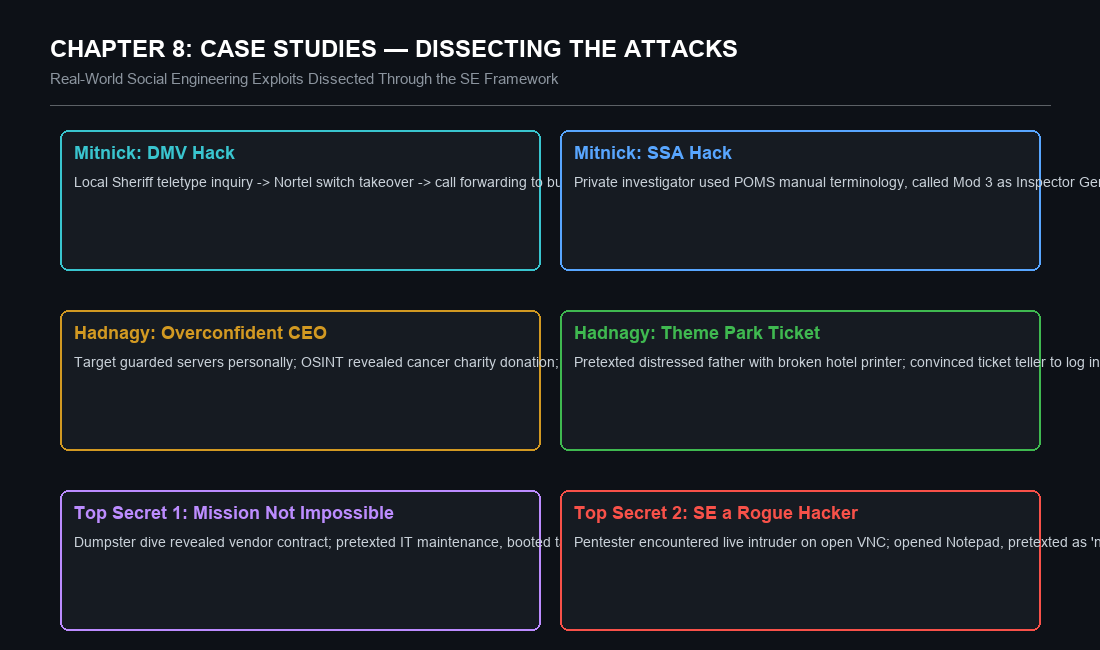
1. Kevin Mitnick Case Study 1: Hacking the DMV
In his book The Art of Deception, Kevin Mitnick recounts the story of “Eric”, who wanted unrestricted access to law enforcement driver’s license databases:
1
2
3
4
5
6
7
8
9
10
11
12
13
14
15
  [ Local Sheriff's Office ]
                Pretext: "Al" calling from an internal extension
                Obtains unlisted law enforcement direct line to DMV

  [ DMV Telecom PBX Desk ]
                Pretext: Nortel Texas Technical Assistance
                Obtains remote dial-in number for DMS-100 switch

  [ Switch Takeover & Call Forwarding ]
                Guesses default password: "update"
                Programs Line 18 in 19-line hunt group to forward to burner phone

  [ Active Exploitation ]
                Police Detectives call DMV for Soundex record checks --> Rings Eric's Cell Phone
                Eric harvests Detective Badges, Agencies, & PII --> Feigns terminal crash
The Breakdown
- Information Gathering: Eric leveraged public operators and police teletype desks to obtain internal numbers. When questioned (“Who are you?”), he gave a confident fake name and a plausible 4-digit extension, relying on the officer’s assumption that an external caller wouldn’t have access to the teletype desk.
- Pretexting: Impersonating a vendor technician allowed him to bypass technical verification.
- The Exploit: By capturing police badge numbers and requester codes, Eric obtained credentials that allowed him to query DMV systems with total legitimacy for months.
2. Kevin Mitnick Case Study 2: Hacking the Social Security Administration (SSA)
A private investigator named Keith Carter was hired to locate hidden assets of a wealthy businessman (“Joe Johnson”) during contentious divorce proceedings:
- Information Gathering via Public Manuals: Keith located the SSA’s internal Program Operations Manual System (POMS) online, memorizing proprietary terms: alphadent (alphabetical search), numident (numerical search), and DEQY (Detailed Earnings Query).
- Obtaining Internal Extensions: Keith called the public SSA number:
“Hi, this is Gregory Adams, District Office 329. I’m trying to reach a claims adjuster who handles accounts ending in 6363; my number goes to fax.”
Operator: “Oh, that is Mod 3, the direct number is…” - The Multi-Layered Pretext: Keith called Mod 3 directly:
“Ms. Wang, this is Arthur Arondale in the Office of the Inspector General… A new analyst is using my computer for a priority audit. Can you help me with a quick inquiry on MCS?”
- The Harvest: Speaking fluent internal jargon, Keith asked for an alphadent on Joseph Johnson, obtained his Social Security Number, ran a numident to extract mother’s maiden name and birth location, and finished with a DEQY revealing exact 2001 earnings ($190,286 from Johnson MicroTech).
SE Principle: Speaking the exact dialect and bureaucratic jargon of an organization disarms suspicion instantly. The clerk never questioned whether Arthur Arondale was real because outsiders do not know what a “DEQY” or “numident” is.
3. Hadnagy Case Study 1: The Overconfident CEO
Hadnagy was contracted to audit a regional printing firm. In an initial conference call, the CEO arrogantly declared:
“Hacking me would be next to impossible because I guard these secrets with my life; not even my core staff have server passwords.”
The Attack Progression
- OSINT with Maltego: Hadnagy discovered the corporate email format was
first.last@company.com, but the CEO’s email failed. Tryingchuck.jones@company.comsucceeded. - Metadata Extraction: Maltego parsed public files on the corporate server, uncovering an Excel invoice (
InvoiceApril.xls) for a $3,500 sponsorship to the annual Children’s Cancer Fund Drive. - Telephone Reconnaissance: Hadnagy called the bank marketing coordinator and the company’s internal marketing director to confirm that the CEO personally cared about the charity because a relative had battled illness.
- Target Profile: Maltego revealed the CEO was from New York, was an avid NY Mets fan, and frequently ate at Domingoes restaurant, loving their Chicken Portabella and Fra Diablo.
- The Execution: On Friday at 4:00 PM (30 minutes before weekend closing), Hadnagy placed the call:
- Pretext: “Tony” from the Cancer Research Institute of America, running an annual raffle. Small donations were entered to win two Mets tickets and dinner at Domingoes.
- Rapport Building: When the CEO expressed surprise, Hadnagy built instant rapport by discussing the restaurant’s dishes and Mets games.
- The Payload: Hadnagy offered to email a verification PDF. He casually asked: “What version of Adobe Reader do you have so I ensure compatibility?” “8.04.”
- Hadnagy sent a weaponized PDF containing a Meterpreter buffer overflow payload. The CEO double-clicked it, Adobe crashed, and a reverse shell connected back to Hadnagy’s workstation on port 443.
- While the CEO stepped away for a minute to refill his coffee mug, Hadnagy established persistent backdoor access. Within hours, the proprietary server passwords were exfiltrated.
4. Hadnagy Case Study 2: The Theme Park Ticket Window
Hadnagy was tasked with testing the physical and social security of an amusement park ticketing infrastructure:
- Onsite Reconnaissance: Buying a ticket at the booth, Hadnagy chatted with the teller, noticed the computer screens, and verified that ticketing terminals had unrestricted outbound internet connectivity.
- Software Discovery: A phone call to the procurement department revealed staff workstations were running Adobe Reader version 8.
- The Pretext: Hadnagy brought his family to the park. While his daughter stood visibly waiting, Hadnagy approached teller Tina looking stressed and sheepish:
“Tina, I really need your help so I don’t win the ‘Loser Dad of the Year’ award. We bought our park tickets online at the hotel to save 15%, but the hotel printer broke down. I emailed the receipt PDF to myself. Could you please log into my webmail and print it out so my daughter isn’t disappointed?”
- The Breach: Overcome with empathy, Tina navigated to Gmail, logged into the account, and double-clicked
Receipt.pdf. The malicious payload executed silently, giving Hadnagy’s remote partner direct shell access to the terminal handling credit card transactions.
5. Top-Secret Case 1: “Mission Not Impossible” (Physical Infiltration)
A penetration tester named “Tim” was contracted to infiltrate air-gapped corporate servers containing proprietary intellectual property:
- Dumpster Diving Reconnaissance: Tim called the facilities department claiming to be a sales rep from a competing waste company. He learned the exact pickup schedule (Wed/Thu) and the name of the current vendor (Wasters Management).
- The Physical Pretext: Tim ordered a custom polo shirt embroidered with the Wasters Management logo. On Tuesday evening, wearing the shirt and holding a clipboard, he told the security gatekeeper:
“Joe, I’m John from Wasters; your office called yesterday reporting a damaged dumpster. I need to inspect it before tomorrow’s pickup.”
- The Infiltration: Buzzed through the gate, Tim loaded discarded office trash bags into his trunk. Sifting through the paper revealed a coffee-stained contract naming an upcoming IT infrastructure upgrade starting Wednesday evening.
- The Facility Breach: The next night, Tim arrived as the outside IT contractors entered, carried paperwork from his car, and got buzzed in. He used a shove knife to slip the latch of an administrator’s office.
- The Virtual Machine Exploit:
- Inserted a bootable BackTrack USB key into the rear of the admin’s desktop.
- Booted into Linux and launched VirtualBox in full-screen mode, configuring the local Windows hard drive as the virtual media.
- Windows booted normally into the admin’s login screen inside the VM.
- A hardware keysniffer captured the administrator’s password when they logged in the next morning.
- Tim accessed the proprietary servers remotely and extracted the entire database.
6. Top-Secret Case 2: Social Engineering a Rogue Hacker Over Notepad
During a network penetration test, an ethical tester named “John” discovered an open, unauthenticated VNC server on an internal workstation. While documenting the vulnerability, the mouse cursor suddenly began moving on its own.
An unauthorized external intruder was actively exploring the client’s network.
Instead of terminating the connection or alerting the intruder, John took a calculated risk. He opened Windows Notepad and initiated a live conversation:
1
2
3
4
5
6
7
8
9
10
11
12
13
14
15
16
17
18
19
[ NOTEPAD LIVE LOG ]
John:      whats up?
Intruder:  hehe, just looking around
John:      yeah, me too. Anything good?
Intruder:  you're a "hacker" too? U was just looking for unsecured VNC servers...
John:      I was looking for something easy. This was easy. You see anything else?
Intruder:  Didn't find anything else of interest here, most is secured pretty good...
           I wrote the "VNC finder" myself btw...
John:      Wow. What did you write it in? Can I dl it? Do you have a handle?
Intruder:  It's written in PureBasic... maybe I can share it anyway, I could upload
           the code somewhere and let you compile it...
John:      Thats cool. you can put it in that pastebin site from irc...
Intruder:  http://pastebin.ca/1273205
           btw... that is kinda very in the "alpha" stage...
John:      Cool. Do you have a handle? I go by jack_rooby
Intruder:  My email is: intruder@hotmail.com
           Send me a message or whatever and I can add you on msn maybe...
           I'm from Norway actually, hehe, I have relatives in Denmark...
           I'm 16, still in school...
The Analytical Masterclass
By adopting the humble pretext of an inexperienced “n00b” hacker, John fed the intruder’s ego. Within 15 minutes of casual chatting in Notepad, John extracted:
- The intruder’s custom source code on Pastebin.
- His personal Hotmail address and MSN Messenger handle.
- His geographic location (Norway) and age (16).
- The precise attack vector used to discover the host.
The intruder believed he had made a friend; the client received a comprehensive incident response dossier that eliminated the threat permanently.
Series Navigation
| Previous Chapter | Current Chapter | Next Chapter |
|---|---|---|
| Chapter 7: The Tools of the Social Engineer | Chapter 8: Real-World Case Studies | Chapter 9: Prevention & Mitigation |
Next in the Series: Chapter 9 (Final Chapter) Preview
In the final installment, Chapter 9: Prevention and Mitigation, we will synthesize the entire book into an actionable defensive blueprint:
- The 6 pillars of building an organizational security awareness culture.
- Developing non-punitive employee verification scripts.
- Managing information valuation and software patch lifecycles.
- How to scope, conduct, and learn from ethical social engineering audits.
Ready to conclude the series? Read Chapter 9: Prevention & Mitigation
References & Authoritative Reading
- Hadnagy, Christopher. Social Engineering: The Art of Human Hacking. Chapter 8: Case Studies. Wiley, 2011.
- Mitnick, Kevin D., & Simon, William L. The Art of Deception: Controlling the Human Element of Security. Chapter 4: “The Reverse Sting.” Wiley, 2002.
- Social Security Administration (SSA). Program Operations Manual System (POMS). Official Government Repository.
- Kennedy, Dave. FastTrack & Social-Engineer Toolkit Case Studies. TrustedSec.
Let’s Connect
Which of these six case studies surprised you the most? Have you ever had to perform incident response or social engineer an active intruder?
- Abdulrahman Mohamed
This technical content and everything shared across this blog is dedicated with sincere intention to serve as enduring, beneficial knowledge (علم يُنتفع به) and an ongoing charity (صدقة جارية). If you find value in this research, please remember me and my family in your sincere prayers.