eCPPT Deep-Dive: Part 1 - System Security & x86 Assembly Fundamentals
An exhaustive technical breakdown of Part 1 of the eCPPT curriculum: x86 processor architecture, IA-32 register sets, process virtual memory layout, stack frame mechanics (EBP/ESP), and calling conventions (__cdecl, __stdcall, __fastcall).
Welcome to the inaugural article of our comprehensive, production-grade masterclass covering the eCPPT (eLearnSecurity Certified Professional Penetration Tester) curriculum by INE Security. Rather than providing superficial slide summaries, this series deconstructs offensive tradecraft from the lowest architectural layers of computer hardware to advanced enterprise Active Directory attacks, multi-tier pivoting, and evasive command-and-control operations.
In this first installment, we dissect the foundational pillars of System Security and x86 Assembly Language. Mastering the execution cycle of the central processing unit (CPU), memory virtualization, stack frame mechanics, and compiler calling conventions is an absolute prerequisite for binary exploitation, custom exploit development, and bypassing modern operating system mitigations.
Key Takeaways
- Processor Architecture: The Central Processing Unit (CPU) executes code via a continuous hardware cycle: Fetch (retrieving instructions from the address pointed to by
EIP), Decode (parsing opcodes and operands), and Execute (performing ALU operations, branch jumps, or memory reads/writes). - IA-32 Architecture Registers: 32-bit x86 systems feature 8 general-purpose registers (
EAX,EBX,ECX,EDX,ESI,EDI,ESP,EBP), the critical instruction pointer (EIP), and the processor status word register (EFLAGS). - Process Virtual Memory Layout: In a 32-bit protected mode process, 4 GB of addressable space is segmented into the Code (
.text) segment, Initialized Data (.data), Uninitialized Data (.bss), the dynamically growing Heap (grows toward higher memory addresses), and the Call Stack (grows downward toward lower memory addresses). - Stack Frame Lifecycle: Subroutine boundaries are created and torn down via the standard Function Prologue (
push ebp; mov ebp, esp; sub esp, X) and Function Epilogue (mov esp, ebp; pop ebp; ret). Overwriting theSaved EIPon the stack allows an attacker to hijack the instruction pointer upon return. - Calling Conventions: In
__cdecl, the caller cleans the stack; in__stdcall, the callee cleans its own stack arguments viaret X; in__fastcall, leading arguments are passed directly within CPU registers (ECX,EDX) for maximum execution speed. - Byte Ordering (Endianness): The x86 architecture is strictly Little-Endian; multibyte numerical values and memory addresses are stored in memory with the Least Significant Byte (LSB) at the lowest memory address.
1. CPU Internals and the Instruction Execution Cycle
The Central Processing Unit (CPU) is the core computational engine of any modern computer system. To construct reliable exploits, an offensive security researcher must maintain an exact mental model of how instructions travel through silicon pipelines.
flowchart LR
    subgraph CPU ["Central Processing Unit (CPU)"]
        CU["Control Unit (CU)<br/>• Instruction Decoder<br/>• Microcode Sequencer"]
        ALU["Arithmetic Logic Unit (ALU)<br/>• Integer Operations (+, -, *, /)<br/>• Bitwise Logic (AND, OR, XOR)"]
        REG["Register File<br/>• General Purpose (EAX..EDX)<br/>• Pointers (ESP, EBP, EIP)<br/>• Flags (EFLAGS)"]
    end

    BUS["System Bus (Control, Address, Data Buses)"]
    RAM[("Physical RAM & Virtual Memory Pages")]

    CPU <--> BUS <--> RAM
The CPU executes compiled machine instructions through three continuous, microarchitectural phases:
- Instruction Fetch (IF): The Control Unit references the address currently stored in the Instruction Pointer (
EIP), transmits a read request across the memory address bus, and fetches the machine code bytes into the instruction queue. - Instruction Decode (ID): The decoder translates binary opcodes into discrete CPU control signals, determines operand addressing modes (immediate values, register contents, or memory dereferences), and prepares execution pipelines.
- Execution (EX): The ALU performs arithmetic or bitwise manipulations, updates the status condition bits in
EFLAGS, and commits results to target registers or memory locations. Finally,EIPis incremented to reference the next instruction in sequence.
2. IA-32 Architecture Register File Breakdown
In 32-bit x86 architecture, the CPU provides 8 primary registers, each 32 bits (4 bytes) wide. To maintain backward compatibility with 16-bit 8086 and 8-bit 8080 processors, the lower portions of several registers can be addressed independently:
classDiagram
    class EAX {
        32-bit: EAX (Bits 0-31)
        16-bit: AX (Bits 0-15)
        8-bit High: AH (Bits 8-15)
        8-bit Low: AL (Bits 0-7)
    }
    class EBX {
        32-bit: EBX (Bits 0-31)
        16-bit: BX (Bits 0-15)
        8-bit High: BH (Bits 8-15)
        8-bit Low: BL (Bits 0-7)
    }
    class ECX {
        32-bit: ECX (Bits 0-31)
        16-bit: CX (Bits 0-15)
        8-bit High: CH (Bits 8-15)
        8-bit Low: CL (Bits 0-7)
    }
    class EDX {
        32-bit: EDX (Bits 0-31)
        16-bit: DX (Bits 0-15)
        8-bit High: DH (Bits 8-15)
        8-bit Low: DL (Bits 0-7)
    }
General-Purpose Registers and Architectural Conventions:
EAX(Accumulator Register): Used natively for arithmetic computations, logical comparisons, and storing function return values upon exit from a subroutine.EBX(Base Register): Historically utilized as a base pointer for memory data segmentation; frequently utilized by compilers as a persistent scratchpad register across loops.ECX(Counter Register): Serves as the dedicated architectural loop and string counter. Instructions such asLOOP,REP MOVS, and shift operations (SHL,SHR) natively decrement or referenceCL/ECX.EDX(Data Register): Serves as an extension ofEAXduring large multiplication and division instructions (such asMULandDIV), storing high-order bits of 64-bit mathematical results.ESI(Source Index Register): Serves as the source memory pointer in bulk block memory and string transfer operations (MOVSB,LODSB).EDI(Destination Index Register): Serves as the destination pointer in bulk memory copy operations (MOVSB,STOSB).
Stack and Control Registers:
ESP(Extended Stack Pointer): Points to the current top of the call stack (the lowest numerical address currently utilized by active stack data). Its value is modified automatically byPUSH,POP,CALL, andRETinstructions.EBP(Extended Base Pointer / Frame Pointer): Remains static throughout the lifetime of a function call, anchoring the base of the current stack frame. Local variables ([ebp - offset]) and function parameters ([ebp + offset]) are indexed relative toEBP.EIP(Extended Instruction Pointer): Contains the absolute virtual memory address of the next instruction waiting to be fetched and executed by the CPU. ControllingEIPis the holy grail of memory corruption exploitation.
Status and Control Flags (EFLAGS):
The EFLAGS register contains 32 single-bit condition flags updated automatically by comparison and arithmetic instructions:
| Flag | Name | Semantic Trigger | Exploitation Relevance |
|---|---|---|---|
ZF | Zero Flag | Set to 1 if an ALU operation yields zero (e.g., CMP EAX, EAX). | Governs conditional jumps like JE (Jump if Equal) and JZ. |
CF | Carry Flag | Set to 1 if an arithmetic operation causes an unsigned overflow. | Detects unsigned integer wrap-around vulnerabilities. |
SF | Sign Flag | Set to 1 if the most significant bit (MSB) of the result is 1 (negative). | Governs signed conditional jumps (JL, JLE). |
OF | Overflow Flag | Set to 1 if signed integer operations exceed register capacity. | Critical for signed integer overflow and underflow exploitation. |
3. Process Virtual Memory Architecture
In a 32-bit x86 operating system (Windows or Linux), every running process is allocated an isolated 4 Gigabyte virtual address space spanning from 0x00000000 to 0xFFFFFFFF. The Operating System Kernel and Memory Management Unit (MMU) use page tables to map these virtual addresses to physical RAM:
flowchart TD
    subgraph VirtualMemory ["32-bit Process Virtual Memory Space (4 GB)"]
        direction TB
        KernelSpace["0xFFFFFFFF<br/>Kernel Land (1 GB on Linux / 2 GB on Windows)<br/>Privilege Level Ring 0 (Hardware, Drivers, Syscalls)"]
        StackSegment["0xBFFFFFFF<br/>Stack Segment (Call Frames, Locals, Return Addresses)<br/>[Grows Downward to Lower Addresses]"]
        Unallocated["Free Unmapped Memory Space<br/>(Guard Pages / Dynamic Virtual Allocations)"]
        HeapSegment["0x08048000<br/>Heap Segment (Dynamic Memory: malloc, HeapAlloc, new)<br/>[Grows Upward to Higher Addresses]"]
        BSSSegment["Uninitialized Data Segment (.bss)<br/>Global & Static variables initialized to 0"]
        DataSegment["Initialized Data Segment (.data)<br/>Global variables with predefined values (e.g. char *str = 'hello')"]
        TextSegment["0x08048000 (Linux) / 0x00400000 (Windows)<br/>Text Segment (.text)<br/>Compiled Assembly Machine Code (Read & Execute ONLY)"]
        NullPage["0x00000000<br/>NULL Pointer Trap Page (Non-readable / Non-writable)"]
    end

    KernelSpace --- StackSegment --- Unallocated --- HeapSegment --- BSSSegment --- DataSegment --- TextSegment --- NullPage
Segment Characteristics:
- Text Segment (
.text): Contains executable binary instructions. Compilers mark this segment as Read-Only and Executable (R-X) to prevent code self-modification during execution. - Data Segment (
.data): Stores initialized global and static variables allocated prior to runtime. - BSS Segment (
.bss): Stores uninitialized global variables. When the program binary loads, the kernel zero-fills this entire memory page. - Heap (
Heap): Dynamically allocated memory requested at runtime via API calls (malloc,calloc,HeapAlloc). It expands upward from lower memory addresses toward higher addresses. - Stack (
Stack): Fast, compiler-managed contiguous memory that allocates local function variables, preserves return addresses, and orchestrates subroutine execution. It expands downward from higher memory addresses toward lower addresses.
4. Stack Anatomy, Stack Frames, and Call Mechanics
The stack operates strictly as a LIFO (Last In, First Out) data structure. The pointer register ESP tracks the current top of the stack:
1
2
3
4
5
6
7
8
9
10
11
12
13
14
15
High Memory Addresses (0xBFFFFFFF)
+---------------------------------------+
| Function Parameter 2 (Arg2)           | [ebp + 12]
+---------------------------------------+
| Function Parameter 1 (Arg1)           | [ebp + 8]
+---------------------------------------+
| Return Address (Saved EIP)            | [ebp + 4]  <-- Pushed by CALL
+---------------------------------------+
| Saved Frame Pointer (Old EBP)         | [ebp]      <-- Pointed to by EBP
+---------------------------------------+
| Local Variable 1 (char buffer[64])    | [ebp - 4]  ... [ebp - 64]
+---------------------------------------+
| Current Top of Stack (ESP)            | <-- Pointed to by ESP
+---------------------------------------+
Low Memory Addresses (0x00000000)
Subroutine Lifecycle Deconstruction:
When a function executes, the CPU coordinates a standardized set of prologue and epilogue instructions:
1. Function Prologue:
Prior to executing a function’s business logic, the new stack frame is established:
1
2
3
push ebp          ; 1. Preserve the caller's base pointer onto the stack
mov  ebp, esp     ; 2. Establish a new base pointer anchor matching current ESP
sub  esp, 0x40    ; 3. Allocate 64 bytes of local stack memory by decrementing ESP
2. Function Epilogue:
Upon completion, the function tears down its local frame and restores the caller’s context:
1
2
3
mov  esp, ebp     ; 1. Collapse local variable allocations by restoring ESP to EBP
pop  ebp          ; 2. Restore the caller's original base pointer from the stack
ret               ; 3. Pop the saved return address from stack directly into EIP!
[!IMPORTANT] The
retinstruction is mechanically equivalent topop eip. If an attacker overflows a local variable buffer on the stack and overwrites theSaved EIPslot, the instantretexecutes, the CPU unconditionally pivots execution to the attacker-supplied memory address.
5. Comparative Analysis of Calling Conventions
Calling conventions define how compilers serialize function arguments, which registers are preserved across calls, and whether the caller or the callee cleans up the stack:
| Property | __cdecl (C Declaration) | __stdcall (Standard Call) | __fastcall (Fast Register Call) |
|---|---|---|---|
| Primary Domain | Standard C/C++ Linux & GCC Binaries | Microsoft Win32 API (kernel32.dll) | Performance-critical math/graphics libraries |
| Argument Ordering | Right-to-Left (Pushed onto Stack) | Right-to-Left (Pushed onto Stack) | First 2 args in ECX, EDX; rest pushed R-to-L |
| Stack Cleanup Duty | Caller (via add esp, N) | Callee (via ret N) | Callee (via ret N) |
| Variable Arg Support | Supported (e.g., printf(...)) | Not Supported | Not Supported |
Code Comparison:
__cdecl Routine:
1
2
3
4
5
; Invoking add_numbers(10, 20) under __cdecl:
push 20           ; Push second argument
push 10           ; Push first argument
call add_numbers  ; Push return address & jump
add  esp, 8       ; Caller cleans up 8 bytes (2 arguments * 4 bytes)
__stdcall Routine:
1
2
3
4
5
; Invoking add_numbers(10, 20) under __stdcall:
push 20
push 10
call add_numbers  ; The function exits via 'ret 8', self-cleaning the stack
; No 'add esp' is executed by the caller!
6. Endianness: Physical Byte Ordering in Memory
Intel x86 and x64 architectures are strictly Little-Endian. In this memory representation scheme, the Least Significant Byte (LSB) is stored at the lowest numerical memory address, while the Most Significant Byte (MSB) is stored at the highest address.
Consider the 32-bit hexadecimal pointer 0x625011AF:
1
2
3
4
5
6
7
8
Dword Value:          0x 62   50   11   AF
Byte Classification:     MSB  ...  ...  LSB

Physical Memory Placement:
Address 0x0012FB00:   \xaf  (Least Significant Byte)
Address 0x0012FB01:   \x11
Address 0x0012FB02:   \x50
Address 0x0012FB03:   \x62  (Most Significant Byte)
When building an exploit payload targeting an address such as 0x625011AF (e.g., a JMP ESP gadget), the byte sequence must be serialized in reverse order: b"\xaf\x11\x50\x62".
7. Offensive Debugging Environment & Tooling
To inspect memory structures, analyze binary control flow, and trace stack state during exploitation, professional penetration testers rely on standard low-level debuggers:
- Linux: GDB enhanced with plugins such as GEF (GDB Enhanced Features) or PEDA (Python Exploit Development Assistance).
- Windows: x64dbg / x32dbg, Immunity Debugger (with
mona.py), or WinDbg.
Essential GDB/GEF Memory Inspection Commands:
1
2
3
4
5
6
7
8
9
10
11
12
13
14
15
16
17
# Launch a compiled binary in GDB without verbose banners
gdb -q ./vulnerable_elf

# Set a breakpoint at function main
gef> break main

# Execute the binary with arbitrary arguments
gef> run $(python3 -c "print('A'*100)")

# Inspect CPU registers and EFLAGS status
gef> info registers

# Dereference and display 16 dwords on the top of the stack
gef> x/16wx $esp

# Disassemble the next 10 instructions from the instruction pointer
gef> x/10i $eip
Visual Architecture: Process Memory & Stack Frame Layout
The following technical diagram illustrates the complete memory mapping of a 32-bit process alongside the exact layer-by-layer anatomy of a function stack frame:
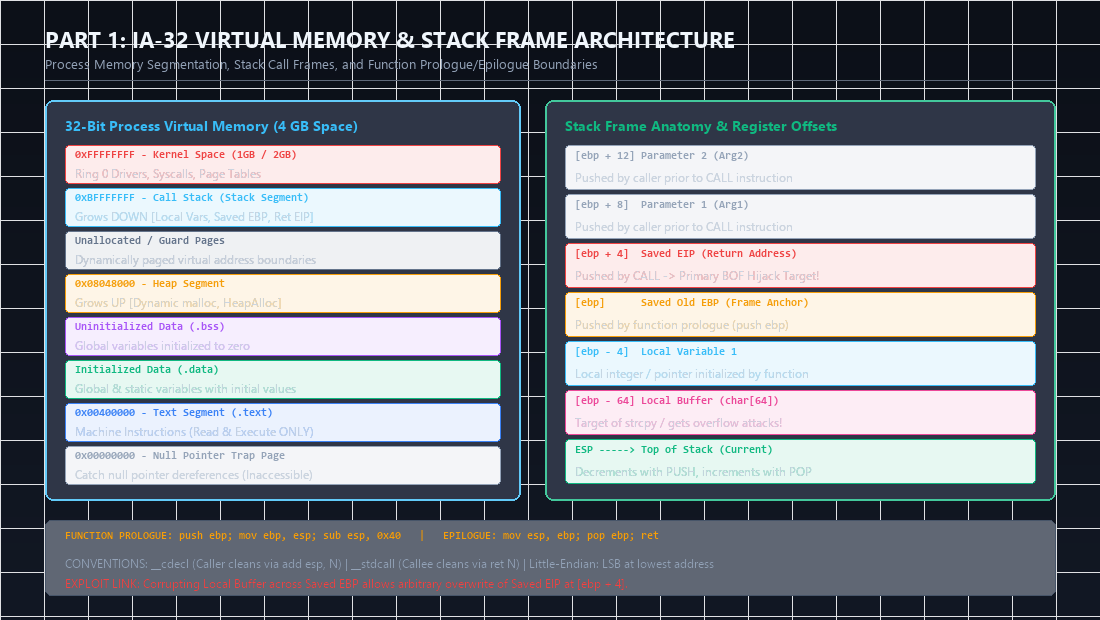
Key Architectural Observations from the Diagram:
- Memory Separation: The 4 GB address space is bifurcated between User Space (
0x00000000to0xBFFFFFFFon Linux, or0x7FFFFFFFon standard Windows) and Kernel Space (0xC0000000to0xFFFFFFFF). User code cannot dereference Kernel page tables without generating an immediateAccess Violation (0xC0000005)fault. - Opposing Memory Growth: The stack expands downward toward lower numerical memory addresses as items are pushed, while the dynamic heap expands upward toward higher memory addresses. This architectural decision preserves maximum contiguous unallocated space for runtime execution.
- The Exploit Bridge: Notice how local variables at
[ebp - X]sit directly adjacent to theSaved EBPandSaved EIPslots at[ebp + 4]. Because memory copy routines write from lower addresses toward higher addresses, any unbounded string copy into the local buffer inherently overwrites the return pointer.
Attack Chain Interconnection: Bridging Assembly to the Penetration Testing Lifecycle
Low-level assembly language and memory architecture are not isolated theoretical concepts; they form the operational foundation of the entire offensive assessment lifecycle:
flowchart LR
    Part1["Part 1: x86 Architecture & Stack Frames"] -->|Direct Foundation| Part2["Part 2: Custom Buffer Overflows & SEH Exploits"]
    Part1 -->|Memory Primitives| Part10["Part 10: In-Memory AMSI Patching via Reflection"]
    Part2 -->|Yields Initial Shell| Part5["Part 5: Local Privilege Escalation (SYSTEM / Root)"]
    Part5 -->|Enables Routing & Injections| Part6["Part 6: Multi-Tier Network Pivoting"]
- Direct Feed into Part 2 (Exploit Development): Understanding that
EIPpoints to the next executable instruction and that the stack pointerESPcan be referenced viaJMP ESPinstructions allows us to calculate exact byte offsets and construct weaponized stack buffer overflows. - Direct Feed into Part 10 (AMSI Evasion): In-memory memory patching techniques (such as replacing
AmsiScanBufferwithmov eax, 0x80070057; ret) require understanding x86/x64 calling conventions and instruction byte opcodes.
Categorized References & Authoritative Sources
1. Official Architecture & Compiler Specifications
- Intel 64 and IA-32 Architectures Software Developer’s Manual: Volumes 1, 2A-2D, and 3A-3D. Intel Corporation Documentation.
- System V Application Binary Interface: Intel386 Architecture Processor Supplement (Fourth Edition).
- Microsoft Learn: x86 Calling Conventions: https://learn.microsoft.com/en-us/cpp/cpp/argument-passing-and-naming-conventions.
2. Seminal Security Research & Whitepapers
- Phrack Magazine Issue 49: Smashing The Stack For Fun And Profit by Aleph One (1996). https://phrack.org/issues/49/14.html.
- OpenSecurityTraining2: Architecture 1001: x86-64 Assembly by Xeno Kovah. https://ost2.fyi/.
3. MITRE ATT&CK Enterprise Techniques
- T1203: Exploitation for Client Execution. https://attack.mitre.org/techniques/T1203/.
- T1055: Process Injection. https://attack.mitre.org/techniques/T1055/.
4. Interactive Practice Labs & Tooling
- GEF (GDB Enhanced Features): Modern debugging environment for exploit developers. https://github.com/hugsy/gef.
- OverTheWire Wargames: Narnia & Protostar: Classic hands-on binary exploitation practice. https://overthewire.org/wargames/narnia/.
Author: Abdulrahman M. Fathi (0x3bdo) • Cyber Security Engineer & Penetration Tester