SAST vs DAST vs IAST vs RASP: AppSec Testing Guide
Compare SAST, DAST, IAST, and RASP, then layer SCA, secrets scanning, IaC, API testing, and ASPM into a practical AppSec program.
Hello everyone,
I hope you’re doing well and having a great day.
If you’ve spent any time in application security or DevSecOps, you’ve almost certainly seen these four acronyms thrown around together: SAST, DAST, IAST, and RASP. Vendors pitch them as competing solutions. Teams argue about which one to buy first. And in practice, most organizations end up confused about what each one actually does — and more importantly, when it should run.
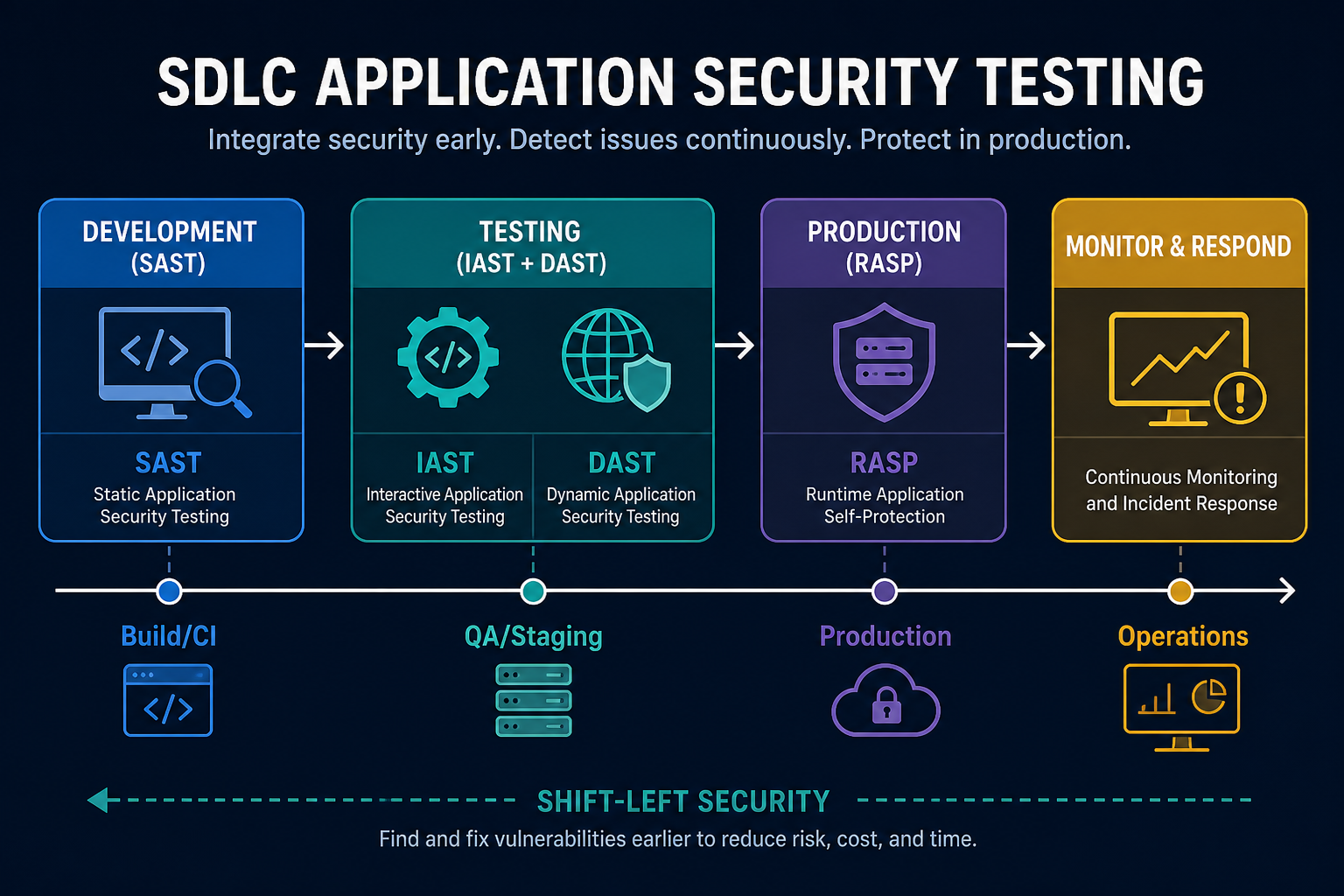
The short answer is that they are not interchangeable. They operate at different stages of the software development lifecycle (SDLC), use different visibility models, and serve different goals. SAST, DAST, and IAST are primarily testing and detection tools. RASP is a runtime protection control. Mature AppSec programs use them together, not instead of each other — and they surround them with composition analysis, secrets controls, infrastructure scanning, API testing, and a way to measure whether risk is actually going down.
In this article, we’ll break down each approach with clear definitions, real-world use cases, trade-offs, and authoritative references from OWASP, NIST, and industry research — then place the four acronyms inside the broader engineering system that real programs actually run.
Let’s get started.
Key Takeaways
- SAST = Static code analysis (shift-left, white-box)
- DAST = Dynamic runtime testing (black-box, external)
- IAST = Instrumented testing (grey-box, high precision)
- RASP = Production protection (real-time blocking)
- Use all four for layered security — they complement, not compete
- Pair them with SCA, secrets scanning, IaC/container scanning, API testing, threat modeling, and ASPM so the rest of the attack surface is not left to chance
Why This Matters
According to the Verizon 2024 Data Breach Investigations Report (DBIR), web application attacks remain one of the most common breach patterns. At the same time, development velocity has never been higher — CI/CD pipelines ship code daily, microservices multiply attack surfaces, and third-party dependencies introduce supply-chain risk.
The challenge is not finding a security tool. The challenge is choosing the right evidence at the right lifecycle stage:
- Before code runs → catch design and coding flaws early
- While the app runs in test → validate real exploitable behavior
- During functional testing → reduce noise with runtime context
- In production → block active exploitation when patches lag behind
That is exactly the gap SAST, DAST, IAST, and RASP were designed to fill — each from a different angle. They still do not, by themselves, cover open-source risk, leaked credentials, cloud misconfiguration, or authorization bugs that only show up in API business logic. Those controls come later in this guide.
Quick Comparison
| Aspect | SAST | DAST | IAST | RASP |
|---|---|---|---|---|
| Full name | Static Application Security Testing | Dynamic Application Security Testing | Interactive Application Security Testing | Runtime Application Self-Protection |
| Primary goal | Find flaws in code/artifacts | Find flaws in running apps | Confirm exploitable paths during tests | Detect and block attacks in production |
| When it runs | Build / CI (shift-left) | Staging / pre-production | Functional / QA testing | Production runtime |
| Visibility | White-box (source/binary) | Black-box (external) | Grey-box (instrumented runtime) | In-app runtime context |
| Source code access | Helpful, not strictly required (source, bytecode, or binaries) | Not required | Helpful for file/line mapping; instrumentation can work without it | Agent only |
| False positives | High without tuning (often cited 30–50%+) | Medium | Low when tests exercise the path (often cited 5–10%) | Low when policies are tuned; poorly tuned rules can block real traffic |
| Can block attacks? | No | No | No | Yes |
| Best for | Early defect prevention | Runtime/config/auth issues | High-confidence triage | Last-line defense |
False-positive ranges and later performance figures are contextual industry estimates, not universal constants. They depend on language, rule packs, test coverage, traffic, and how aggressively the tool is tuned.
Sources: OWASP Developer Guide — Secure Development, OWASP DevSecOps Guideline, NIST SP 800-53 Rev. 5 — SI-7 Software Integrity
1. SAST — Static Application Security Testing
What It Is
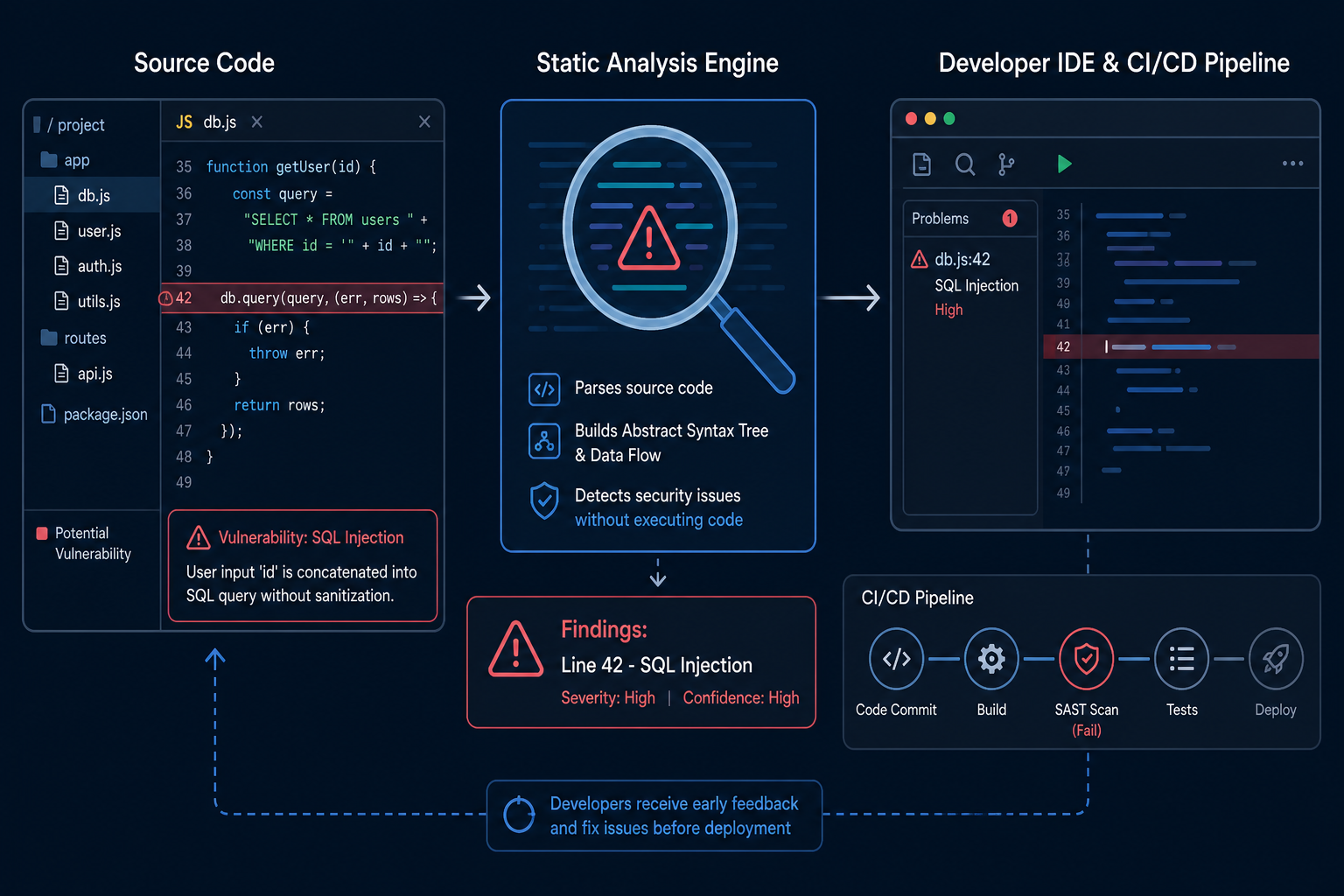
SAST analyzes source code, bytecode, or compiled binaries without executing the application. It is a white-box technique: the scanner has full visibility into the codebase and traces data flows, control flows, and dangerous function usage to identify patterns associated with vulnerabilities.
Think of SAST as a code reviewer that never sleeps — it can inspect every branch, every file, and every commit.
How It Works
SAST engines typically:
- Parse code into an abstract syntax tree (AST)
- Build a model of data flow from sources (user input) to sinks (SQL queries, shell commands, file writes)
- Match patterns against known vulnerability rules (CWE mappings, OWASP Top 10 categories)
- Report findings with file names and line numbers
Integration points include the IDE (pre-commit), pull request gates, and nightly build scans. The OWASP Developer Guide describes SAST as analyzing code without running it, making it one of the core automated testing types in modern DevSecOps pipelines.
What SAST Finds Well
- SQL injection sinks without proper sanitization
- Cross-site scripting (XSS) via unescaped output
- Hardcoded credentials and API keys (a dedicated secrets scanner is still better at git history, provider verification, and rotation)
- Weak cryptographic algorithms
- Path traversal and unsafe deserialization patterns
- Missing input validation at the code level
Limitations
- High false positive rates — static analysis cannot always determine whether sanitization or framework protections make a sink safe
- No runtime context — cannot detect misconfigured servers, broken auth flows, or environment-specific issues
- Language and framework dependency — tool coverage varies significantly across stacks
- Cannot confirm exploitability — a flagged sink may never receive attacker-controlled input in production
When to Use SAST
- Shift-left security in CI/CD pipelines
- Enforcing secure coding standards on every pull request
- Auditing legacy codebases where documentation is sparse
- Mapping findings to CWE/OWASP categories for compliance reporting
2. DAST — Dynamic Application Security Testing
What It Is
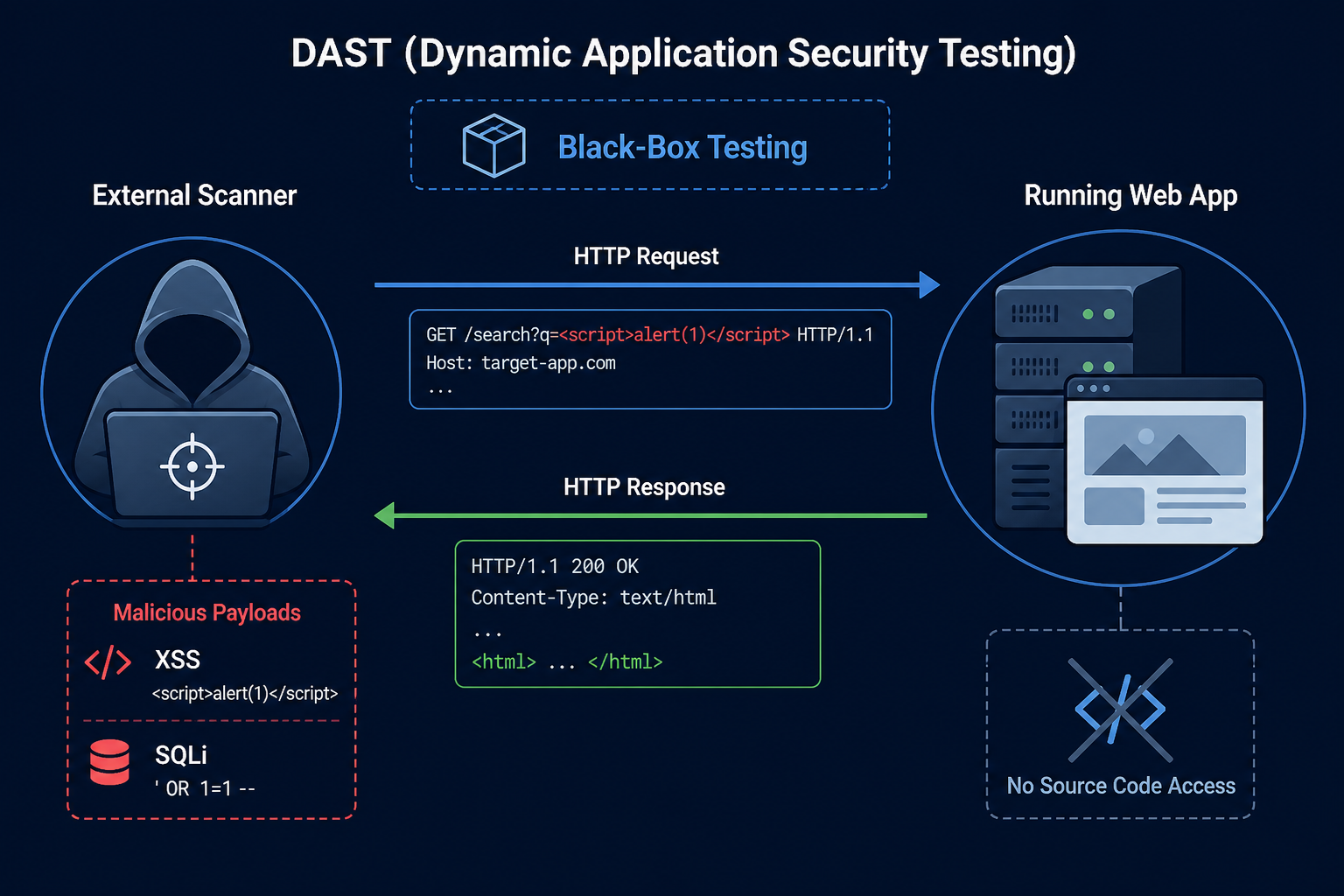
DAST tests a running application from the outside, simulating real attacker behavior. It is black-box testing: no source code access is required. The scanner crawls reachable endpoints, sends crafted payloads, and analyzes HTTP responses to infer vulnerabilities.
As the OWASP Developer Guide on DAST explains, DAST tools detect vulnerabilities by actually performing attacks against the web front-end, rather than analyzing source code statically.
How It Works
A typical DAST scan involves:
- Discovery — crawl the application, map endpoints, forms, and API routes
- Authentication — handle login flows, session cookies, and token-based auth
- Fuzzing — inject payloads for SQLi, XSS, SSRF, command injection, and more
- Analysis — evaluate response codes, timing differences, error messages, and content reflection
Because DAST interacts with the live application, it validates what an external attacker can actually reach and exploit.
What DAST Finds Well
- Missing security headers (CSP, HSTS, X-Frame-Options)
- SSL/TLS misconfigurations
- Authentication and session management flaws
- Server-side injection vulnerabilities that produce observable responses
- Exposed debug endpoints and default credentials
- CORS misconfigurations and information disclosure
Limitations
- Coverage is bounded by reachability — unlinked endpoints, complex auth flows, and business logic flaws are often missed. Authorization bugs such as BOLA are a common gap unless you add API-specific tests.
- Runs late in the SDLC — findings discovered in staging cost more to fix than SAST findings in development
- No code-level pinpointing — reports the vulnerable URL, not the exact line of code
- Environment dependent — results vary based on test data, configuration, and deployment state
The OWASP DevSecOps Guideline on DAST notes that DAST is especially effective for input/output validation issues, authentication problems, and server configuration mistakes.
When to Use DAST
- Pre-release security validation in staging environments
- External-facing web applications and APIs
- Compliance assessments requiring black-box testing evidence
- Verifying that SAST findings are actually exploitable at runtime
3. IAST — Interactive Application Security Testing
What It Is
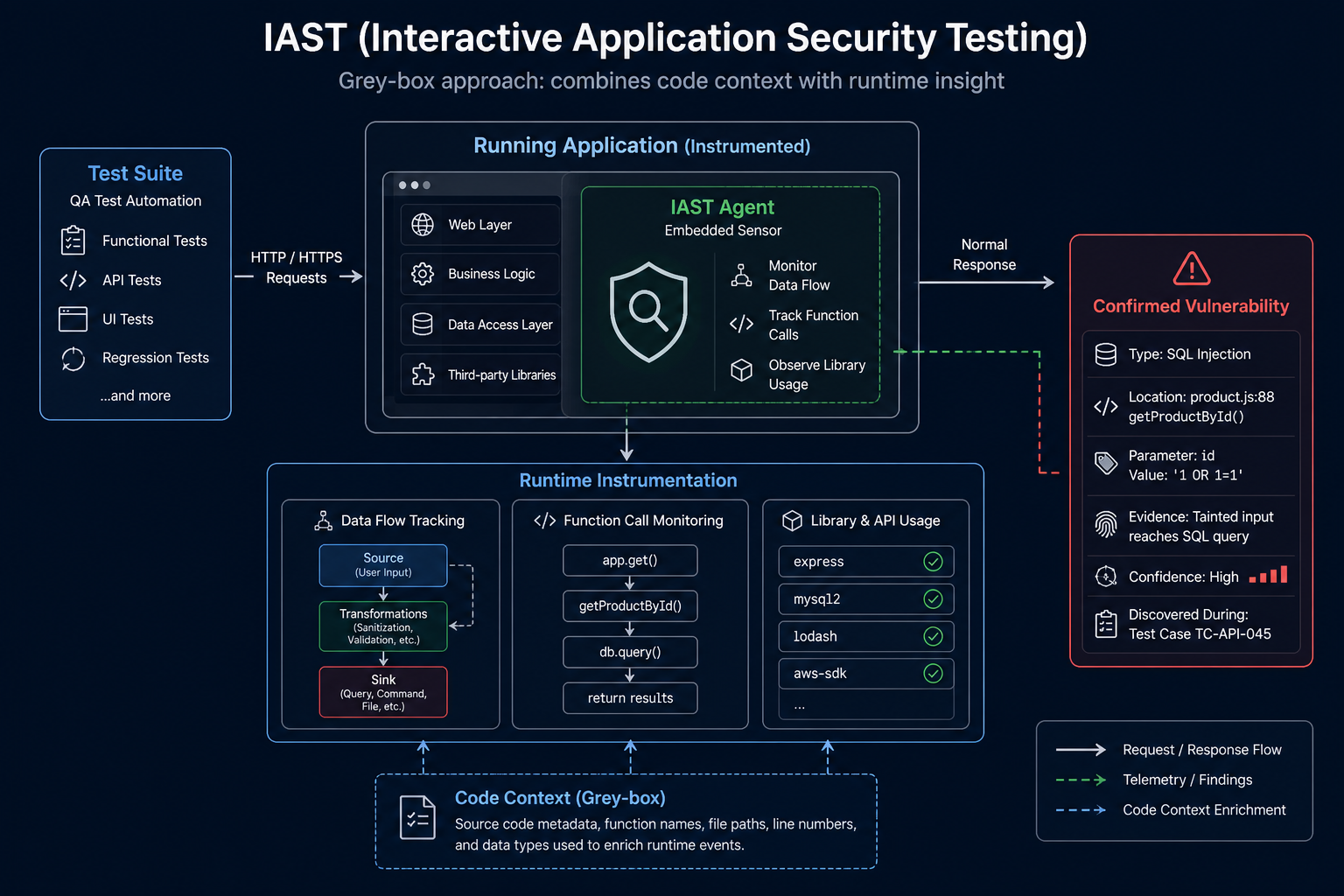
IAST sits between SAST and DAST. It instruments the running application with an agent that monitors code execution, library calls, and data flow while functional or automated tests run. This grey-box approach combines SAST’s code visibility with DAST’s runtime context. Source access improves file and line mapping, but IAST does not always need it — instrumentation can still observe executed paths at runtime.
The OWASP Developer Guide describes IAST as providing instant feedback during testing, designed to run both manually and as part of automated pipelines.
How It Works
During a test session:
- An IAST agent is deployed alongside the application (in-process or as a sidecar)
- QA engineers or automated test suites exercise normal user flows
- The agent observes which code paths execute, tracking tainted data from input to sink
- When a dangerous pattern is confirmed on an executed path, IAST reports it with full code context
Because IAST only flags vulnerabilities on paths that tests actually trigger, false positive rates are usually much lower than SAST — often cited in the 5–10% range, depending on tests and tuning.
What IAST Finds Well
- Confirmed SQL injection on exercised code paths
- XSS with verified taint propagation
- Insecure deserialization triggered by test inputs
- Vulnerable third-party library calls during runtime
- Authentication bypasses reachable through tested flows
Limitations
- Coverage equals test coverage — if your test suite never hits an endpoint, IAST won’t either
- Deployment complexity — requires agent installation and configuration per runtime
- Performance overhead during test execution
- Not a replacement for DAST — IAST depends on internal test traffic, not external attacker simulation
When to Use IAST
- Mature CI/CD pipelines with solid automated test coverage
- Reducing SAST false positive triage burden
- Security gates before release with high-confidence findings
- Teams that need both file/line context and runtime confirmation
4. RASP — Runtime Application Self-Protection
What It Is
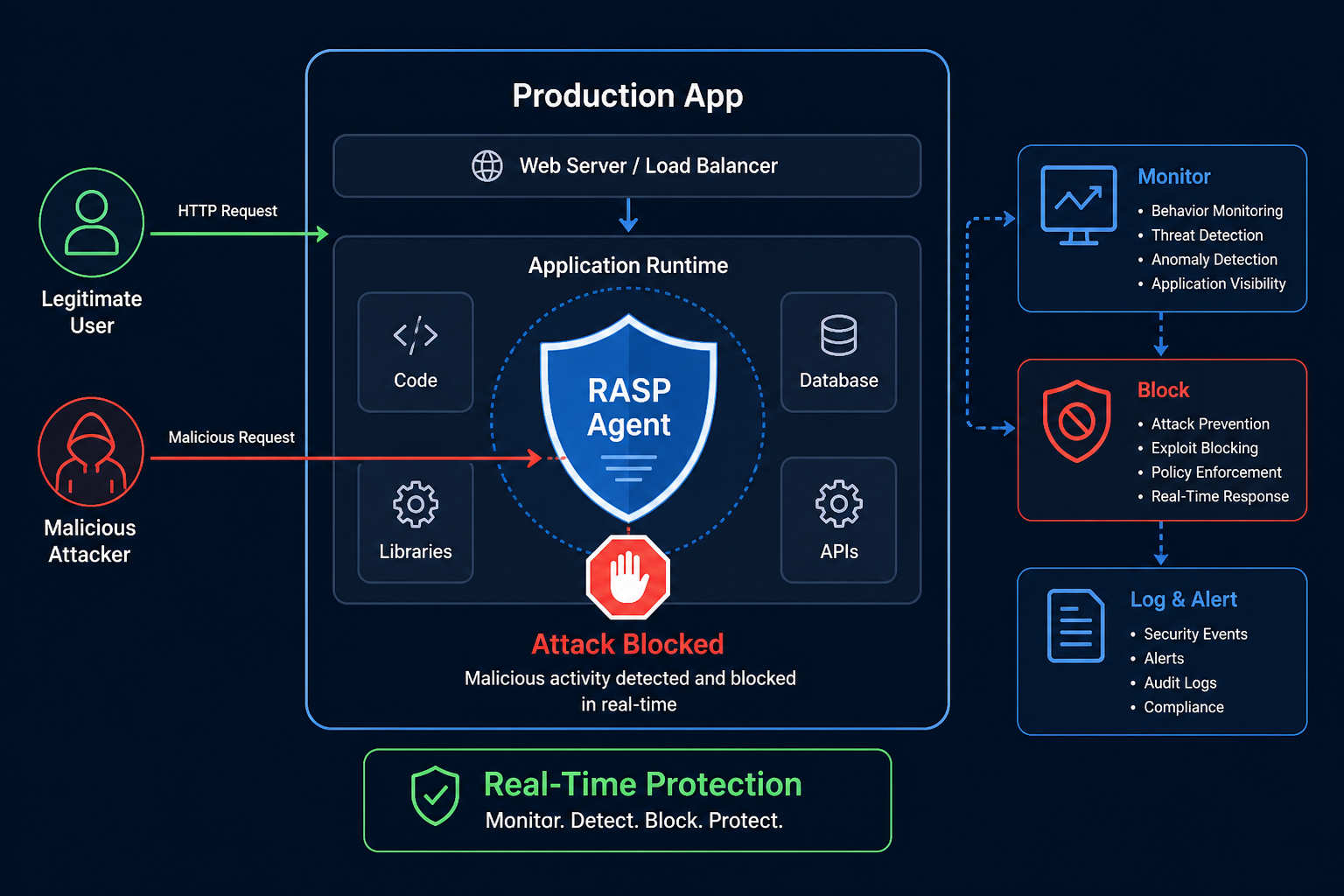
RASP is fundamentally different from the other three. It is not a testing tool — it is a production security control embedded inside the application’s runtime. RASP monitors live traffic, detects malicious behavior using in-app context, and can block attacks in real time.
NIST SP 800-53 Rev. 5 includes controls for software integrity and runtime protection, reflecting the growing recognition that detection alone is insufficient when patches cannot be deployed immediately.
How It Works
A RASP agent typically:
- Hooks into the application runtime (JVM, .NET CLR, Node.js, etc.)
- Monitors sensitive operations — database queries, file access, deserialization, reflection
- Applies policy rules to detect attack patterns (SQLi, command injection, path traversal)
- Takes action: block the request, terminate the session, alert SOC, or log for forensics
RASP operates with full runtime context — it knows the current user, the call stack, and the actual query being executed. This enables behavioral detection that can stop zero-day exploitation even before a CVE is published.
What RASP Protects Against
- SQL injection and NoSQL injection at the query layer
- Command injection and OS command execution
- Path traversal and arbitrary file access
- Deserialization attacks
- Known and unknown exploitation attempts (behavioral blocking)
Limitations
- Does not fix the underlying vulnerability — it mitigates exploitation, not root cause
- Performance overhead in production — often estimated around 3–15%, but the real cost depends on runtime, traffic, instrumentation depth, and policy complexity
- Language/runtime coverage varies — not all stacks have mature RASP support
- Risk of bypass — determined attackers may find evasion techniques if policies are poorly tuned
- Fail-open vs fail-closed decisions — operational policy must be carefully defined
When to Use RASP
- High-risk production applications that cannot be patched immediately
- Legacy systems where code changes are expensive or impossible
- Defense-in-depth alongside WAF and secure coding practices
- Zero-day protection while remediation is in progress
How They Fit Together in the SDLC
The most effective AppSec strategies layer these controls sequentially across the development lifecycle:
1
2
3
4
5
6
7
8
9
10
11
┌──────────────────────────────────────────────────────────────────────────────┐
│                        SOFTWARE DEVELOPMENT LIFECYCLE                        │
├────────────┬─────────────┬──────────────┬──────────────┬─────────────────────┤
│    PLAN    │    CODE     │    BUILD     │     TEST     │    DEPLOY / RUN     │
├────────────┼─────────────┼──────────────┼──────────────┼─────────────────────┤
│ Threat     │ Secrets     │ SBOM         │ IAST         │ WAF (edge)          │
│ modeling   │ (pre-commit │ Container    │ DAST         │ RASP (in-app)       │
│            │  + PR)      │ scan         │ API tests    │ Runtime telemetry   │
│            │ SAST + SCA  │              │ Pentest      │                     │
│            │ IaC scan    │              │              │                     │
└────────────┴─────────────┴──────────────┴──────────────┴─────────────────────┘
The four core tools still sit on that timeline — SAST early, IAST during tests, DAST against a running build, RASP in production — but they are no longer the only evidence sources.
Recommended Layering Strategy
| Phase | Control | Purpose |
|---|---|---|
| Design | Threat modeling | Find architectural flaws before they become code |
| Pre-commit / PR | Secrets + SAST + SCA + IaC | Stop credentials, coding flaws, bad dependencies, and cloud misconfig before merge |
| Build | SBOM + container scan | Record what shipped and scan image layers |
| QA / Staging | IAST + DAST + API security tests | Confirm exploitability with tests, external scans, and authorization checks |
| Pre-release | Risk-based gates + pentest as needed | Block high-confidence, high-severity issues; exercise business logic |
| Production | WAF + RASP + monitoring | Edge filtering, in-app blocking, detection, and response |
The OWASP DevSecOps Guideline provides a comprehensive overview of how SAST, DAST, IAST, and SCA fit into CI/CD pipeline steps — and emphasizes that no single tool covers the full attack surface.
Common Mistakes to Avoid
1. Treating Them as Either/Or
SAST alone misses runtime misconfigurations. DAST alone misses unexposed code paths. IAST alone depends on test quality. RASP alone doesn’t fix bugs. Use them together.
2. Running DAST Too Late
If DAST only runs once before a major release, you’ll accumulate expensive findings. Integrate DAST into staging deployments that happen weekly or per-sprint.
3. Ignoring SAST False Positives
High false positive rates cause developer fatigue and tool abandonment. Tune rules, suppress known-safe patterns, and prioritize findings by reachability and severity.
4. Deploying RASP as a Substitute for Secure Development
RASP is a safety net, not a development strategy. A WAF or RASP bypass can still compromise the application if the underlying code remains vulnerable.
5. Skipping IAST Because “We Have SAST and DAST”
IAST’s value is precision. It tells you which SAST findings are actually reachable and which DAST findings map to specific code — saving hours of manual triage.
6. Treating the Four Acronyms as the Whole Program
SAST, DAST, IAST, and RASP do not see most dependency CVEs, leaked keys in git history, Terraform mistakes, container base-image risk, or Broken Object Level Authorization. If those controls are missing, the “layered” program still has holes.
Choosing the Right Starting Point
If you’re building an AppSec program from scratch, here’s a pragmatic rollout:
- Start with SAST in CI — lowest friction, highest shift-left value
- Add secrets scanning on pre-commit and pull requests, plus a real secret manager so detection is followed by rotation
- Add SCA for direct and transitive dependencies, and generate an SBOM on every release
- Add IaC and container scanning as soon as you deploy with Terraform, Kubernetes, or images
- Introduce DAST against staging, then API-focused tests for authorization (BOLA/BFLA)
- Add IAST once automated test coverage is mature
- Evaluate WAF + RASP for exposed production workloads
- Correlate findings (ASPM or an equivalent process) and measure mean time to remediate
This aligns with the layered verification approach recommended by OWASP ASVS (Application Security Verification Standard) and with secure development practices in NIST SSDF (SP 800-218) — security requirements are verified at multiple levels, not through a single scan.
Popular Tools (By Category)
| Category | Open Source | Commercial |
|---|---|---|
| SAST | Semgrep, SonarQube, Bandit, Brakeman | Checkmarx, Veracode, Fortify |
| DAST | OWASP ZAP, Nikto | Burp Suite Enterprise, Invicti, StackHawk |
| IAST | Contrast Community (limited) | Contrast Security, HCL AppScan IAST |
| RASP | — | Contrast Protect, Imperva RASP, Waratek |
| SCA / SBOM | OSV-Scanner, Trivy, Syft, cdxgen | Snyk, Mend, Black Duck, GitHub Dependabot |
| Secrets | Gitleaks, TruffleHog, detect-secrets | GitHub secret scanning, GitGuardian |
| IaC / containers | Checkov, tfsec, KICS, Trivy, OPA/Conftest | Wiz, Prisma Cloud, Aqua, Snyk IaC |
| API security | OWASP ZAP, schemathesis, RESTler | 42Crunch, Noname/Akamai, Salt, Burp |
Names change with acquisitions; treat the table as a starting map, not a buying recommendation.
For tool effectiveness comparisons, the OWASP Benchmark Project provides a scientific framework for measuring detection accuracy across SAST, DAST, and related tools.
Beyond SAST, DAST, IAST, and RASP
The four models answer important questions, but they do not cover the whole attack surface of a modern application. A mature program therefore treats the following controls as first-class citizens and correlates their evidence instead of running each scanner in isolation.
This section is scoped to web, API, and cloud-native delivery. Mobile application security testing (MAST) and LLM-specific risks such as prompt injection are related disciplines; they deserve their own verification, not a footnote pretending they are solved by DAST.
Software Composition Analysis and Supply Chain Integrity
Software Composition Analysis (SCA) identifies open-source and third-party components and maps them to known vulnerabilities, license obligations, and operational risk. Tools parse manifests and lockfiles such as package.json, pom.xml, build.gradle, requirements.txt, go.mod, Gemfile.lock, and Cargo.lock, then resolve direct and transitive dependencies. The transitive graph matters because most applications depend on packages nobody on the team explicitly chose.
A mature SCA process produces a Software Bill of Materials (SBOM), preferably in CycloneDX or SPDX format, stores it with the release, and can answer what was inside a given build later during incident response. Reachability analysis helps because a vulnerable function is not automatically exploitable if the application never calls it. VEX statements can document whether a CVE actually affects the product, which cuts noise.
SCA should run on every pull request, every build, and every release, and feed the same risk-based triage process as SAST and DAST.
SCA is still not the whole supply chain. Known CVEs are one failure mode; malicious packages, typosquatting, dependency confusion, and unsigned artifacts are others. Pin versions, prefer private or verified registries, generate provenance, and sign release artifacts (for example with Sigstore/cosign) so you can verify what you intended to ship. Frameworks such as SLSA describe increasing levels of build integrity. If you only scan for CVEs, you will miss a dependency that was malicious on day one.
Secrets Scanning
Secrets include API keys, database passwords, cloud access keys, private keys, JWT signing secrets, OAuth client secrets, and connection strings. Dedicated scanners inspect source, config, commit history, CI logs, and sometimes image layers. Effective scanning combines regexes, entropy, and provider-specific verification: a high-entropy string is not always a live credential, and a live credential is far more dangerous than a false positive.
Detection without rotation and revocation only documents the leak. Run scanners at pre-commit, on pull requests, and across history for secrets that may still be valid. Pair that with a central secret manager, short-lived credentials, and least privilege so the next leak is smaller.
Infrastructure as Code and Container Scanning
IaC scanners review Terraform, CloudFormation, ARM templates, Kubernetes manifests, Helm charts, and Dockerfiles before they hit a real environment. Typical findings include public buckets, overly broad IAM, unencrypted volumes, disabled logging, open security groups, privileged containers, missing resource limits, and secrets baked into templates. Policy-as-code (for example Open Policy Agent) lets you version and test those rules. Practical scanners include Checkov, tfsec, KICS, and Trivy.
Container scanning covers OS packages, language runtimes, and image layers. Run it at build time and continuously after deploy, because CVEs land after the image has already shipped. Sign images and enforce admission policy in the cluster so unsigned or unscanned images cannot run. SAST and DAST will never see most of this class of cloud-native misconfiguration.
API Security Testing
Generic DAST and IAST do not fully replace API-specific testing. REST, GraphQL, gRPC, WebSockets, and event-driven interfaces each have their own surface. Start from an accurate spec (OpenAPI or a GraphQL schema) and verify authentication, authorization, input validation, rate limiting, schema enforcement, and data exposure.
Broken Object Level Authorization (BOLA) and Broken Function Level Authorization (BFLA) are among the highest-impact API risks: they let an attacker reach another user’s object or a privileged function. Mass assignment, excessive data exposure, inventory gaps, and unrestricted resource consumption show up constantly. Specialized tests fuzz endpoints, replay authenticated traffic, and walk role matrices that a generic crawler will miss. Identity design (OAuth/OIDC, session handling, service-to-service auth such as mTLS) is part of this work, not a separate afterthought.
Run API tests in staging with the same auth and test-data discipline QA already uses. Protocol or file fuzzing still belongs next to parsers and custom protocols; API fuzzing alone does not cover those.
Threat Modeling
Threat modeling is a design-time activity: assets, trust boundaries, data flows, threat agents, abuse cases, and security requirements before the expensive code exists. STRIDE, PASTA, LINDDUN, and attack trees are structured ways to reason about spoofing, tampering, repudiation, disclosure, denial of service, privilege, and privacy.
The output should be diagrams, stated assumptions, abuse cases, and requirements that become test cases. Threat modeling does not replace SAST or DAST; it tells the team what those tools should be looking for. Done early, it catches missing tenant isolation, weak trust boundaries between services, and auth flows that cannot support fine-grained authorization. Keep it lightweight and repeat it in design reviews rather than as a one-off compliance artifact. Data classification (what is PII, what must be encrypted, what can leave a trust zone) belongs in the same conversation.
Manual Testing, Bug Bounties, and Disclosure Programs
Automated tools still struggle with business logic, multi-step workflows, race conditions, tenant isolation, and privilege-escalation chains. A skilled tester can combine low-severity findings into a high-impact path. Bug bounty programs extend that by inviting external researchers under clear rules.
Neither replaces continuous scanning. Feed their findings back into SAST rules, DAST configs, IAST coverage, and developer training so the same class of bug is less likely to recur.
A Vulnerability Disclosure Program (VDP) is not the same as a bounty. A VDP is the intake channel, legal safe harbor, and response SLA for people who find issues even when you are not paying for them. Run a VDP before or alongside a bounty; paying researchers without a way to receive reports is backwards.
Application Security Posture Management
ASPM is the discipline of aggregating, deduplicating, correlating, and prioritizing findings from all of the above. One application can emit SAST, DAST, IAST, SCA, secrets, IaC, container, API, and pentest results that describe the same weakness from different angles.
Platforms (or a well-run process) normalize that data, map it to applications and owners, enrich it, and rank it using CVSS, EPSS, CISA KEV, reachability, internet exposure, data sensitivity, and business criticality. Without correlation, teams drown in duplicates. With it, you can answer which issue is the highest real risk this week and which fix reduces that risk most.
Cloud posture tools (CSPM/CNAPP) overlap with IaC findings but are not a substitute for application testing. Use them for cloud configuration drift; do not pretend they replace SAST or API authorization tests.
Production: WAF, RASP, Telemetry, and Response
RASP sits inside the runtime. A WAF sits on the edge: it sees TLS, bots, volumetric abuse, and can apply virtual patches before traffic reaches the app. Use both. RASP has richer application context; the WAF has a cheaper place to drop junk and a different bypass surface.
Protection is not detection. Log failed authentication, repeated authorization failures, admin actions, and RASP/WAF blocks. Ship that telemetry to the SOC, and keep an AppSec-relevant incident playbook: rotate secrets, invalidate sessions, rebuild from a known SBOM, and patch. Runtime sensors on the workload (for example eBPF-based detection) can catch behavior neither SAST nor a WAF signature will see. Fail-open versus fail-closed for RASP is an availability decision — make it on purpose.
People, Ownership, and Metrics
Tools without owners become dashboards. Name application owners, run a security champions network, keep a short secure-coding standard, and review security-sensitive diffs as humans — scanners miss design intent. Program frameworks such as OWASP SAMM and NIST SSDF help you score the process, not only the scanner count.
Useful metrics include scan coverage, the percentage of builds that run SAST/SCA/secrets/IaC, mean time to detect, triage, and remediate, vulnerability escape rate, false-positive rate, backlog aging, SLA compliance, and accepted risks that never expire. Use them to tune the system, not to punish developers. A high false-positive rate often means rules need work; a high escape rate often means coverage or gates are too weak.
Security gates should be risk-based. Blocking every low-severity finding trains people to bypass the pipeline. Block high-confidence, high-severity, reachable issues. Every suppression needs an owner, a justification, and an expiration date.
CI/CD is the backbone: secrets at pre-commit; SAST, SCA, and IaC on the pull request; SBOM and container scan on the build; IAST, DAST, and API tests in QA; WAF, RASP, and monitoring in production. The pipeline should also leave evidence for audit and incident response.
No single category is a silver bullet. The attack surface spans code, dependencies, secrets, infrastructure, containers, APIs, runtime behavior, and how people actually work.
Frequently Asked Questions
Can RASP replace WAF?
No. RASP protects from inside the application runtime; a WAF protects at the network edge. They fail and bypass differently. Use both for defense-in-depth, and still fix the underlying vulnerability.
What’s the false positive rate for SAST?
Often cited around 30–50%+ without tuning. IAST is often cited around 5–10% when tests actually exercise the vulnerable path. Treat both as starting points for tuning, not as guarantees.
Which tool should I implement first?
Start with SAST in CI, then secrets scanning and SCA. Add DAST (and API authorization tests) for runtime validation once you have a stable staging environment.
Is RASP worth the performance overhead?
For high-risk applications that cannot be patched immediately, often yes. Overhead is commonly estimated in the low-to-mid single digits up to around 15%, but measure it on your runtime and traffic. Poorly tuned rules can also block legitimate users.
Does SCA replace SAST?
No. SCA reasons about components you imported. SAST reasons about code you wrote. You need both, plus secrets scanning for credentials that neither category handles well on its own.
Conclusion
SAST, DAST, IAST, and RASP still answer different questions at different times:
- SAST asks: “Does the code contain dangerous patterns?”
- DAST asks: “Can an external attacker exploit the running application?”
- IAST asks: “Did our tests trigger a real, reachable vulnerability?”
- RASP asks: “Can we stop this attack right now, in production?”
A mature program also asks what is in the dependency graph, whether a secret leaked, whether the Terraform will open a bucket to the internet, whether user 2 can read user 1’s object, and which of a thousand findings is actually the highest business risk this week.
None of those questions makes the others irrelevant. Orchestrate the four core tools across the SDLC, surround them with SCA, secrets, IaC, API testing, human review, and runtime detection, then correlate and measure. Security is not a single scan, and it is not a single acronym. It is a continuous engineering process — from the first design review to the last request in production.
Thank you for reading.
I hope this guide helps you navigate the AppSec tooling landscape with clarity.
Until the next article, stay curious and keep learning.
— Abdulrahman Mohamed
Next Steps
- Audit your current AppSec tooling — the four core tools plus SCA, secrets, IaC, and API tests
- Find the gaps — map SDLC stages to the layering table above
- Start small — SAST in CI, then secrets scanning and SCA
- Measure results — false positives, escape rate, and mean time to remediate
- Layer up — DAST, API authorization tests, IAST, WAF/RASP, then correlate findings so developers see one prioritized backlog
References
- OWASP Developer Guide — Secure Development and Integration
- OWASP Developer Guide — DevSecOps Guideline
- OWASP Developer Guide — DAST Tools
- OWASP — DevSecOps Guideline: Dynamic Application Security Testing
- OWASP — Application Security Verification Standard (ASVS)
- OWASP — Benchmark Project
- NIST — SP 800-53 Rev. 5: Security and Privacy Controls
- Verizon — 2024 Data Breach Investigations Report (DBIR)
- Gartner — How to Deploy Application Security Testing Tools (Market Guide)
- MITRE — CWE Top 25 Most Dangerous Software Weaknesses
- OWASP — API Security Top 10
- NIST — SSDF SP 800-218: Secure Software Development Framework
- OWASP — Software Assurance Maturity Model (SAMM)
- CycloneDX — SBOM standard
- SPDX — Software Package Data Exchange
- CISA — Known Exploited Vulnerabilities Catalog
- CISA — Vulnerability Exploitability eXchange (VEX)
- SLSA — Supply-chain Levels for Software Artifacts
Let’s Connect
Have a question, suggestion, or topic you’d like to discuss? Feel free to reach out or connect:
— Abdulrahman M. Fathi
This technical content and everything shared across this blog is dedicated with sincere intention to serve as enduring, beneficial knowledge (علم يُنتفع به) and an ongoing charity (صدقة جارية). If you find value in this research, please remember me and my family in your sincere prayers.