Android Security Internals: Chapter 5 - Cryptographic Providers
An exhaustive analysis of Chapter 5 of Nikolay Elenkov's 'Android Security Internals', investigating the Java Cryptography Architecture (JCA), AndroidOpenSSL, Bouncy Castle, SecureRandom entropy flaws, and CVE-2013-7372.
Hello everyone,
Welcome back to our book summary series covering “Android Security Internals” by Nikolay Elenkov, expanded with mathematical cryptanalysis and real-world mobile vulnerability research from Google Project Zero and the OWASP Mobile Application Security Verification Standard (MASVS).
In Chapter 4, we explored multi-user architecture and storage virtualization. In this installment, we explore Chapter 5: Cryptographic Providers, investigating the engine that powers encryption, digital signatures, message integrity, and pseudorandom number generation across the Android platform.
Cryptography on Android is built atop the Java Cryptography Architecture (JCA). However, Android deviates significantly from standard desktop Oracle Java. In this deep dive, we examine how Android transitioned from Apache Harmony and Bouncy Castle to high-performance native OpenSSL/BoringSSL C engines, analyze how the system collects entropy, mathematically deconstruct the infamous 2013 Android PRNG flaw that resulted in the mass theft of Bitcoin wallets worldwide, and audit common mobile cryptographic anti-patterns.
Series Navigation
| Previous Chapter | Current Chapter | Next Chapter |
|---|---|---|
| Chapter 4: User Management | Chapter 5: Cryptographic Providers | Chapter 6: Network Security and PKI |
Key Takeaways
- JCA Provider Architecture: Android decouples cryptographic APIs from their underlying implementations. Applications request primitives via engine classes (
Cipher,Signature,KeyStore), and the framework delegates execution to registered security providers configured injava.security. - Native Acceleration via
AndroidOpenSSL: While Bouncy Castle (BC) historically provided pure Java cryptographic primitives, modern Android routes performance-critical operations toAndroidOpenSSL(Conscrypt/BoringSSL), utilizing compiled C/assembly routines and hardware acceleration. - Entropy Harvesting: Android seeds
java.security.SecureRandomusing/dev/urandom, which collects kernel entropy from hardware interrupts, touchscreen input, and driver timings. - CVE-2013-7372 (The Bitcoin PRNG Flaw): A failure in the JNI glue layer between Java
SecureRandomand OpenSSL’s internal state resulted in unseeded PRNG instances, causing predictable ECDSA nonces ($k$) and allowing attackers to calculate private keys from public blockchain transactions. - Common Cryptographic Pitfalls: Mobile developers frequently compromise strong algorithms through insecure modes (AES in ECB mode), static Initialization Vectors (IVs), and hardcoded cryptographic keys inside decompiled DEX bytecode.
1. The Java Cryptography Architecture (JCA) in Android
The Java Cryptography Architecture (JCA) is structured around two key concepts: Engine Classes and Cryptographic Service Providers (CSPs).
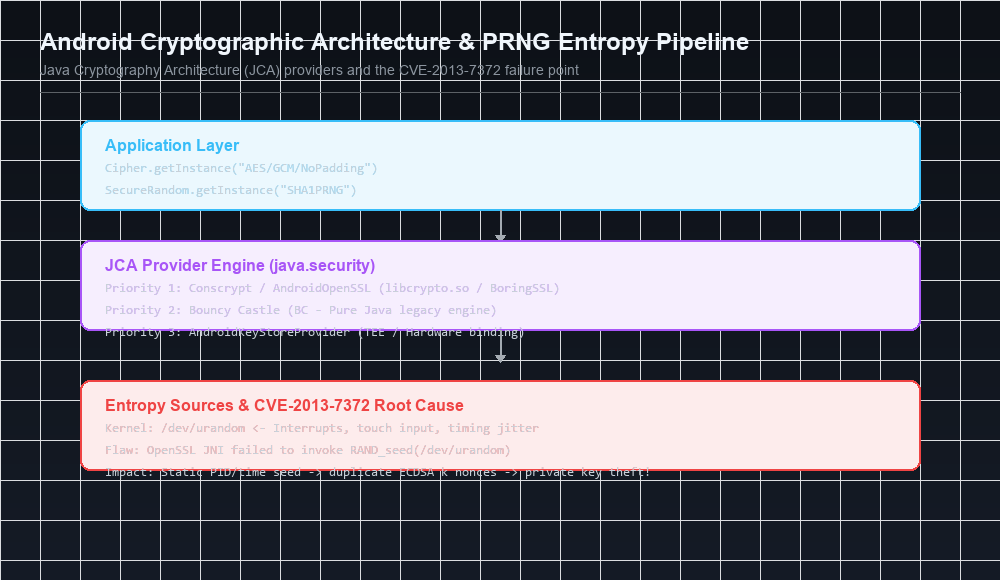
Engine Classes vs. Providers
Engine classes define abstract cryptographic operations without implementing them:
Cipher: Symmetric and asymmetric encryption/decryption (AES, RSA).Signature: Digital signature generation and verification (ECDSA, RSA-PSS).MessageDigest: Cryptographic hashing (SHA-256, SHA-3).KeyStore: Secure container for private keys and certificates.SecureRandom: Cryptographically secure pseudorandom number generation.
When an application calls Cipher.getInstance("AES/CBC/PKCS5Padding"), the JCA runtime queries the registered provider list in order of priority until it finds a provider supporting that algorithm string.
1
2
3
4
5
6
7
8
9
10
11
12
Application Code
      |
      v
Cipher.getInstance("AES/CBC/PKCS5Padding")
      |
      v
JCA Security Framework (java.security)
      |
      +---> 1. AndroidOpenSSL (Native libcrypto.so) -> MATCH!
      +---> 2. BC (Bouncy Castle Java Provider)
      +---> 3. HarmonyJSSE (Apache Harmony Fallback)
      +---> 4. AndroidKeyStore (Hardware TEE Provider)
The Provider Registry: java.security
The static provider list is configured in /system/etc/security/java.security:
1
2
3
4
5
security.provider.1=org.apache.harmony.xnet.provider.jsse.JSSEProvider
security.provider.2=com.android.org.conscrypt.OpenSSLProvider
security.provider.3=com.android.org.bouncycastle.jce.provider.BouncyCastleProvider
security.provider.4=org.apache.harmony.security.provider.crypto.CryptoProvider
security.provider.5=android.security.AndroidKeyStoreProvider
2. Cryptographic Engines: OpenSSL vs. Bouncy Castle
Android ships with multiple cryptographic provider implementations, each serving different architectural purposes:
1. Bouncy Castle (BC)
Originally bundled via Apache Harmony, Bouncy Castle is a comprehensive, pure-Java cryptographic library.
- Strengths: Broad algorithm coverage, supporting legacy algorithms, esoteric padding modes, and ASN.1 parsing.
- Weaknesses: Pure Java bytecode execution incurs high CPU overhead and memory allocations; lacks direct access to CPU hardware instructions (ARMv8 Crypto Extensions / AES-NI).
2. AndroidOpenSSL (Conscrypt / BoringSSL)
To overcome Java performance bottlenecks, Google introduced AndroidOpenSSL, a lightweight Java Native Interface (JNI) wrapper around C-based OpenSSL (and later Google’s BoringSSL fork).
- Performance: Operations execute compiled native assembly directly in
libcrypto.so. - Hardware Acceleration: Automatically detects and leverages hardware cryptographic acceleration on modern ARM processors.
- Memory Safety: Cryptographic keys are processed in native memory, reducing exposure in the Dalvik/ART garbage-collected heap.
3. Pseudorandom Number Generation & Entropy Pools
Cryptographic security fundamentally collapses if random numbers are predictable. Android applications rely on java.security.SecureRandom to generate encryption keys, IVs, salts, and digital signature nonces.
Kernel Entropy Architecture
The Linux kernel maintains an internal entropy pool located in the kernel memory space:
- Input Sources: Environmental timing jitter from hardware interrupts (IRQ), touchscreen taps, accelerometer movements, and disk/flash I/O operations.
- Character Devices:
/dev/random: Blocks when estimated entropy falls below a threshold (rarely used in userspace)./dev/urandom: A non-blocking, cryptographically secure stream that uses a CSPRNG (ChaCha20 or SHA-1/AES) seeded by the entropy pool.
When SecureRandom is initialized, Android binds it directly to /dev/urandom.
4. The Historic Android PRNG Flaw (CVE-2013-7372)
In August 2013, the Bitcoin community discovered a catastrophic vulnerability: unauthorized transactions were draining Bitcoin balances from wallets generated on Android devices across multiple popular apps (Bitcoin Wallet, Blockchain.info, Mycelium).
The root cause was an architectural flaw in Android’s SecureRandom implementation.
The Cryptographic Failure Mechanics
ECDSA (Elliptic Curve Digital Signature Algorithm) signatures consist of two integers: $(r, s)$. During signature generation, the algorithm picks a random secret nonce, $k$:
\(r = (k \cdot G)_x \pmod n\) \(s = k^{-1} (z + r \cdot d_A) \pmod n\)
Where:
- $G$: Curve base point
- $z$: Hash of the transaction message
- $d_A$: The user’s private key
- $k$: Ephemeral cryptographic nonce
The Golden Rule of ECDSA: The nonce $k$ must be cryptographically random and never reused.
If an attacker observes two distinct signatures $(r, s_1)$ and $(r, s_2)$ that share the same $r$ value, it proves that the exact same nonce $k$ was reused! The attacker can compute the private key $d_A$ algebraically:
\(k = rac{z_1 - z_2}{s_1 - s_2} \pmod n\) \(d_A = rac{s_1 \cdot k - z_1}{r} \pmod n\)
Practical Python Proof of Concept: Private Key Recovery
1
2
3
4
5
6
7
8
9
10
11
12
13
14
15
# Demonstrating ECDSA private key recovery from duplicate nonce k
# secp256k1 curve order n
n = 0xFFFFFFFFFFFFFFFFFFFFFFFFFFFFFFFEBAAEDCE6AF48A03BBFD25E8CD0364141

# Observed public transactions sharing r:
# (r, s1, z1) and (r, s2, z2)
def recover_private_key(r, s1, z1, s2, z2):
    # Calculate k = (z1 - z2) / (s1 - s2) mod n
    numerator = (z1 - z2) % n
    denominator = (s1 - s2) % n
    k = (numerator * pow(denominator, -1, n)) % n

    # Calculate dA = (s1 * k - z1) / r mod n
    dA = ((s1 * k - z1) * pow(r, -1, n)) % n
    return dA
Why Did Android Reuse $k$?
Android’s JCA architecture contained a subtle initialization bug in OpenSSLProvider:
- When applications invoked
SecureRandom.getInstance(), the runtime instantiated the OpenSSL engine. - The JNI bridge expected the underlying OpenSSL library to seed itself automatically from
/dev/urandom. - However, under certain process lifecycle states, OpenSSL’s internal
RAND_seed()was never called with external entropy. - Instead, OpenSSL fell back to generating pseudorandom streams seeded exclusively by
PID,UID, and coarse system millisecond timestamps! - When mobile Bitcoin wallets generated multiple transactions rapidly or on freshly forked processes, the identical seed was generated, outputting duplicate $k$ nonces onto the public Bitcoin blockchain!
The Emergency Patch: PRNGFixes.java
Before Google could push OS-level OTA updates to millions of fragmented devices, Google published PRNGFixes.java, a mitigation class that all Android developers were instructed to execute during application startup:
1
2
3
4
5
6
7
8
9
10
11
12
13
14
15
16
17
18
19
20
21
22
23
public final class PRNGFixes {
    public static void apply() {
        // 1. Force OpenSSL to explicitly ingest 32 bytes from /dev/urandom
        byte[] seed = generateSeed(32);
        NativeCrypto.RAND_seed(seed);

        // 2. Install a custom SecureRandomProvider at priority position 1
        Security.insertProviderAt(new LinuxPRNGSecureRandomProvider(), 1);
    }

    private static byte[] generateSeed(int numBytes) {
        try {
            FileInputStream in = new FileInputStream("/dev/urandom");
            byte[] buffer = new byte[numBytes];
            DataInputStream dis = new DataInputStream(in);
            dis.readFully(buffer);
            dis.close();
            return buffer;
        } catch (IOException e) {
            throw new SecurityException("Failed to seed PRNG from /dev/urandom", e);
        }
    }
}
5. Common Mobile Cryptographic Anti-Patterns
Vulnerability assessments of commercial Android applications consistently reveal critical cryptographic design flaws:
1. Electronic Codebook (ECB) Mode
1
2
// VULNERABLE: ECB mode does not use an IV; plaintext patterns leak into ciphertext!
Cipher cipher = Cipher.getInstance("AES/ECB/PKCS5Padding");
- Remediation: Always use Authenticated Encryption with Associated Data (AEAD) such as
AES/GCM/NoPadding, orAES/CBC/PKCS5Paddingwith an HMAC-SHA256 integrity tag.
2. Static Initialization Vectors (IVs)
1
2
3
// VULNERABLE: Constant zero IV destroys semantic security across encryptions!
byte[] iv = new byte[16]; // All zeros
IvParameterSpec ivSpec = new IvParameterSpec(iv);
- Remediation: Generate a fresh, unpredictable 12-byte (for GCM) or 16-byte (for CBC) IV for every encryption operation using
SecureRandom.nextBytes(iv).
3. Hardcoded Symmetric Keys
1
2
// VULNERABLE: Easily extracted via APK decompiler (JADX / apktool)
SecretKeySpec key = new SecretKeySpec("SuperSecretKey123".getBytes(), "AES");
- Remediation: Store keys inside the hardware-backed Android KeyStore, or derive them from user credentials via
PBKDF2WithHmacSHA256orscrypt.
Next in the Series: Chapter 6 Preview
In Chapter 6: Network Security and PKI, we will investigate:
- Android’s TLS/SSL network stack and
TrustManagervalidation algorithms. - The system CA trust store in
/system/etc/security/cacerts/and its[hash].0naming structure. - User-installed certificates and the enterprise trust boundary.
- Insecure custom TrustManagers and certificate pinning bypasses using Frida.
References & Authoritative Reading
- Elenkov, Nikolay. Android Security Internals. No Starch Press, 2015. Chapter 5: “Cryptographic Providers,” pp. 115–144.
- Android Developers - Cryptography Architecture Overview
- Android Security Team - Some Thoughts on Android’s SecureRandom (Official CVE-2013-7372 Disclosure)
- NIST SP 800-90A Rev. 1: Recommendation for Random Number Generation Using Deterministic Random Bit Generators
- Conscrypt GitHub Repository (Google BoringSSL JNI Provider)
- OWASP Mobile Application Security Verification Standard (MASVS-CRYPTO)
Let’s Connect
Have you audited mobile cryptographic implementations for nonce reuse or ECB mode flaws?
- Abdulrahman Mohamed
This technical content and everything shared across this blog is dedicated with sincere intention to serve as enduring, beneficial knowledge (علم يُنتفع به) and an ongoing charity (صدقة جارية). If you find value in this research, please remember me and my family in your sincere prayers.