Android Security Internals: Chapter 8 - Online Account Management
A technical breakdown of Chapter 8 of Nikolay Elenkov's 'Android Security Internals', focusing on AccountManagerService, AbstractAccountAuthenticator, token delegation protocols, OAuth security boundaries, and PKCE.
Hello everyone,
Welcome back to our book summary series covering “Android Security Internals” by Nikolay Elenkov, enriched with identity security research, OAuth 2.0 mobile security profiles, and auditing tradecraft from the OWASP Mobile Application Security Verification Standard (MASVS-AUTH).
In Chapter 7, we explored credential storage, master key derivation, and ARM TrustZone integration. In this installment, we explore Chapter 8: Online Account Management, analyzing how Android centralizes identity, manages authentication tokens, and provides seamless Single Sign-On (SSO) across applications.
Rather than forcing every application to implement its own login screens, store raw user passwords, and handle OAuth token refresh loops independently, Android introduced the AccountManager framework. In this chapter, we dissect how AccountManagerService coordinates authenticators, manages SQLite token storage, and enforces security boundaries to prevent unauthorized token harvesting.
Series Navigation
| Previous Chapter | Current Chapter | Next Chapter |
|---|---|---|
| Chapter 7: Credential Storage | Chapter 8: Online Account Management | Chapter 9: Enterprise Security |
Key Takeaways
- Centralized Identity: Android decouples account authentication from third-party applications. Apps request authentication tokens through
AccountManagerwithout ever handling raw user passwords. - The Authenticator Architecture: Identity providers (Google, Microsoft, Twitter) implement an
AbstractAccountAuthenticatorservice that handles login workflows, multi-factor authentication (MFA), and credential verification. - Token Storage in
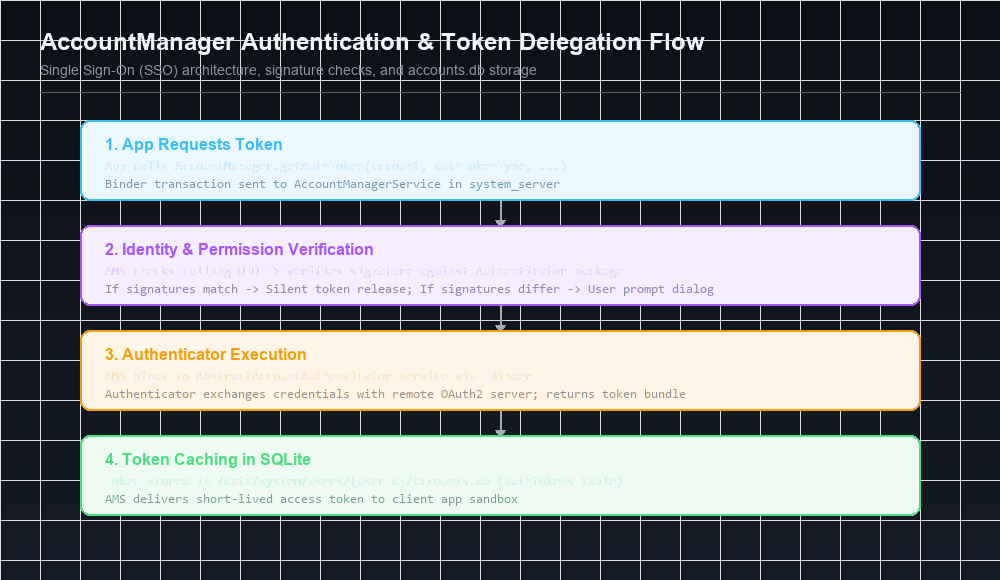
accounts.db: Account metadata, user identifiers, and encrypted authentication tokens are stored per-user in/data/system/users/[userId]/accounts.db. - Caller Authorization & Signature Matching: If a requesting application is signed with the exact same cryptographic key as the authenticator,
AccountManagerServicegrants the auth token silently. Otherwise, an interactive user consent prompt is enforced. - Attack Surfaces: Flawed authenticators that leak tokens via unverified intents, expose exported components, or store plain-text passwords can lead to account hijacking across the device.
1. The AccountManager Architectural Framework
Android’s online account management framework is organized around three primary actors:
Core Components
AccountManager: The client-side Java facade used by applications to list accounts, request tokens, and register listeners.AccountManagerService: The centralized system service running insidesystem_server, mediating all account queries and persisting tokens on disk.AbstractAccountAuthenticator: An abstract base class implemented by identity providers to handle provider-specific authentication flows.accounts.db: An isolated SQLite database maintained per-user in/data/system/users/[userId]/accounts.db.
2. Implementing an Authenticator Service
To register a custom account type (e.g., com.example.corporate.account), a developer must declare a dedicated service in AndroidManifest.xml:
1
2
3
4
5
6
7
8
9
10
<service
    android:name=".sync.AccountAuthenticatorService"
    android:exported="true">
    <intent-filter>
        <action android:name="android.accounts.AccountAuthenticator" />
    </intent-filter>
    <meta-data
        android:name="android.accounts.AccountAuthenticator"
        android:resource="@xml/authenticator" />
</service>
The Authenticator Metadata: res/xml/authenticator.xml
1
2
3
4
5
6
<account-authenticator xmlns:android="http://schemas.android.com/apk/res/android"
    android:accountType="com.example.corporate.account"
    android:icon="@drawable/ic_corp_account"
    android:smallIcon="@drawable/ic_corp_small"
    android:label="@string/corp_account_label"
    android:accountPreferences="@xml/account_preferences" />
3. Storage and Token Persistence: accounts.db
The internal state of all registered accounts is managed by AccountManagerService inside /data/system/users/[userId]/accounts.db.
1
2
3
4
5
# Inspect registered accounts via ADB shell
dumpsys account

# Inspecting accounts.db directly (requires root)
sqlite3 /data/system/users/0/accounts.db "SELECT _id, name, type FROM accounts;"
4. Modern OAuth 2.0 & Proof Key for Code Exchange (PKCE)
In modern enterprise mobile architectures, authenticators avoid storing static credentials and rely strictly on OAuth 2.0 with PKCE (RFC 7636):
- Code Verifier: The client generates a high-entropy cryptographic random string $V$.
- Code Challenge: The client computes $C = ext{BASE64URL}( ext{SHA256}(V))$.
- Authorization Request: Sends $C$ to the authorization server via an in-app browser tab (Chrome Custom Tabs).
- Token Exchange: When exchanging the authorization code, the client sends the original $V$. The server computes $ ext{SHA256}(V)$ and validates that it matches $C$.
- Security Defense: Even if an attacker registers a rogue URI scheme handler to intercept the authorization code, they cannot exchange it for an access token without the secret code verifier $V$ stored in client memory!
Next in the Series: Chapter 9 Preview
In Chapter 9: Enterprise Security, we will analyze:
- The Device Administration API and
DevicePolicyManagerService(DPMS). - Enforcing lockscreen complexity, hardware camera disablement, and remote device wiping.
- Enterprise containerization architectures: Samsung KNOX and Android for Work (Managed Profiles).
- Mobile Device Management (MDM) enrollment workflows and ransomware abuse of device admin privileges.
References & Authoritative Reading
- Elenkov, Nikolay. Android Security Internals. No Starch Press, 2015. Chapter 8: “Online Account Management,” pp. 191–214.
- Android Developers - AccountManager API Guide
- RFC 7636: Proof Key for Code Exchange by OAuth Public Clients (PKCE). IETF, 2015.
- OWASP Mobile Application Security Verification Standard (MASVS-AUTH)
- Chin, Erika, et al. Analyzing Inter-Application Communication in Android. ACM MobiSys, 2011.
Let’s Connect
Have you audited mobile Single Sign-On (SSO) integrations or OAuth token flows on Android?
- Abdulrahman Mohamed
This technical content and everything shared across this blog is dedicated with sincere intention to serve as enduring, beneficial knowledge (علم يُنتفع به) and an ongoing charity (صدقة جارية). If you find value in this research, please remember me and my family in your sincere prayers.