Android Security Internals: Chapter 11 - NFC and Secure Elements
A technical dissection of Chapter 11 of Nikolay Elenkov's 'Android Security Internals', examining the NFC architecture stack, Host-based Card Emulation (HCE), ISO 7816-4 APDU routing, and hardware Secure Elements (UICC/eSE).
Hello everyone,
Welcome back to our book summary series covering “Android Security Internals” by Nikolay Elenkov, enriched with EMV contactless payment specifications and wireless security research.
In Chapter 10, we examined physical device security, full disk encryption, and verified boot integrity. In this installment, we explore Chapter 11: NFC and Secure Elements, dissecting the short-range wireless radio stack that powers contactless mobile payments, transit ticketing, access control badges, and cryptographic identity tokens.
For years, contactless mobile transactions were trapped behind a formidable architectural barrier: telecom carrier control of the physical SIM card.
In this deep dive, we trace the evolution from hardware-bound Secure Elements (UICC and eSE) to Android 4.4’s industry-disrupting innovation: Host-based Card Emulation (HCE). We will analyze the ISO 7816-4 smart card protocol, trace how NfcService dispatches APDUs, and evaluate contactless attack surfaces like relay attacks and rogue AID registrations.
Series Navigation
| Previous Chapter | Current Chapter | Next Chapter |
|---|---|---|
| Chapter 10: Device Security | Chapter 11: NFC and Secure Elements | Chapter 12: SELinux in Android |
Key Takeaways
- The Three Operating Modes: Android’s NFC subsystem operates in three distinct modes: Reader/Writer mode, Peer-to-Peer mode (Android Beam), and Card Emulation mode.
- The Hardware Secure Element Bottleneck: Early mobile payment deployments required a dedicated hardware Secure Element (UICC/SIM card or embedded eSE). Telecom carriers controlled cryptographic domain keys on the SIM via Single Wire Protocol (SWP), effectively preventing banks and software developers from issuing payment cards.
- Host-based Card Emulation (HCE): Introduced in Android 4.4 (KitKat), HCE allows software applications to emulate contactless smart cards directly inside Android userspace, bypassing carrier-controlled hardware chips entirely.
- ISO 7816-4 Smart Card Protocol: NFC card transactions communicate via Application Protocol Data Units (APDUs).
NfcServiceroutes incoming command APDUs to registered applications using Application Identifiers (AIDs). - Payment Tokenization Defenses: Because software-emulated cards running in Android userspace are theoretically vulnerable to memory inspection on rooted devices, the payment industry adopted Cloud-Based Tokenization (DPANs) and single-use transaction cryptograms.
1. The Android NFC Architecture Stack
Android’s Near Field Communication stack spans from the physical radio controller chip to high-level framework services:
The Three NFC Operating Modes
- Reader/Writer Mode: The device acts as an active NFC reader, powering and reading data from passive RFID/NFC tags, smart posters, and contactless cards (NDEF format).
- Peer-to-Peer (P2P) Mode: Two Android devices communicate bidirectionally using the Simple NDEF Exchange Protocol (SNEP) to exchange URLs, contacts, or photos (Android Beam).
- Card Emulation Mode: The Android smartphone behaves as a passive contactless smart card, responding to RF queries from point-of-sale (POS) payment terminals and transit gates.
2. Hardware Secure Elements: UICC vs. eSE
Before Host-based Card Emulation existed, mobile payment security relied exclusively on dedicated Hardware Secure Elements (SE).
Types of Hardware Secure Elements
- UICC (SIM Card): The subscriber identity module provided by the mobile operator. It contains a secure microcontroller running Java Card OS. The NFC controller links to the SIM card via a physical wire using the Single Wire Protocol (SWP).
- eSE (Embedded Secure Element): A dedicated tamper-resistant silicon chip soldered directly onto the device motherboard by the OEM (e.g., Google Nexus S, modern Apple iPhones).
Why Hardware SE Failed as a Mass Payment Solution
- The Carrier Tollgate: Because carriers owned the SIM card, any bank or merchant wishing to deploy a mobile wallet had to negotiate proprietary business and technical agreements with hundreds of regional telecom carriers globally.
- Fragmentation: Devices possessed incompatible secure element configurations, severely limiting developer adoption.
3. Host-based Card Emulation (HCE) Architecture
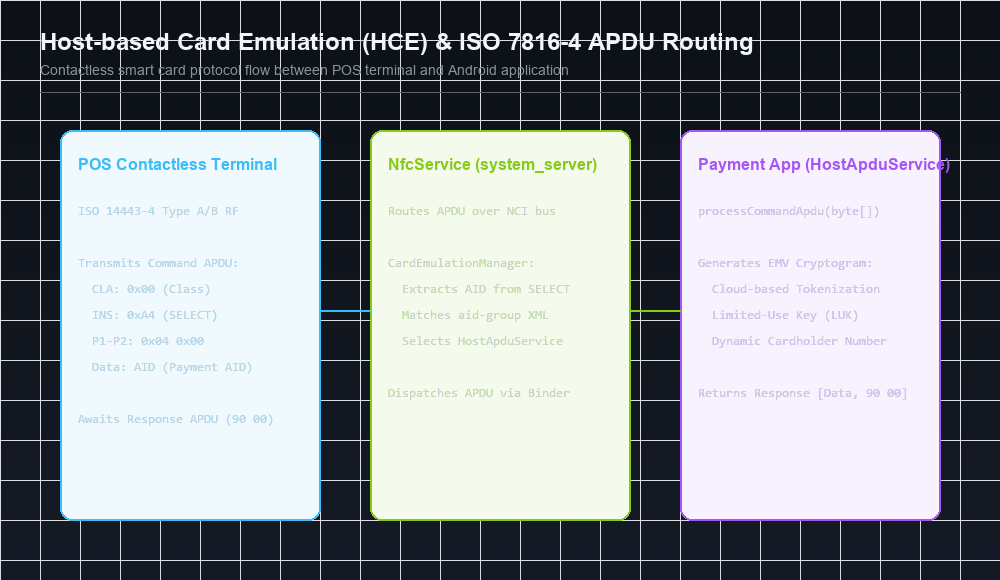
In Android 4.4, Google bypassed the hardware Secure Element bottleneck by introducing Host-based Card Emulation (HCE):
1
2
3
4
5
6
7
8
9
10
11
12
13
14
15
16
17
18
19
Contactless POS Terminal
          |
          | 13.56 MHz RF Field (ISO 14443-4)
          v
NFC Radio Controller
          |
          | Routes APDU packets directly over NCI bus
          v
libnfc-nci.so (Native HAL)
          |
          v
NfcService (system_server)
   ├── Extracts Application Identifier (AID) from SELECT command
   ├── Queries AID routing table
   └── Dispatches APDU to target application's HostApduService
          |
          v (Binder IPC)
Bank / Payment Application (HostApduService)
   └── Computes cryptogram and returns Response APDU
4. ISO 7816-4 APDU Protocol & AID Routing
Contactless smart cards communicate with terminals using Application Protocol Data Units (APDUs) conforming to the ISO/IEC 7816-4 standard.
The APDU Communication Format
An APDU exchange follows a strict Command-Response cycle:
1
2
3
4
5
Command APDU (Terminal -> Device):
[CLA (1B)] [INS (1B)] [P1 (1B)] [P2 (1B)] [Lc (1B)] [Data (variable)] [Le (1B)]

Response APDU (Device -> Terminal):
[Data (variable)] [Status Word SW1 (1B)] [Status Word SW2 (1B)]
For example, a successful transaction response terminates with the status bytes:
1
SW1 SW2 = 0x90 0x00  (Success / OK)
Implementing a HostApduService
1
2
3
4
5
6
7
8
9
10
<!-- In AndroidManifest.xml -->
<service android:name=".PaymentService"
         android:exported="true"
         android:permission="android.permission.BIND_NFC_SERVICE">
    <intent-filter>
        <action android:name="android.nfc.cardemulation.action.HOST_APDU_SERVICE"/>
    </intent-filter>
    <meta-data android:name="android.nfc.cardemulation.host_apdu_service"
               android:resource="@xml/apduservice"/>
</service>
1
2
3
4
5
6
7
8
9
10
11
<!-- res/xml/apduservice.xml -->
<host-apdu-service xmlns:android="http://schemas.android.com/apk/res/android"
    android:description="@string/service_desc"
    android:requireDeviceUnlock="true">
    <aid-group android:description="@string/payment_group" android:category="payment">
        <!-- MasterCard Contactless AID -->
        <aid-filter android:name="A0000000041010" />
        <!-- Visa Contactless AID -->
        <aid-filter android:name="A0000000031010" />
    </aid-group>
</host-apdu-service>
5. EMV Transaction Flow & Cloud Tokenization
In a real-world contactless EMV transaction, the terminal and the phone exchange several standardized APDUs:
SELECT PPSE: Terminal queries the Proximity Payment System Environment (2PAY.SYS.DDF01).SELECT AID: Terminal selects the specific payment network (Visa or MasterCard AID).GET PROCESSING OPTIONS (GPO): Phone supplies Application Interchange Profile (AIP) and Application File Locator (AFL).READ RECORDS: Terminal extracts card metadata.GENERATE AC: Phone generates an Application Cryptogram using a Limited-Use Key (LUK) provided by a cloud Token Service Provider (TSP).
Even if a malicious root app dumps memory, it only compromises a single-use token that cannot be used for subsequent unauthorized payments!
Next in the Series: Chapter 12 Preview
In Chapter 12: SELinux in Android, we will analyze:
- Mandatory Access Control (MAC) vs. Discretionary Access Control (DAC).
- The SEAndroid architecture, kernel security server, and Access Vector Cache (AVC).
- Compiling policy files (
sepolicy,file_contexts,seapp_contexts,mac_permissions.xml). - Project Treble split policies (
plat_sepolicyvsvendor_sepolicy) and SELinux bypass exploitation.
References & Authoritative Reading
- Elenkov, Nikolay. Android Security Internals. No Starch Press, 2015. Chapter 11: “NFC and Secure Elements,” pp. 289–318.
- Android Developers - Host-based Card Emulation Overview
- ISO/IEC 7816-4: Identification cards - Integrated circuit cards.
- EMVCo: EMV Contactless Specifications for Payment Systems.
- Francis, Lishoy, et al. Practical Relay Attack on Contactless POS Terminals. IEEE RFID, 2012.
Let’s Connect
Have you audited mobile payment architectures or analyzed NFC smart card protocols?
- Abdulrahman Mohamed
This technical content and everything shared across this blog is dedicated with sincere intention to serve as enduring, beneficial knowledge (علم يُنتفع به) and an ongoing charity (صدقة جارية). If you find value in this research, please remember me and my family in your sincere prayers.